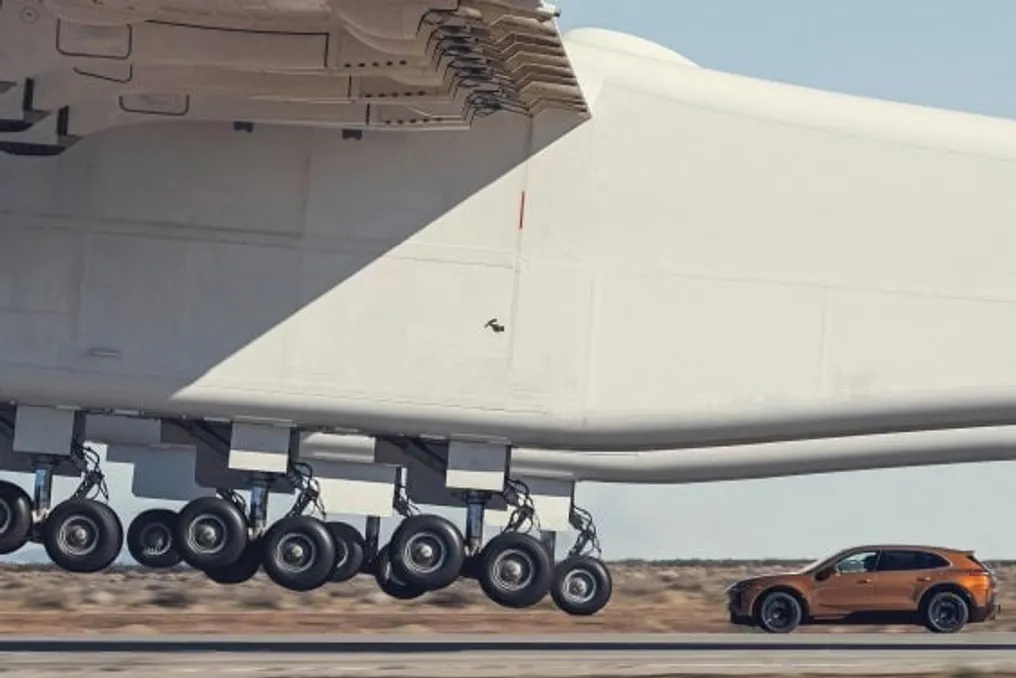
Porsche used an unusual approach to demonstrate the capability of its new electric Cayenne: the SUV was driven at 269 km/h beneath the planet's largest aircraft during its takeoff and landing phases.
Presentation scene in Mojave
This demonstration took place at the Mojave Air and Space Port, located in California. The vehicle had to reach speeds exceeding 257 km/h to keep pace with the giant aircraft, which is the Roc, belonging to Stratolaunch. This is an experimental twin-fuselage airplane designed to serve as a space vehicle launch platform.
The Roc has an impressive wingspan of 117 meters, making it the largest in the world. Furthermore, it features six engines that generate a total thrust of 154 tons and a maximum takeoff capacity of 590 tons.
Aerodynamic Challenge
The concept for this maneuver did not originate from Porsche, but rather from the engineers at Stratolaunch. By analyzing the aerodynamics of the Roc, they identified an area of relative calm in the middle of the intense airflow: this zone is located just after the landing gear and before the tail, where turbulence and engine jet significantly decrease.
However, this pocket of air moves along with the aircraft. This posed a challenge to the driver: he had to enter this zone before the engines gained speed and remain there with millimeter precision until takeoff. A delay could result in direct impact with the jet, putting the car at risk of being thrown upwards, while moving too early would mean colliding with the landing gear.
Power of the Cayenne Turbo Electric
To meet the requirement of keeping pace with the aircraft at any speed, maintaining stability, and exceeding the Roc's takeoff speed of 257 km/h, the new Cayenne Turbo Electric was chosen. This model offers 1,155 horsepower and 153 kgfm of torque, capable of accelerating from 0 to 100 km/h in approximately 2.5 seconds and equipped with active aerodynamics.
The SUV's weight, which is 2,645 kg, normally considered a disadvantage, became an advantage because it prevented the vehicle from being affected by turbulence as a lighter car would. Patrick Long, an endurance driver and former factory team member of Porsche, drove the vehicle. He reported that the experience was one of the most intense and focused moments of his life. Initially, he maintained low power to position himself correctly, and the actual acceleration only occurred when the aircraft's six engines came into full operation. After exceeding 161 km/h, he activated Boost mode and pushed to the limit, staying alongside the landing gear, registering over 273 km/h on the dashboard before reducing acceleration.
Participants in the Maneuver
Two takeoffs and two landings were performed under the Roc. The landing maneuver echoes procedures carried out by the American Air Force decades ago with the Lockheed U-2, which uses a support car on approach, although in this case, the aircraft is three times larger. In subsequent flights, the Cayenne also transported other people, including actor Orlando Bloom, Porsche Design ambassador, journalist Mat Watson, and two Stratolaunch team leaders.