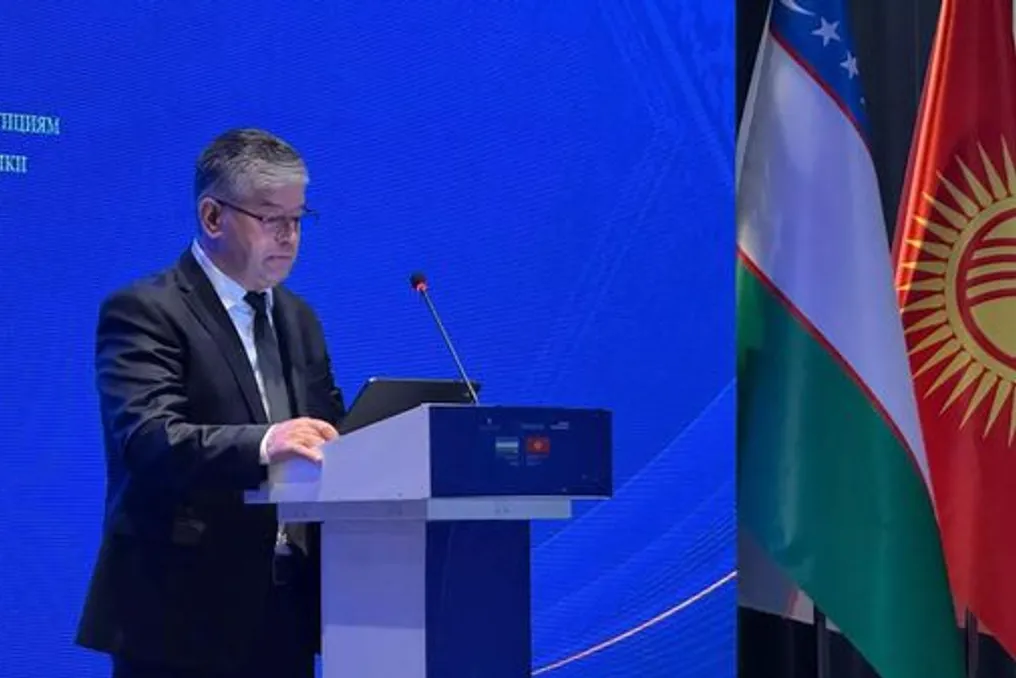
Ravshanbek Sabirov, head of the National Investment Agency of Kyrgyzstan, announced at the Kyrgyz-Uzbek business forum in Bishkek the countries' intention to increase mutual trade volume to $2 billion.
Ravshanbek Sabirov, head of the National Investment Agency of Kyrgyzstan, announced at the Kyrgyz-Uzbek business forum in Bishkek the countries' intention to increase mutual trade volume to $2 billion.
According to Sabirov, achieving this goal will be done through joint production and investment projects between Uzbekistan and Kyrgyzstan. He emphasized that developing industrial cooperation and accessing third-country markets through joint ventures will help increase trade turnover.
Sabirov noted that Uzbekistan is one of Kyrgyzstan's key strategic partners in the field of investment. Kyrgyzstan is interested in attracting Uzbek investors to projects in sectors such as energy, agro-industrial complex, construction, pharmaceuticals, digital economy, and services. One of the priority areas named is the creation of clusters for joint production and industrial sites.
One practical example of cooperation is the trade and logistics center created on the border of the Jalolobod and Namangan regions. Ulanbek Maksimbekov, CEO of 'Kyrgyz Eco Export', reported that over 12 thousand square meters of facilities have been built in this center, and roads, bridges, and electrical networks have been laid.
Based on this project, it is proposed to create a small economic zone. Initially, it will function as a trading platform, and subsequently, the placement of joint ventures and production capacities is planned. Maksimbekov added that negotiations are currently ongoing between the two parties, and the new center is intended to expand direct contacts between entrepreneurs from Namangan and Jalolobod.
The volume of non-performing loans (NPL) in the banking system of Uzbekistan continues to grow. According to data from the Central Bank, by the end of the first half of 2026, the volume of such loans reached 22.9 trillion sums. This figure is significantly higher than 18.1 trillion sums at the beginning of the year, an increase of 27 percent.
Although the growth of the credit portfolio is considered a natural process, the faster rate of increase in non-performing loans raises concerns within the banking system. Over six months, the total credit portfolio grew from 604 trillion sums to 643 trillion sums, representing an increase of 6.4 percent. Meanwhile, non-performing loans grew almost four times faster—by 27 percent.
The share of non-performing loans in the total credit portfolio has also increased. If this indicator was 2.99 percent at the beginning of the year, it reached 3.57 percent by the end of the half-year period. Analysts note that the majority of non-performing loans are concentrated in state-participating commercial banks. The volume of NPL in these banks increased from 12.8 trillion sums to 16.4 trillion sums over six months. This means that almost 72 percent of all non-performing loans in the country's banking system are concentrated specifically in state banks.
As a result, the share of non-performing loans in state banks rose from 3.17 percent to 3.89 percent. At the same time, the situation in banks with private and foreign capital remained relatively stable, with the NPL share increasing from 2.62 percent to 2.95 percent.
In terms of relative growth, the largest increase was recorded at TBC Bank, where the share of non-performing loans increased from 5.71 percent to 12.12 percent, becoming the highest in the system. Microcreditbank also demonstrated an increase in the NPL share from 4.41 percent to 7.86 percent, surpassing others in absolute volume of non-performing loans, which increased by almost 900 billion sums over six months.
Despite the overall trend of growth, some banks managed to improve the quality of their credit portfolio. The most significant positive changes were observed at Poytaht Bank, where the share of non-performing loans decreased from 24.40 percent to 7.32 percent. Kapitalbank reduced the volume of non-performing loans by almost 200 billion sums, bringing the NPL share down from 2.81 percent to 2.14 percent. Ipoteka Bank achieved a reduction in the volume of non-performing loans by 163 billion sums. Indicators also decreased at Hayot Bank (from 3.96 percent to 2.68 percent) and Ziraat Bank Uzbekistan (from 3.86 percent to 2.96 percent).
Furthermore, the share of non-performing loans remained at 0 percent in KDB Bank Uzbekistan and Octobank. Uzumbank, ApexBank, and Open Bank were among the banks with the lowest NPL rates, at 0.01 percent, 0.04 percent, and 0.35 percent, respectively.
In summary, the half-year results show that alongside the increase in lending volume, strengthening control over debt quality is required. Especially in state-participating banks, the high rate of growth of non-performing loans requires improving risk management mechanisms, credit assessment, and borrower engagement. Nevertheless, the successful experience of some banks in revitalizing their credit portfolios demonstrates the existence of effective approaches in this area.
New initiatives have been introduced aimed at strengthening the budgets of the mahallas. Initially, it was planned that the mahalla budgets for this year would amount to 600 billion sums.
By a Presidential decree adopted in June, the share of land and property tax paid into the mahalla was increased from 10% to 15%. Additionally, 10% of fines for violating sanitary norms and illegal construction will now go to the mahalla.
It has also been permitted for the mahallas themselves to sell buildings up to 5 thousand square meters. This will allow an increase in revenue to the mahalla budgets by another 405 billion sums.
Now, 5% of the land and property tax collected from real estate objects in the mahalla will also go directly to the mahalla itself. Thanks to this, the mahallas will receive an additional 400 billion sums annually.
During the year, 200 mahallas that demonstrate the highest number of registered entrepreneurs, create the most new jobs, have the highest level of understanding, and have found the largest tax base will be awarded 2 billion sums.
Overall, according to the new initiatives, revenues to the mahalla budgets this year will reach 1 trillion 600 billion sums, and from next year—2 trillion sums.
Under the chairmanship of President Shavkat Mirziyoyev, video selection meetings continue regarding the implementation of a new environment in the mahallas and the updating of 'mahalla yettiligi' activities.
Namangan region and Russia are actively developing partnerships covering trade, education, labor migration, and joint production. Khokim of Namangan region, Shavkat Abdurazakov, elaborated on this in an interview with Sputnik Uzbekistan.
Shavkat Abdurazakov emphasized that Russia is one of the key partners and main sales markets for Namangan region. According to him, almost 60% of the region's exports go to companies and regions in Russia. Currently, 29 investment projects worth a total of $1.2 billion are being implemented.
The Khokim noted close ties with the leadership of Russian regions such as Ivanovo, Tula, Samara, Sverdlovsk, Moscow, and Leningrad. Within the framework of cooperation with Ivanovo, two joint textile enterprises have been established where thousands of people work, and all products from these enterprises are exported to Russia. Furthermore, projects for processing agricultural products involving Russian companies are being implemented in Namangan region.
Bilateral contacts have been established in the field of education. There is a joint educational program between Namangan State University and Ural University. Cooperation is also underway with the 'Synergy' corporation in the field of vocational education and training. The center, opened at the base of a college in the city of Namangan, has been operating for three years, and its graduates will complete their studies this year.
In the center, young people mainly study in information technology fields, and there are plans to expand short-term professional training programs in the future. The Khokim stated the need to pay more attention to vocational education to prepare youth for the competitive labor market.
Russian technologies are used in various sectors of Namangan region, including construction, stone processing, and pharmaceuticals. Since some complex building materials for constructing industrial facilities are not yet localized in Uzbekistan, they are imported in partnership with Russian companies. Joint projects for building materials and stone processing are also underway, and Russian technologies are being attracted to the Kosonsoy pharmaceutical economic zone.
A system has been introduced in Namangan region for sending citizens planning to work abroad, after preliminary preparation for their profession and language, based on contracts concluded with employers. During visits to Russia, Abdurazakov met with Namangans employed under contract to study their working and living conditions.
The Khokim stressed that they are working on actively promoting organized labor migration. Over the past five years, the number of young people going abroad through this system has been growing. Although labor migration destinations are not limited to Russia now, there are requests for workers in South Korea, Japan, Germany, and Eastern European countries. Therefore, work is also being done to prepare citizens for work in different countries by teaching English, Japanese, and Korean languages.