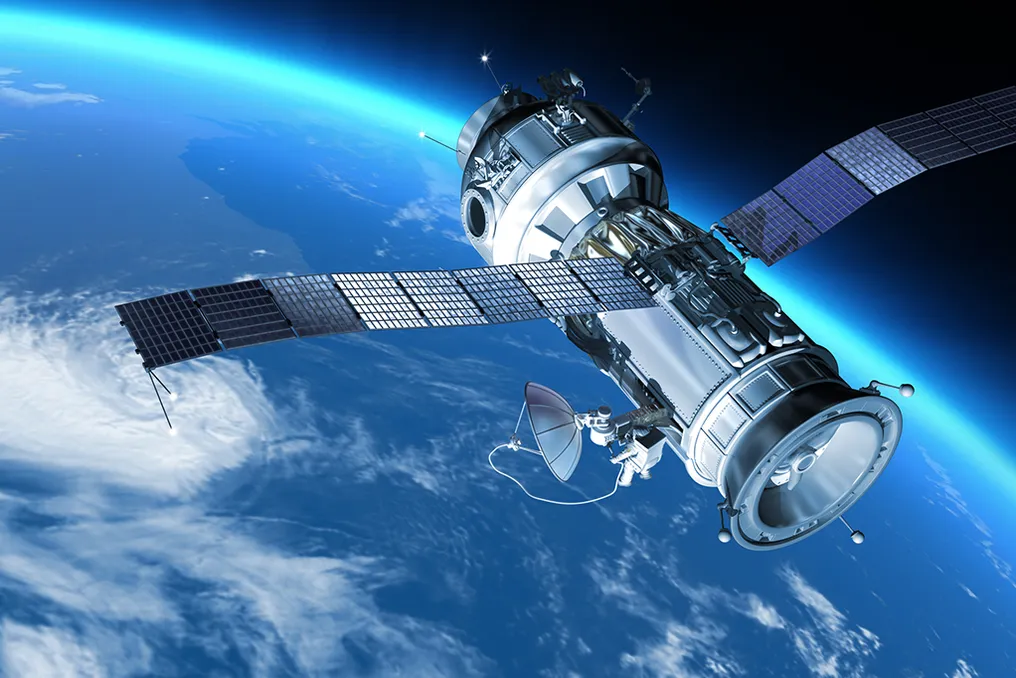
There is a frequent question about what happens to satellites that finish their useful life in space: are they removed from their orbits, or do they remain, contributing to the accumulation of space debris?
There is a frequent question about what happens to satellites that finish their useful life in space: are they removed from their orbits, or do they remain, contributing to the accumulation of space debris?
Currently, about 17.6 thousand satellites are operating around our planet, playing crucial roles in various areas. Their functions include transmitting telecommunication signals, meteorological monitoring, Earth observation to aid agriculture and monitor deforestation, navigation support like GPS, in addition to supporting astronomical studies.
When these devices stop functioning, there are generally two possibilities: either the satellite is directed out of orbit to reenter the atmosphere, or it remains in space, becoming space debris.
Active satellites use four distinct categories of orbit. Low Earth Orbit (LEO) covers altitudes up to 2,000 km. Medium Earth Orbit (MEO) extends from 2,000 km up to approximately 35,786 km. Geostationary Orbit (GEO) is located 35,786 km above the equator, characterized by a rotation period equal to that of the Earth, giving the illusion of fixed presence in the sky, which is ideal for communications and meteorology.
Another category is Highly Elliptical Orbit (HEO), defined by large variations between the lowest and highest points of the trajectory.
The largest concentration of active satellites, about 12.8 thousand, is in LEO, a region with a very thin atmosphere. Over time, this atmosphere generates resistance, gradually decreasing the satellite's speed and altitude.
Upon losing sufficient altitude, the satellite enters the atmosphere at high speed. Friction causes extreme heating, potentially exceeding 1,500 °C, resulting in the vaporization or fragmentation of most of the object. Therefore, many modern models are designed to perform a controlled reentry, using remaining fuel to fall into safe locations, often over sparsely populated oceans, such as the South Pacific Uninhabited Area.
In higher orbits, such as GEO, reentry requires considerable fuel consumption. In these cases, operators move the satellite to a 'graveyard orbit,' situated several hundred kilometers above the operational orbit, keeping it away from active satellites to minimize collision risks.
These satellites in graveyard orbits remain there indefinitely, although factors such as solar radiation pressures and gravitational perturbations can alter their trajectories. Without communication or fuel, they become inert objects, joining rocket stages and other human debris, forming space junk.
Historically, many initial missions did not follow proper disposal protocols, leaving satellites in orbit after mission completion, which contributed to the accumulation of debris.
Currently, the US Space Surveillance Network monitors about 28 thousand pieces of space debris, but millions of smaller fragments are impossible to track. Explosions caused by residual fuel are a significant source of new debris, according to the European Space Agency (ESA).
With the increase in launches, driven by the private sector, collisions tend to become the main cause of space debris generation in the future. Companies like SpaceX, led by Elon Musk, launch between 20 and 60 Starlink satellites weekly.
A piece of space debris travels at approximately 28,000 km/h. If it hits another satellite, it can trigger the Kessler syndrome, a cascade effect where collisions generate more debris, increasing the risk of further collisions. The ESA warns that, with current launch rates and projections of historical fragmentation, the number of debris will constantly grow, increasing the probability of catastrophic collisions.
Planning a space mission covering the entire Solar System is an enormous complexity even in our day. To imagine such an undertaking in the 1970s, when computer processing power was incomparably less than that of a modern smartphone, is a real challenge.
Nevertheless, it was this boldness that led to the creation of the legendary Voyager spacecraft, launched in 1977 to study giant planets and reveal a much more dynamic and amazing universe than scientists had assumed.
For almost five decades, the Voyager 1 and 2 spacecraft have significantly expanded our understanding of Jupiter, Saturn, Uranus, and Neptune. They discovered unprecedented phenomena, recorded historic images, and, most importantly, became the first human-made objects to explore interstellar space. Their contribution has forever changed the history of space exploration and continues to yield scientific results to this day.
To recall this outstanding adventure, learn behind-the-scenes details, and understand why Voyager remains one of the most important missions in the history of astronomy, amateur astronomer and science popularizer Alessandro Mota participates in the Olhar Espacial program. This promises to be a fascinating journey through one of the greatest epics of space research.
The Olhar Espacial program, hosted by Marcelo Zurita, President of the Paraíba Astronomy Association (APA) and member of the Brazilian Astronomical Society (SAB), as well as Technical Director Bramon and National Coordinator of Asteroid Day Brazil, is broadcast live every Friday at 9:00 PM Brazilian time via the broadcaster's official channels on YouTube, Facebook, Instagram, X (formerly Twitter), LinkedIn, and TikTok.
Alessandro Mota is a science popularizer, astrophotographer, and amateur astronomer. He dedicates his time to popularizing astronomy, constantly translating, writing, and recording videos with a didactic approach for the Mistérios do Espaço project. He is from the city of Conceição do Coite and is a student at the Faculty of Social Communications of the State University of Bahia.