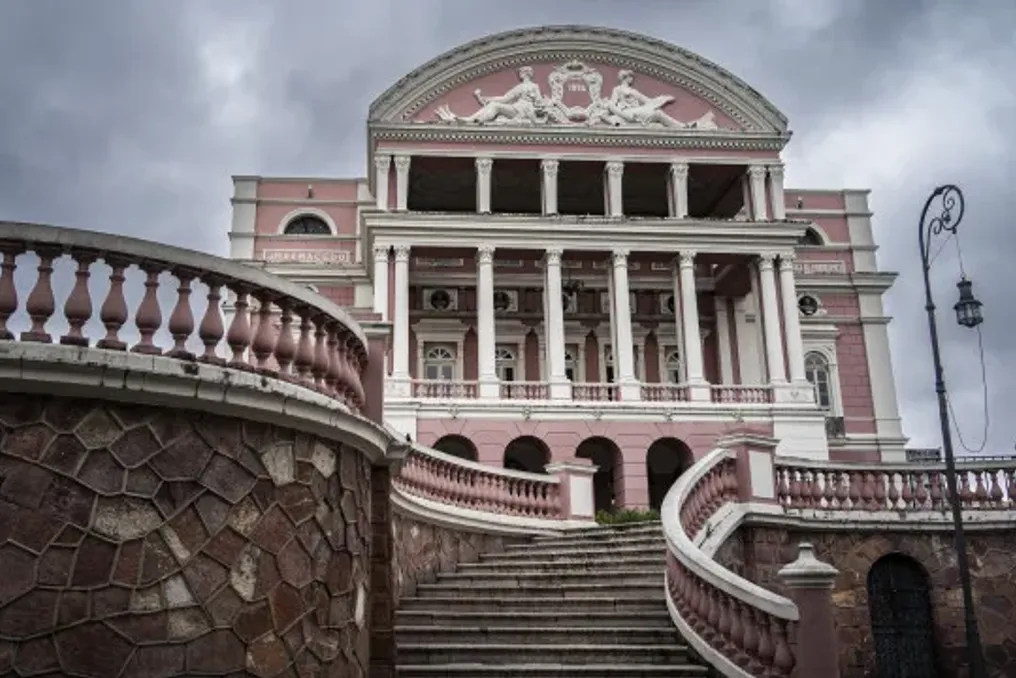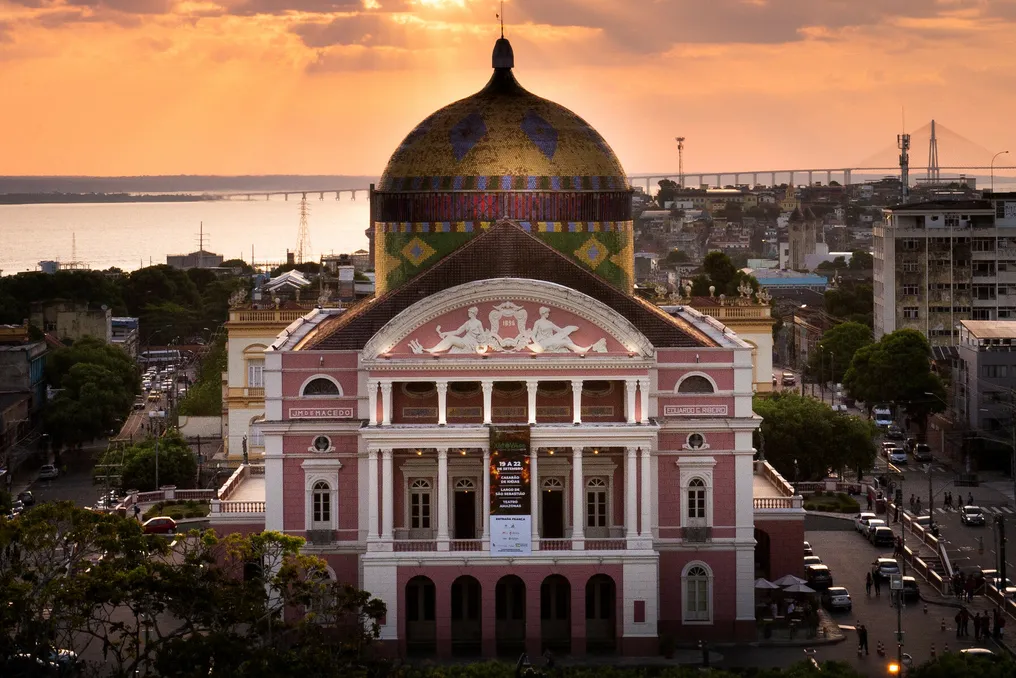
The Amazonas Theatre and Theatro da Paz have been officially inscribed as a single cultural property, named "Theatres of the Amazon," thus becoming the first World Cultural Heritage Site in the North Region of Brazil.
The Amazonas Theatre and Theatro da Paz have been officially inscribed as a single cultural property, named "Theatres of the Amazon," thus becoming the first World Cultural Heritage Site in the North Region of Brazil.
Brazil has expanded its list of cultural properties recognized by Unesco with this new title. The Amazonas Theatre, located in Manaus, and Theatro da Paz, situated in Belém, received World Cultural Heritage status on Monday, the 27th. This announcement took place in Busan, South Korea, during the World Heritage Committee meeting at the entity's annual assembly.
Although they are in different cities, Unesco recognized them jointly as a single heritage due to their historical connection with the rubber cycle in the Amazon in the late 19th century. This recognition concludes a process initiated by the World Heritage Committee, which involved technical evaluations by independent bodies and analysis by the committee's 21 members, responsible for approving, altering, or rejecting the inscription.
The pair of magnificent theatres symbolizes the economic peak of the Amazon region during the 19th century, driven by rubber extraction, which fostered the growth of the metropolises of Manaus and Belém. The buildings were erected as a manifestation of the prestige of the local elite.
The Theatro da Paz, inaugurated in 1878, and the Amazonas Theatre, inaugurated in 1896, were among the first great opera houses in the Americas, attracting European companies to both cities. It was this shared trajectory that motivated Unesco to group them under a unified title, highlighting that both represent a project of regional modernization, blending European architectural influences with elements and references from the forest.
Considered a postcard of Belém, Theatro da Paz is seen as the pioneering entertainment venue of the Amazon and still dominates the landscape of Praça da República, a traditional spot in the city. Its elegance is notable from the entrance, with crystal chandeliers, noble wood mosaic flooring, Carrara marble busts of José de Alencar and Gonçalves Dias, and golden details, creating an atmosphere typical of the Belle Époque.
In the performance hall, the ceiling draws attention with a fresco illustrating Apollo and Aphrodite leading the muses of the arts to the Amazon. The space accommodates 880 people seated in vintage wooden chairs. Guided tours are available from Tuesday to Friday, from 9 am to 12 pm and from 2 pm to 5 pm, and on Saturdays and Sundays, from 9 am to 12 pm. The tour lasts approximately 45 minutes, and groups depart continuously. The tour cost is R$ 10, with tickets sold at the local box office; prior scheduling by email is required for closed groups of more than six people.
Located in Largo de São Sebastião, the Amazonas Theatre was designed to demonstrate the economic power of Manaus in the 19th century. Its structure includes elements such as scots, Carrara marble on columns and stairs, and chandeliers imported from Italy.
The main hall accommodates 684 spectators and stands out for its concave ceiling adorned with four paintings from France, representing music, dance, tragedy, and opera, in addition to honoring the Brazilian composer Carlos Gomes. The columns display masks that pay tribute to figures such as Mozart, Verdi, Rossini, Molière, and Aristophanes. Additionally, the Noble Hall exhibits the painting "The Glorification of the Fine Arts of the Amazon," by Domenico de Angelis, dated 1899.
Guided tours take place from Tuesday to Saturday, from 9 am to 5 pm, and on Sundays and holidays, from 9 am to 1 pm, with departures scheduled every half hour. Admission costs R$ 20, sold at the box office, but Manaus residents have free access upon proof of residence. The show schedule is published monthly on the Cultura do AM website, managed by the State Secretariat of Culture and Creative Economy of Amazonas.
Brazil celebrated UNESCO's recognition that classified the architectural complex formed by the Amazonas Theater, dating from 1896, in Manaus, and the Theatro da Paz, from 1878, in Belém, as world heritage sites.
These two opera houses, located in the states of Amazonas and Pará, in the North region of Brazil, had already been classified as Brazilian cultural heritage by the National Institute of Historic and Artistic Heritage (Iphan) since 1960.
With UNESCO's approval, the two historic buildings are now jointly listed on the organization's register under the denomination 'Theaters of the Amazon,' alongside other Brazilian sites already recognized as World Cultural Heritage.
Deyvesson Gusmão, president of Iphan, emphasized that UNESCO's endorsement strengthens 'the essential dimension of the Amazon' and honors Amazonian society. In a comment to Lusa, he stated that the UNESCO seal not only recognizes the historical and economic relevance of the construction period but also projects these values into the present, highlighting the current significance of the Theaters of the Amazon for Amazonian society, Brazil, and the world.
Gusmão detailed that this recognition reinforces that the Amazon has a fundamental dimension: it is nature, but also a territory rich in culture, memory, creativity, and heritage, whose human wealth is intrinsically linked to its biodiversity.
The Ministry of Culture informed that the theaters represented a common project of urban modernization and the integration of the Amazon region into global cultural and commercial markets, being considered some of the first major opera houses in the Americas and attracting European companies for performances in Belém and Manaus.
According to the Ministry, although conceived by an elite influenced by the ideals of the Belle Époque and built by local workers, the theaters evolved beyond the initial intention of the founders. Over time, these spaces came to host various manifestations of Brazilian popular culture, ranging from carimbó to jazz, from boi-bumbá to cinema, consolidating themselves as civic and cultural landmarks of the two cities and constituting the first World Cultural Heritage site in the North Region of Brazil.
Both constructions were erected at the end of the 19th century in the two largest urban centers of the Amazon, using resources generated by the peak of rubber exploitation. Global demand for latex transformed the region into an important economic hub for Brazil, enabling the replication of European architectural and cultural refinement in the tropics.
The logistical difficulty of erecting such structures in an isolated area, surrounded by the jungle, where almost all materials had to be transported by waterway after crossing the Atlantic and traveling up the Amazon River, served as inspiration for the famous German film 'Fitzcarraldo' (1982).
In total, the list includes 16 cultural assets, nine natural assets, and one mixed asset site. Among the cultural ones are the historic center of Ouro Preto, in Minas Gerais (recognized in 1980), the historic center of Olinda (1982), the historic center of Salvador (1985) in the Bay, and the Pilot Plan in Brasília (1987).
In the category of natural assets, there are the Pantanal conservation area (2000), the Central Amazon conservation area (2000), and the Lençóis Maranhenses National Park (2024).
The last time UNESCO recognized a Brazilian site as world heritage was in 2025, with the Peruaçu River Canyon, in Minas Gerais, and Paraty and Ilha Grande, both in Rio de Janeiro, under the title 'Culture and Biodiversity.'