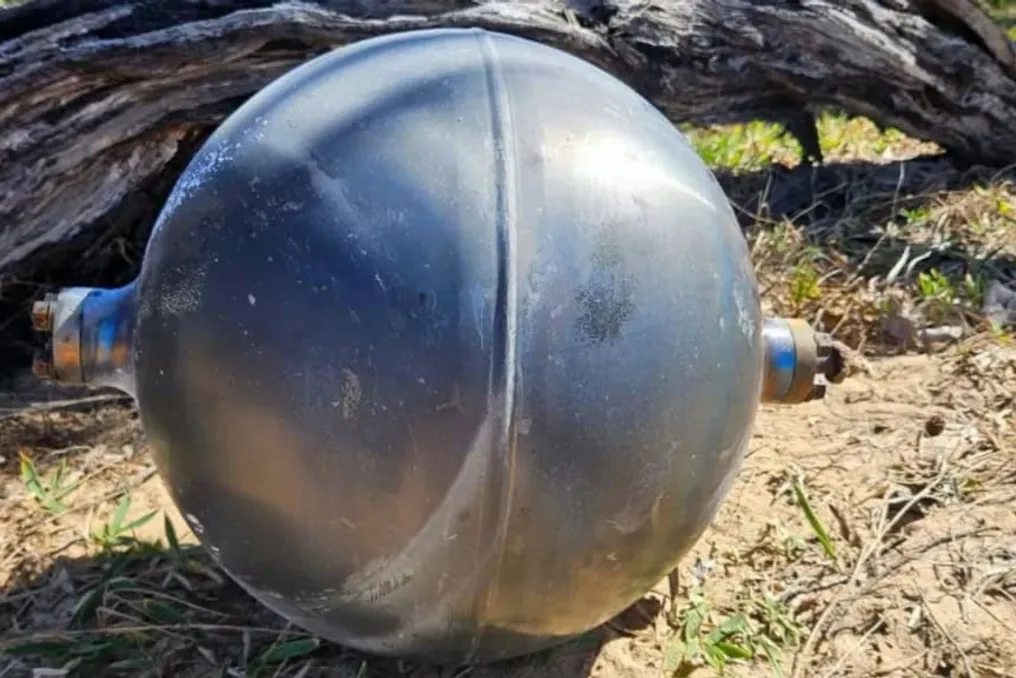
Six metallic spheres were recently discovered on the beaches of Queensland, Australia, and are currently under investigation as possible pieces of a rocket that returned to Earth's atmosphere. Following a preliminary assessment by the Australian Space Agency (ASA), experts are explaining why this type of object can reach the ground almost intact and what difficulties this poses for space debris monitoring.
Discovery Details
Researchers indicate that the pressure vessels used in launch vehicles are constructed with materials extremely resistant to the heat generated during re-entry. Additionally, the growing volume of space launches leads to a repetition of these events, although most of the debris usually falls into the ocean.
The Case of the Metallic Spheres
Specifically, the six spheres were located on the beaches of the Queensland region in northern Australia, appearing over several days in the coastal area of Forrest Beach, near Townsville. The ASA confirmed that these pieces are consistent with pressure vessels from a foreign spacecraft body that re-entered the atmosphere. As a precautionary measure, authorities isolated certain beach areas until the safety of the materials was guaranteed. The precise origin of the fragments is still being determined, and the Australian agency is contacting international bodies to identify the responsible launch.
Re-entry Heat Resistance
Marlon Sorge, Executive Director of the Center for Orbital and Reentry Debris Studies (CORDS), belonging to the Aerospace Corporation, commented to Space.com that the survival of these so-called 'space balls' during atmospheric passage is not surprising. According to the specialist, these components are often manufactured from titanium, a material capable of withstanding very high temperatures. Their shape also contributes to them decelerating more during the fall compared to solid metal blocks, resulting in a lower impact upon touching the surface. Sorge emphasizes that pressure vessels, including COPV models, are already recognized by science as components with a high probability of surviving re-entry.
Impact of Controlled Re-entry
The researcher suggested that some of the problems could be mitigated if the upper stages of rockets were guided for a controlled re-entry, instead of returning to Earth randomly. In this hypothetical scenario, even if some component survived the extreme heat, it would be directed toward uninhabited zones, reducing risks to people and property. Sorge added that the vessels found in Australia appear to have come from an uncontrolled re-entry event, falling first into the sea before being brought to the coast.
Space Debris Study
Studying the recovered objects provides crucial data on how space debris behaves when returning to Earth. The way materials reach the ground can indicate, for example, the temperatures faced during re-entry and which conditions failed to destroy them. Such information helps scientists refine their models of space junk. An additional challenge pointed out by Sorge is determining the exact origin of these items; having precise records of the time and location of impact would facilitate linking the fragments to the original launch.
Difficulty in Predicting Falls
Michelle Hanlon, Executive Director of the Center for Air and Space Law at the University of Mississippi, informed Space.com that it is common for fragments from the same rocket to be found in various regions of the globe. She explains that low-Earth orbit objects cross a large part of the planet while the Earth rotates beneath them. When re-entry is not managed, small variations caused by atmospheric friction can shift the final landing point by thousands of kilometers. Since most of the Earth's surface is oceanic, most debris ends up in the sea, but more robust components can survive and be found on beaches or populated areas.
Growth of Space Activity
Hanlon emphasizes that pressure vessels, like those found in Australia, have a high chance of remaining intact post-re-entry due to their design to withstand extreme pressures. The specialist also assesses that identifying the country of origin does not always depend on a visible mark; this can be done through the piece's design, serial numbers, or launch records, since inscriptions may not withstand intense heat. The main current obstacle, according to Hanlon, is improving data sharing and tracking of these objects so that authorities can quickly identify the provenance, assess potential risks, and hold the issuing country accountable. She concludes that the increase in these incidents accompanies the growth of global space activity, meaning more returns to Earth and, consequently, more chances of resilient parts appearing in unexpected locations.