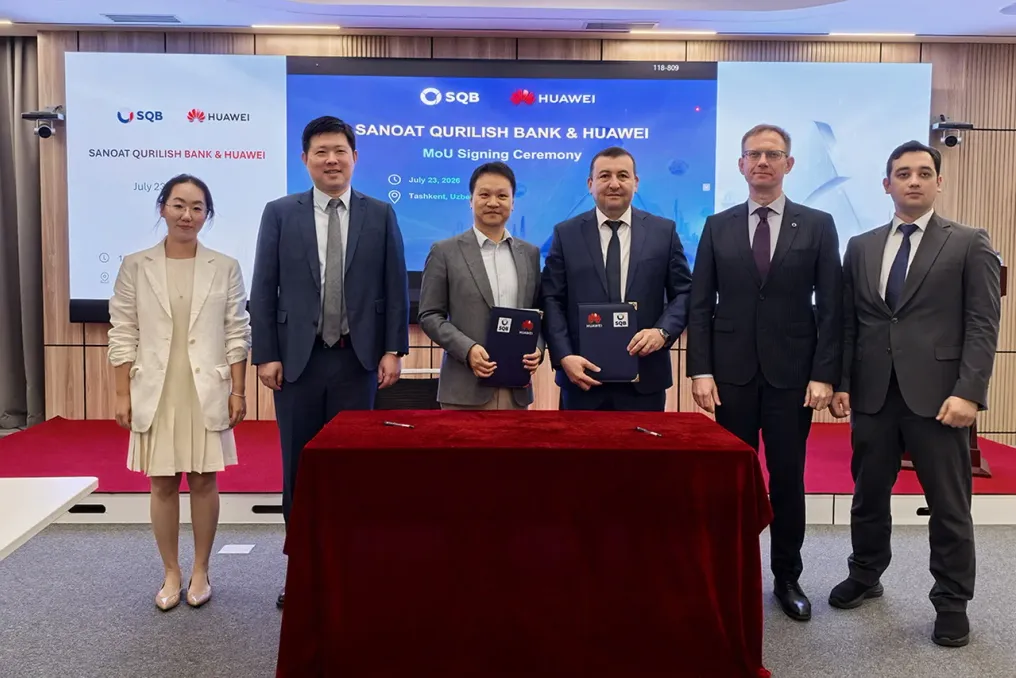
JSCB Uzpromstroybank (SQB) and Huawei signed a memorandum of understanding aimed at deepening their partnership in the fields of artificial intelligence, digital technologies, and banking infrastructure.
JSCB Uzpromstroybank (SQB) and Huawei signed a memorandum of understanding aimed at deepening their partnership in the fields of artificial intelligence, digital technologies, and banking infrastructure.
This document provides for the implementation of innovative solutions to promote the bank's digital transformation. As part of broader reforms led by the President of Uzbekistan, large-scale transformations are being implemented in the country to develop the digital economy, digitize public and financial services, and widely introduce artificial intelligence technologies.
A key priority in this process is the effective application of advanced technologies in the banking system, modernization of digital infrastructure, and launch of new customer services. According to the memorandum, the parties will implement joint projects focused on developing intelligent financial products, creating high-performance computing infrastructure, increasing the efficiency of banking operations, and providing customers with new digital services.
During the signing ceremony, participants also studied international best practices for implementing modern banking technologies. Huawei specialists presented examples of projects and results achieved in China's financial sector.
Tan Xiaoshan, Director of Huawei Uzbekistan, noted that Huawei and SQB have already completed several joint projects related to network infrastructure. He emphasized that SQB is actively engaged in digital development, improving customer experience, operational efficiency, and implementing intelligent solutions, which aligns with Huawei's strategy of creating value through AI capabilities. He expressed readiness to expand cooperation and introduce advanced technologies into the country.
Sergey Kozlov, Director of Artificial Intelligence at Uzpromstroybank, highlighted that this agreement is an important stage in the bank's technological strategy. He particularly emphasized Huawei's extensive international experience in information technology, hardware, and AI, noting that the partnership will give SQB access to advanced knowledge and technologies, accelerate digital transformation, and support the creation of smart products. Kozlov added that this cooperation lays a solid foundation for strengthening regional interaction and opening new prospects in Central Asia.
Huawei has sixteen years of experience in developing technologies for the financial industry and currently collaborates with over 7100 financial institutions in 80 countries worldwide. The signed memorandum will allow SQB to utilize international experience, apply innovative solutions, and develop next-generation, AI-driven banking services.
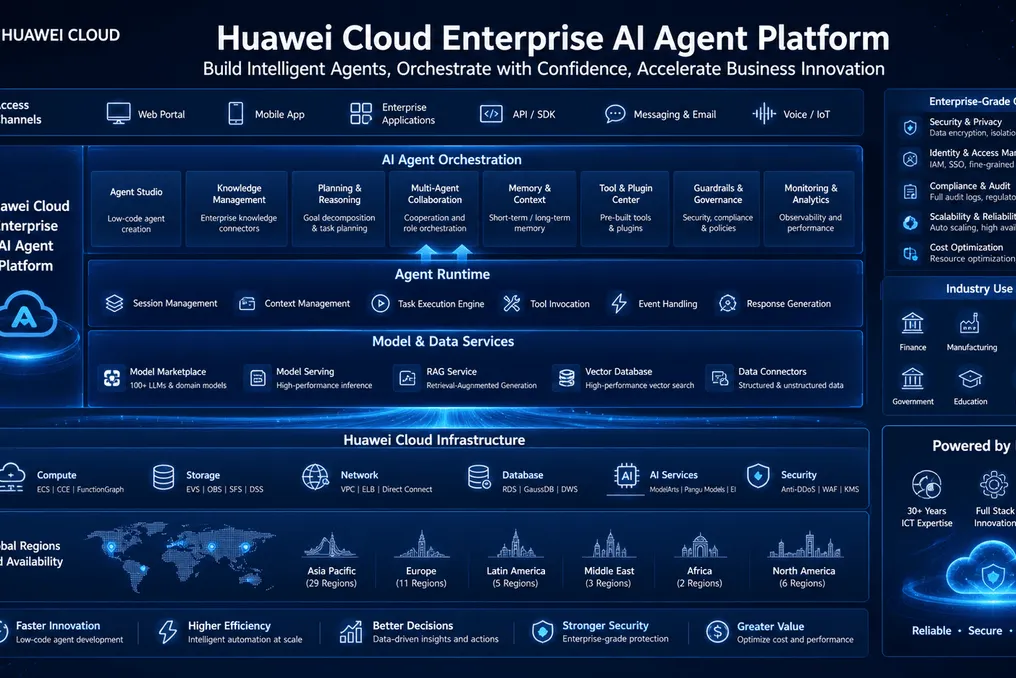
At the WAIC 2026 event, Huawei Cloud CEO Zhou Yu Feng introduced the AgentArts platform and the openJiuwen framework. These developments aim to implement enterprise-level agents, ensuring stability, security, and the ability to coordinate multiple agents.
Zhou Yu Feng outlined the company's strategy in enterprise AI at WAIC 2026. He emphasized that transitioning from demonstration agent models to full production systems requires three interconnected achievements: the adoption of open protocols, the utilization of reusable industry resources, and the application of a platform approach that raises both the upper and lower thresholds of agent capabilities. The central element is AgentArts—a full lifecycle platform that includes AgentStudio for flexible development, AgentRun for reliable operation, and AgentOps for continuous functioning, with openJiuwen serving as the open-source core framework.
The primary problem Huawei Cloud addresses is the gap in stability between demonstration and production agent environments. Zhou noted that agents are gradually transforming the traditional SaaS ecosystem. However, enterprises require agents capable of 24/7 operation, self-optimization, defense against AI-inherent threats, and providing constant observability of task execution chains. AgentArts solves this by introducing multi-level controllers, self-evolution capabilities, Agent Identity, session-level isolation, dynamic tokens, and detailed permission control to minimize agent errors during complex operations.
OpenJiuwen, an open-source framework for enterprise agents, shares over 90% of its code with AgentArts. It introduces two engineering paradigms: Coordination Engineering for the collaboration of multiple agents and Symbiosis Engineering for long-term human-agent cooperation. The framework treats large language models, memory stores, and agent protocols as new computational, storage, and network resources, respectively, which are managed through a unified corporate agent operating system (AgentOS). CLI and MCP serve as standard interfaces for calling external tools and services.
Several financial institutions have already begun using these technologies. China Postal Savings Bank developed an agent execution mechanism using the Huawei Cloud and openJiuwen stack, achieving automated 24/7 operation with minute-level data collection, analysis, and multi-channel distribution. Tianyancha integrated 160 MCP capabilities and converted six risk control scenarios into reusable Skills. Furthermore, Huawei Cloud, in collaboration with ICBC, China UnionPay, and over ten other financial institutions, launched the 'AI Dream Industrial Factory' initiative in the Smart Finance Zone to create and exchange industry-specific agent assets covering mobile banking, intelligent marketing, risk control, and remote banking scenarios.
The China Academy of Information and Communications Technology (CAICT) forecasts that agent penetration will reach 70% by 2027 and 90% by 2030. Nevertheless, CAICT Director Wei Kai pointed out that individual efficiency does not equal organizational efficiency. Enterprises cannot deploy agents in isolation; they require engineering methodologies for goal setting, roadmaps, evaluation systems, and continuous iteration. Simultaneously, issues such as business integration, data governance, multi-agent interaction, end-to-end security, and responsibility distribution between humans and machines must be addressed. Huawei Cloud's platform approach aims to provide the infrastructural layer necessary to achieve this systematic transformation of agents within enterprises, moving them from simple Q&A responses to executing real business tasks in banking, energy, manufacturing, and other key industries.
As part of the World Artificial Intelligence Conference held in Shanghai, China, Minister of Digital Technologies Sherzod Shermatov held a meeting with the management of one of the world's leading technology companies—Alibaba Cloud.
The negotiations covered topics such as artificial intelligence, cloud technologies, Data Centers, the development of modern digital infrastructure, and the training of highly qualified IT specialists.
Representatives from Alibaba Cloud shared information about the company's latest developments in artificial intelligence, advanced AI models, cloud services, and experience in implementing these technologies across various aspects of life. They highly appreciated the potential of Uzbekistan's youth, the rapidly developing digital market, and the reforms being implemented in the country to advance artificial intelligence.
Sherzod Shermatov emphasized the growing number of local companies utilizing open-source models and artificial intelligence technologies from Alibaba Cloud in Uzbekistan. He noted that it is crucial to develop human capital, improve the qualifications of local specialists, and expand practical cooperation in the field of artificial intelligence.
Information was also provided regarding the favorable investment environment for developing data centers in Uzbekistan, including infrastructure opportunities based on 'green' energy.
The parties discussed the phased development of artificial intelligence infrastructure in the country, expanding the capabilities of modern AI platforms for local programmers and enterprises, and training a new generation of specialists in collaboration with the engineering teams of UZINFOCOM and UNICON-SOFT.
Particular attention was paid to forming engineering teams capable of developing and implementing AI-based solutions in vital sectors such as healthcare and education. Furthermore, the agenda included strengthening partnerships with higher educational institutions and creating AI solutions tailored to the needs of government agencies and businesses.
Following the meeting, it was planned to advance projects to the practical stage under the coordination of the Artificial Intelligence Development Center, launch cooperation between technical teams, and demonstrate initial results during ICT Week Uzbekistan, which will take place in September of this year. Further expansion of cooperation on implementing artificial intelligence agents and practical AI solutions in various sectors of the economy was also discussed.