The Swiss federal criminal court in Geneva imposed a fine of 3 million Swiss francs on the private bank Lombard Odier in connection with money laundering cases involving Gulnora Karimova. This was reported by the Swiss publication Swissinfo.
The Swiss federal criminal court in Geneva imposed a fine of 3 million Swiss francs on the private bank Lombard Odier in connection with money laundering cases involving Gulnora Karimova. This was reported by the Swiss publication Swissinfo.
According to the court, the bank failed to implement all necessary organizational measures to prevent the former employee's money laundering activities. The Swiss prosecutor's office alleges that Gulnora Karimova created and headed a criminal organization called 'Office'. This structure was used to conceal corrupt funds received from foreign companies operating in Uzbekistan's telecommunications market and subsequently transfer these funds to accounts in foreign banks.
The funds first passed through opaque financial operations before being deposited into bank accounts of companies associated with 'Office' in various countries, including accounts at Lombard Odier. A former client relationship manager at the bank, identified as 'C.', was aware of signs that the funds might have a corrupt origin. In instances where the statute of limitations had not expired, over 120 million dollars were deposited into the accounts.
The charges against Karimova were dismissed on the merits, but the case was discontinued for procedural reasons. The court noted that she is unlikely to come to Switzerland or be extradited before the end of her sentence, as she is serving time in Uzbekistan. Meanwhile, Lombard Odier stated that it had informed Swiss authorities about the suspicions back in 2012 and that the bank had an internal anti-money laundering system in place. The bank also announced its intention to appeal the decision, declining to join the court's findings.
According to the publication, Switzerland and Uzbekistan signed two agreements to return a total of 313 million dollars confiscated in the Gulnora Karimova case. These funds will not go directly to the state budget but will be channeled through the UN Trust Fund to implement projects in healthcare and education.
The volume of non-performing loans (NPL) in the banking system of Uzbekistan continues to grow. According to data from the Central Bank, by the end of the first half of 2026, the volume of such loans reached 22.9 trillion sums. This figure is significantly higher than 18.1 trillion sums at the beginning of the year, an increase of 27 percent.
Although the growth of the credit portfolio is considered a natural process, the faster rate of increase in non-performing loans raises concerns within the banking system. Over six months, the total credit portfolio grew from 604 trillion sums to 643 trillion sums, representing an increase of 6.4 percent. Meanwhile, non-performing loans grew almost four times faster—by 27 percent.
The share of non-performing loans in the total credit portfolio has also increased. If this indicator was 2.99 percent at the beginning of the year, it reached 3.57 percent by the end of the half-year period. Analysts note that the majority of non-performing loans are concentrated in state-participating commercial banks. The volume of NPL in these banks increased from 12.8 trillion sums to 16.4 trillion sums over six months. This means that almost 72 percent of all non-performing loans in the country's banking system are concentrated specifically in state banks.
As a result, the share of non-performing loans in state banks rose from 3.17 percent to 3.89 percent. At the same time, the situation in banks with private and foreign capital remained relatively stable, with the NPL share increasing from 2.62 percent to 2.95 percent.
In terms of relative growth, the largest increase was recorded at TBC Bank, where the share of non-performing loans increased from 5.71 percent to 12.12 percent, becoming the highest in the system. Microcreditbank also demonstrated an increase in the NPL share from 4.41 percent to 7.86 percent, surpassing others in absolute volume of non-performing loans, which increased by almost 900 billion sums over six months.
Despite the overall trend of growth, some banks managed to improve the quality of their credit portfolio. The most significant positive changes were observed at Poytaht Bank, where the share of non-performing loans decreased from 24.40 percent to 7.32 percent. Kapitalbank reduced the volume of non-performing loans by almost 200 billion sums, bringing the NPL share down from 2.81 percent to 2.14 percent. Ipoteka Bank achieved a reduction in the volume of non-performing loans by 163 billion sums. Indicators also decreased at Hayot Bank (from 3.96 percent to 2.68 percent) and Ziraat Bank Uzbekistan (from 3.86 percent to 2.96 percent).
Furthermore, the share of non-performing loans remained at 0 percent in KDB Bank Uzbekistan and Octobank. Uzumbank, ApexBank, and Open Bank were among the banks with the lowest NPL rates, at 0.01 percent, 0.04 percent, and 0.35 percent, respectively.
In summary, the half-year results show that alongside the increase in lending volume, strengthening control over debt quality is required. Especially in state-participating banks, the high rate of growth of non-performing loans requires improving risk management mechanisms, credit assessment, and borrower engagement. Nevertheless, the successful experience of some banks in revitalizing their credit portfolios demonstrates the existence of effective approaches in this area.
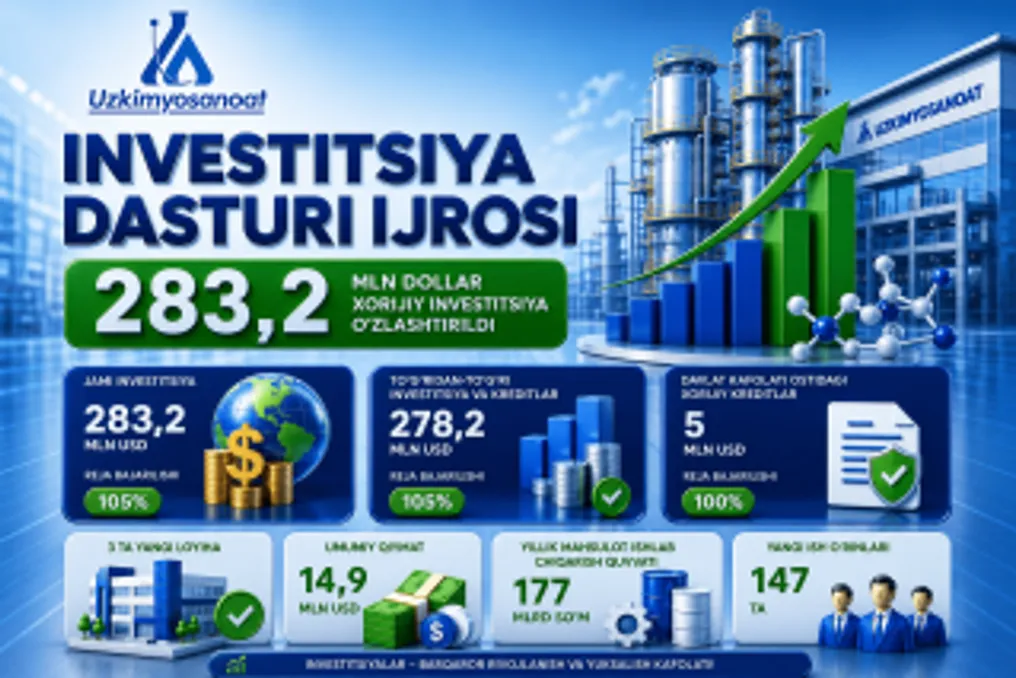
The joint-stock company 'Uzkimyosanat' successfully implemented the tasks set out in the Investment Plan during the first half of 2026.
Significant results were achieved during the reporting period in the areas of enterprise modernization, development of high-tech production, and job creation. Over six months, $283.2 million in foreign investments were attracted, resulting in the Investment Plan being fulfilled at 105%.
The attracted funds consisted of $278.2 million in direct foreign investment and loans, as well as $5 million in foreign loans under state guarantees.
Furthermore, three investment projects with a total value of $14.9 million were commissioned during the six-month period. These projects enabled the creation of production capacity worth 177 billion UZS annually and provided for the creation of 147 new jobs.
It is noted that these projects make a significant contribution to increasing production potential, expanding the output of import-substituting and export-oriented products, and ensuring employment of the population.
The European Central Bank has selected 36 payment service providers in the eurozone to participate in the digital euro project, according to the publication Italpress.
The planned pilot project is set to begin in the second half of 2027 and will last for 12 months. Its goal is to test the technical solution, operational process, and user experience associated with the digital euro.
Banks as well as non-state financial institutions will take part in this project. During the trials, employees of the European Central Bank and 19 national central banks will conduct online and offline payments between individuals and legal entities using a beta version of the digital euro.
Pierro Cipollone, a member of the Executive Board of the European Central Bank, emphasized that the high interest from the private sector stimulates the active development of the digital euro project.