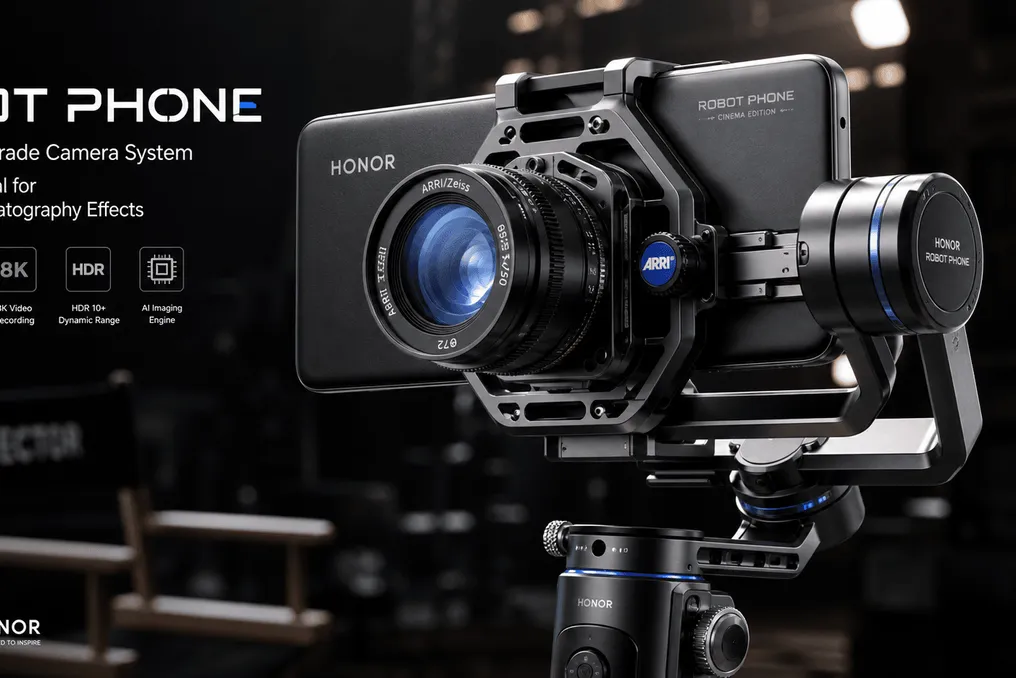
Honor has introduced its AiMAGE visualization system for the Robot Phone in partnership with ARRI. This system is positioned as the first instance of a complete transfer of professional cinematic color grading standards to a consumer smartphone.
Honor has introduced its AiMAGE visualization system for the Robot Phone in partnership with ARRI. This system is positioned as the first instance of a complete transfer of professional cinematic color grading standards to a consumer smartphone.
The AiMAGE architecture is built on a full-featured Chip-Edge-Cloud stack. At the chip level, it utilizes the specialized image processor Yuguang H1, which provides an efficiency of 18.8 TOPS per watt. It performs real-time processing in the RAW domain, improving the signal-to-noise ratio by 8 dB and providing a cinematic-level dynamic range of 14 stops.
The sensor is equipped with a patented dichroic color separation structure that physically reconstructs photon collection and color separation. The cloud level uses specialized reconstruction models in the RAW domain to restore full sensor performance through image quality reconstruction across the entire chain.
The system includes a three-axis gimbal with a 2.6 g titanium motor, which is 65% smaller and has 30% greater torque, as well as eight-axis CPA. The main module has a resolution of 200 MP, a sensor size of 1/1.28 inch, and an aperture of f/1.6, supporting stepless zoom, along with a 200 MP periscope telephoto lens. Six stabilization modes are available, ranging from manual to cinematic.
AI agent functions include pre-capture suggestions, real-time composition, and post-capture editing using NLP. Event vision sensors are used for stabilization and low-light operation, while five computational enhancement engine pipelines provide additional capabilities. Creative video generation is performed using cloud AI. The master frame generation function allows for videos with controlled camera trajectories, utilizing classic cinematography techniques such as the Hitchcock zoom and the 'bullet time' effect. An immersive one-shot tour function is under development, which uses a world model and 3D reconstruction to create extended smooth shots from uploaded material. Spatial 3D photos are also implemented, combining 3D reconstruction, rendering, and V2V technology.
Honor stated that 2026 will be the year of absolute differentiation in video, and 2027 will target a generational leap thanks to redesigned sensors and dedicated hardware-software image processing algorithms. The collaboration with ARRI solidifies the status of the Honor Robot Phone as a mobile visualization platform connecting consumer photography with professional film production workflows.
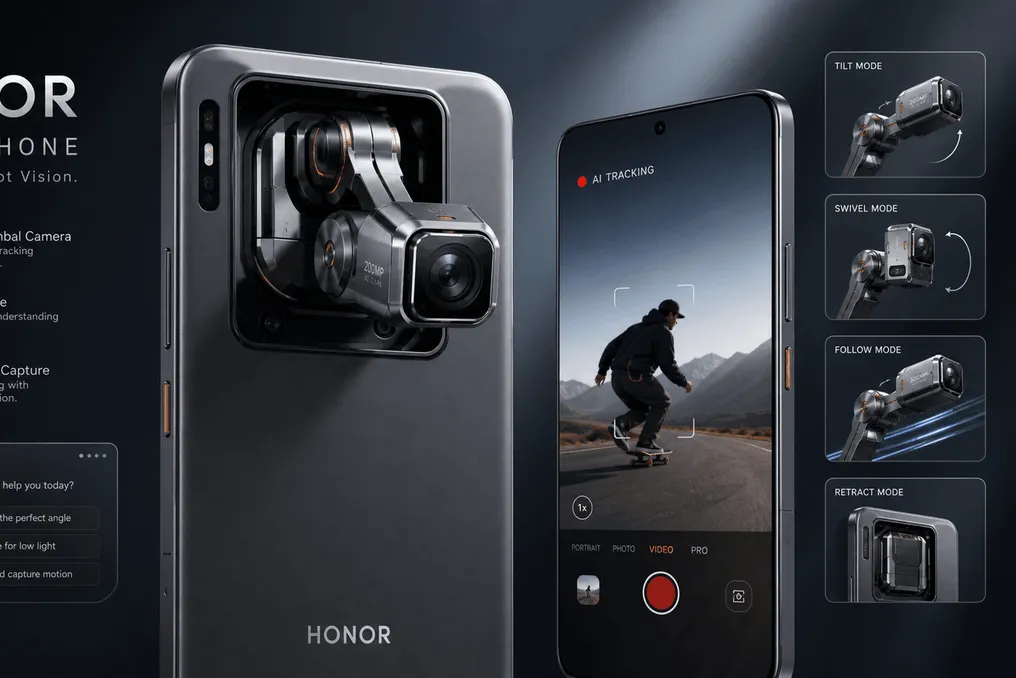
Honor introduced its world's first Robot Phone at the WAIC 2026 event. This gadget fundamentally changes the concept of smartphone form factor by integrating a four-degree-of-freedom (4DoF) titanium alloy mechanical suspension system directly into the phone's body.
The suspension system is the device's central innovation. It is made of titanium alloy and equipped with micro-motors that are 70% smaller than comparable components on the market. This system ensures a CIPA level stabilization of 5.5 and compensates for 96% of walking vibrations. The camera module can rotate 360 degrees to track objects and also supports smooth movements of 90 and 180 degrees to create cinematic effects. During normal use, the system is completely hidden in the phone's body and is activated by pressing a single button.
The AI functionality goes beyond standard smartphone assistants. Honor's YOYO Artificial Intelligence demonstrates the ability to perform tasks proactively, processing continuous commands from a single user request. For example, it can sequentially execute turning on motion sickness mode, adjusting screen brightness, setting an alarm, and calling a taxi with minimal user intervention.
During the demonstration, the Robot Phone used real-time match data analysis to predict Spain's victory over Argentina by a score of 3:1 in the World Cup. Furthermore, it physically expressed its analytical confidence through the movement of the suspension, nodding and swaying to emphasize key moments while explaining the prediction.
The device's camera features flagship specifications. The rear triple camera system includes a 200MP main camera with 4D suspension and an F1.6 aperture and 23mm equivalent focal length, a 50MP ultra-wide-angle lens, and a 200MP periscope telephoto lens. Additionally, this phone is the first product under the strategic partnership between Honor and ARRI, allowing the use of ARRI Log-C encoding and LUT color grading in mobile video. It also offers professional filmmaking features such as C-Log, LUT, focus lock, white balance lock, exposure lock, and motion data recording, aimed at serious video creators.
The Robot Phone represents the first concrete product announced under Honor's Alpha Strategy in March 2025. This three-stage roadmap aims to transform the company from a smartphone manufacturer into a leading ecosystem of AI terminals. Instead of gradual hardware improvements, this device marks a redefinition of the category: when AI moves beyond software and takes physical form, the smartphone transforms from a simple electronic unit into an intelligent companion that perceives its environment, interacts with the physical world, and actively serves its user. The mechanical suspension here acts not just as decoration but as a physical embodiment of Honor's thesis that the next competitive frontier in smartphones is determined by how AI capabilities integrate with the device's morphology to create new interaction models.