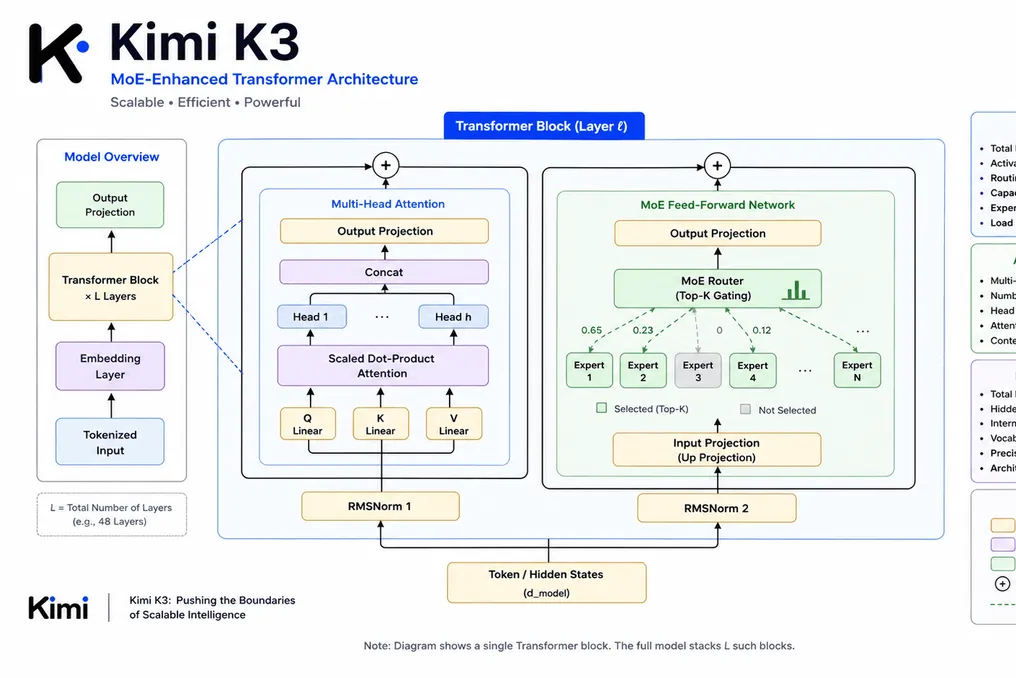
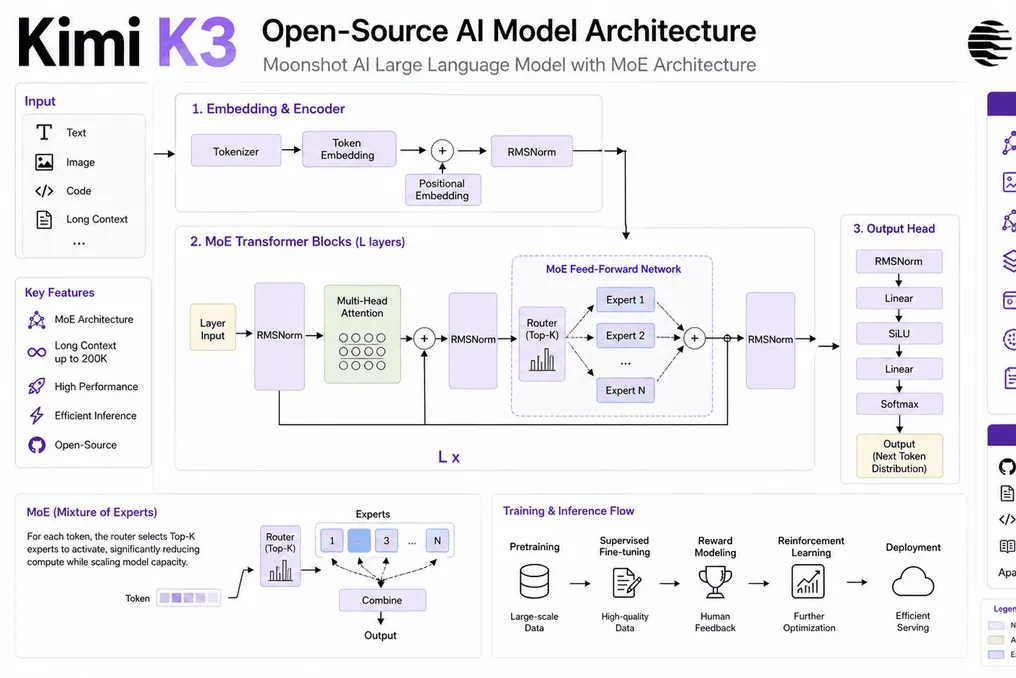
Moonshot AI has officially released the open-source Kimi K3 model. This model features 2.8 trillion MoE parameters, incorporates 896 routed experts, supports 16 active experts per token, and boasts a context window of 1 million tokens. Additionally, the infrastructure tools MoonEP, FlashKDA, and AgentEnv have been released.
Technical Specifications and Model Improvements
The launch of Kimi K3 occurred on July 27th. The model has become the largest in the world among open-weight models. Compared to the previous generation K2.5, the parameter scale of K3 has increased by approximately three times, and computational efficiency has risen by 2.5 times due to the use of Kimi Delta Attention, Attention Residuals, and MoonEP technologies, enabling operation under limited computational resources.
Architectural Innovations
The technical report reveals several architectural novelties. The hybrid KDA attention structure combined with Gated MLA merges linear attention for efficient long-context processing and gated multi-head latent attention for high-quality local representation. The Stable LatentMoE routing mechanism addresses the expert collapse problem often encountered when training large MoE models by stabilizing the router's gradient dynamics. Furthermore, the MoonViT-V2 vision encoder training scheme ensures native multimodal interpretation without the need for separate vision and language adapters. The model was trained and tested on universal reasoning, agent, and coding tasks, demonstrating K3's broad capabilities beyond purely linguistic tasks.
Infrastructure Solutions
In addition to the model itself, three infrastructure tools were opened up. MoonEP is a high-performance communication library designed for large-scale MoE training, which eliminates the all-to-all communication bottleneck that limits MoE scalability. FlashKDA provides a high-performance computation kernel for Kimi Delta Attention; benchmarks show it achieves a prefill speed improvement from 1.72x to 2.22x on the H20 GPU compared to the baseline flash-linear-attention. AgentEnv is an agent sandbox system developed using KVCache.ai, supporting fast snapshot creation, restoration, and forking for large-scale agent training environments. These infrastructure releases lower the barrier for reproducing and further developing K3-class models.
Ecosystem Implications of the Release
The open-source release has significant implications for the ecosystem. K3 meets or surpasses closed state-of-the-art models such as GPT-5.6 and Claude Fable 5 across several specific tests, particularly in frontend code generation. Moreover, the cost of using K3 via API is 40% lower than Claude and 70% lower than Fable. The open-weight license allows for local deployment and the development of proprietary applications without API dependency. However, due to its 2.8 trillion parameter scale, even local implementation requires substantial hardware—at least 10 GB300 class GPUs just to load the model, making inference infrastructure costs the primary factor in deployment, rather than API fees.
Market Reaction and Limitations
This release triggered a chain reaction in the ecosystem. Alibaba Cloud's Qianwen AI platform announced K3 availability. Huawei announced the adaptation of Ascend 0-day for K3, marking the first instance of launching a 3-trillion-level model on domestic hardware. The open-source community gained access to model weights that previously required hundreds of millions in investment to reproduce. Moonshot AI stated that the open-source initiative aims to advance the open-weight model ecosystem, lowering barriers to development and deployment for the broader AI community. However, shortly thereafter, it was announced that K3 suspended new user subscriptions due to computational capacity constraints, highlighting the contradiction between open-source ideals and the reality of serving a 2.8 trillion parameter model at scale.