The Kimi K3 model from Moonshot AI has demonstrated significant technical progress, ranking third in the global artificial intelligence rating, yet its path to a breakthrough comparable to DeepSeek's is complicated by issues of pricing, computational limitations, and ecosystem maturity.
Technical Achievements of Kimi K3
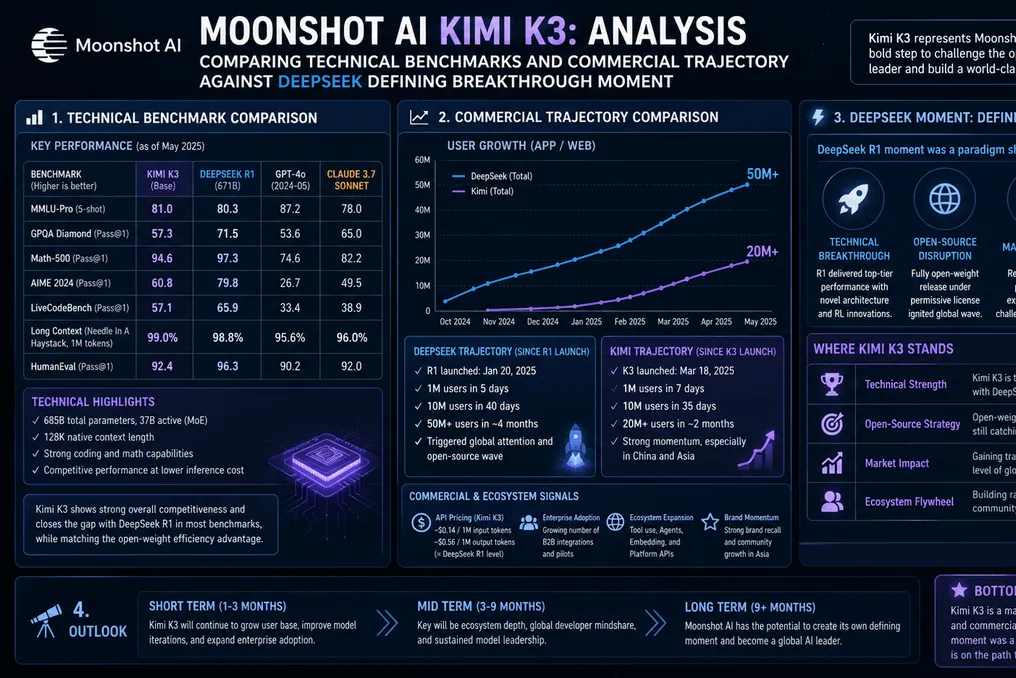
Kimi K3 leads global coding benchmarks and ranks third overall, trailing only Fable 5 and GPT-5.6. The model has reached a level previously unattainable by Chinese large models, securing third place in the AI rating and even surpassing Fable 5 in the Arena 2026 frontend coding benchmark. Elon Musk called this result impressive, and global media dubbed it the 'Second DeepSeek Shock.'
Architecture and Capabilities of the Model
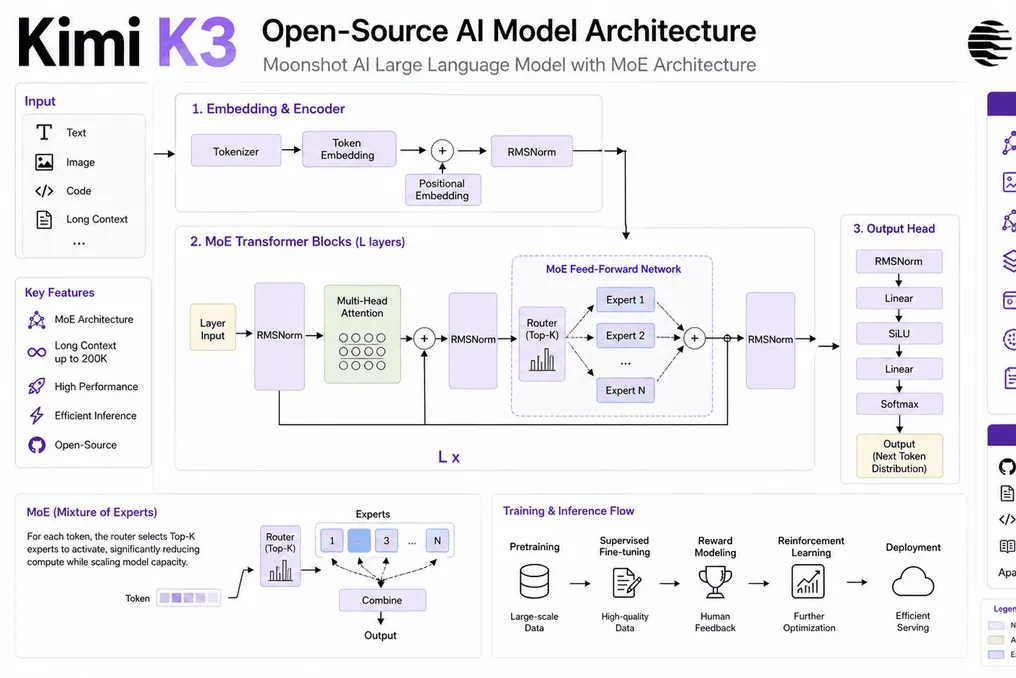
On the Artificial Analysis platform, Model K3 holds the third global position. It is built on a Mixture-of-Experts architecture with 896 experts, features 2.8 trillion parameters, supports a native context length of 1 million tokens, and utilizes the KDA attention mechanism. The model shows high efficiency in tasks related to coding, agent work, and long-context reasoning, which has direct commercial applications. Nevertheless, compared to leading closed-source models, K3 still exhibits measurable gaps in complex reasoning and multimodal tasks.
Barriers to Market Entry
A significant obstacle is pricing: K3 costs 3 to 15 times more than DeepSeek per million tokens. While this confirms the ability of Chinese AI to command premium prices, it limits the viral growth of the ecosystem that DeepSeek achieved through ultra-low access costs and mass adoption.
Computational Limitations and Demand
The most critical bottleneck is computational constraints. Although K3 was trained with surprisingly efficient resource utilization, shortly after its release, Kimi was forced to suspend new consumer subscriptions due to enormous inference demand. A single K3 query requires approximately 1.4 TB of memory even after low-precision quantization. Moonshot AI is actively working to scale up computing power, but the gap between demand and available infrastructure remains the main factor separating K3 from sustained market influence. These limitations also hinder commercial deployment, as enterprise clients require guaranteed inference throughput that Moonshot AI cannot yet provide at scale.
Ecosystem Versus Model Quality
The key difference in DeepSeek's breakthrough moment was not just the quality of the model itself, but the creation of a self-sustaining cycle: mass user adoption stimulated the growth of the developer ecosystem, which in turn improved the model's capabilities and led to further adoption growth. Kimi K3 has achieved the technical prerequisite but has not yet launched this 'ecosystem flywheel.' The coming weeks will determine whether Moonshot AI can overcome the computational barrier, transform technical admiration into stable commercial relationships, and build a developer ecosystem that turns an excellent model into a full-fledged platform. Engineering capabilities are proven, but the business model and infrastructure strategy are still under development.