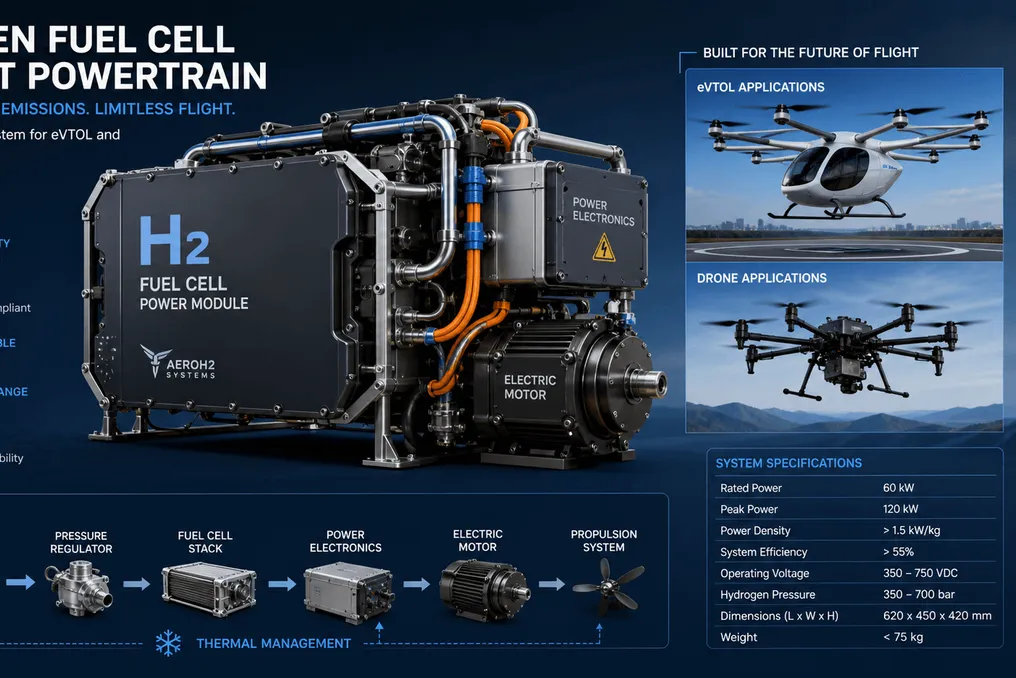
YiQing Power, a company founded based on Tsinghua University, has successfully completed an angel funding round and beyond, securing funds to develop liquid-cooled fuel cells ranging from 30 kW to 110 kW. This company serves as a supplier for Comac in the field of hydrogen propulsion and has developed an air-cooled variant for drones capable of long flights lasting up to 30 hours.
Advantages of Hydrogen in Aviation
In the world of aviation, hydrogen fuel cells are in an early stage of development and lack an established supply chain, unlike their automotive counterparts. Founder and CEO Zhang Kexun, a Doctor of Science in Automotive Engineering from Tsinghua who has been involved in new energy power trains since 2002, emphasizes the key advantage of hydrogen—its high energy density. Hydrogen provides 3 to 4 times the range compared to batteries and allows for faster refueling and better performance in cold weather, making it an ideal choice for eVTOL taxi business models with frequent route changes.
Company's Technological Strategy
As the cost of green hydrogen decreases in China, hydrogen fuel is expected to become cheaper than aviation kerosene, creating a strong economic argument for adopting hydrogen in aviation, in addition to technical advantages. YiQing Power employs a dual-track technological strategy that separates liquid-cooled and air-cooled fuel cell systems, each targeting different aircraft segments and commercialization timelines.
Development of the Liquid-Cooled Line
The liquid-cooled line was initially developed based on a 30-kilowatt unit in collaboration with Northwestern Polytechnical University in 2020, and subsequently upgraded to a 90-110 kW capacity. It is designed for large aircraft and long-haul applications at high altitudes, requiring high adaptability to extreme conditions such as 10,000 meters altitude, severe cold, a service life exceeding 10,000 hours, and strict certification compliance. The company acts as a supplier for Comac in developing hydrogen propulsion and collaborates with several eVTOL manufacturers to create hydrogen-powered variants.
Air-Cooled Products for Drones
The air-cooled product line, developed in 2024 as a strategic expansion in response to the low-altitude economy opportunities, targets smaller drones with faster iteration cycles and lower technical barriers, accelerating market entry. Over the past year, this system has undergone three iterations and begun expanding its applications. Chengfei (Chengdu Aircraft) utilized the YiQing air-cooled system on a high-altitude drone powered by gaseous hydrogen, achieving continuous flight for 30 hours in 2025, and 24 hours in 2026, demonstrating a range advantage over battery alternatives. Furthermore, the air-cooled solution costs approximately the same as equivalent pure electric systems but provides 3 to 4 times the flight time.
Business Model and Prospects
The dual-track strategy supports a dual-speed business model: air-cooled products generate short-term revenue in drone inspection and low-altitude logistics markets, having already earned several million yuan in the first half of 2026, with plans to reach tens of millions by the end of the year. Liquid-cooled products form long-term technological advantages, with significant revenue expected only between 2027 and 2028 when certification processes become more mature. Zhang predicts that China will follow the trajectory of electric vehicles in hydrogen aviation: initial certification will be slower, but scaling will happen faster after technology validation, leveraging the country's manufacturing capacity and the low cost of green hydrogen, potentially bypassing slower certification regimes in Europe and America. YiQing Power positions itself as a provider of comprehensive solutions for hydrogen power trains—from stack to system integration and aircraft integration support—aiming to capture the entire value chain of hydrogen aviation, from drones to full-scale aircraft, as the next frontier in aviation decarbonization.