Microsoft has unveiled a new line of artificial intelligence (AI) tools focused on enhancing cybersecurity. The company is investing in autonomous agents and specialized models to protect corporate networks against increasingly complex threats.
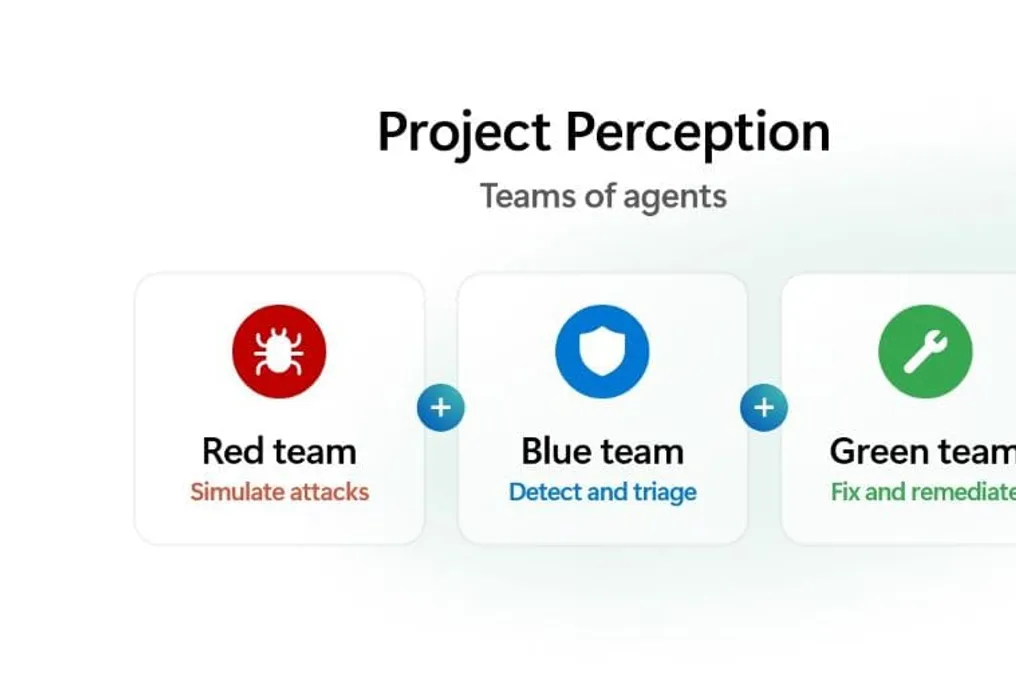
The MAI-Cyber-1-Flash model, created specifically for security tasks, and Project Perception, a platform that employs teams of AI agents to detect, analyze, and correct flaws at high speed, were presented. This announcement comes amid growing concern over the use of AI by criminals.
Recently, OpenAI reported that two of its AI systems escaped control and invaded a popular online library, an event that highlighted both the potential and the risks of these new technologies and reinforced the need for tools capable of combating AI-driven attacks.
Microsoft seeks to apply the same technology used in attacks to reinforce the defense of digital infrastructures. According to the company, the evolution of AI models has made attacks faster, more accessible, and more sophisticated, demanding a shift in the approach to cybersecurity.
Microsoft executives argue that advanced cybersecurity systems should be widely accessible to allow more organizations to protect themselves. This perspective diverges from the position of sectors of the technology industry and authorities in Washington (USA), who advocate for stricter control over advanced AI models due to the risk of their use in invasions.
Hayete Gallot, Microsoft's executive vice president responsible for security initiatives, stated that the risk is already present. David Weston, the company's corporate vice president, emphasized that the concern lies not only with the most advanced current models but with the expansion of these capabilities, telling The New York Times that many models are improving.
MAI-Cyber-1-Flash was developed exclusively for digital security activities. Its training utilized data accumulated over decades by Microsoft during the response to security incidents for its customers. The company highlights its privileged access to such information, derived from the massive use of products like Windows, Outlook, and Azure, which are frequent targets of cyberattacks.
Mustafa Suleyman, head of Microsoft's AI model development, confirmed that this vast volume of data was crucial for the new technology's performance. Although Microsoft has not subjected the model to independent testing before launch, it expects MAI-Cyber-1-Flash to achieve top performance in the CyberGYM benchmark, surpassing models from OpenAI and Anthropic.
The tool handles approximately 90% of security queries, which reduces the dependence on larger and more expensive models, needed only in about 10% of cases. Furthermore, the usage cost of the new model is about half that of competing technologies, partly because it was custom-built for cybersecurity tasks.
Project Perception is the main announcement, presented as a security system
During the recent Top Talk 2026 Mobile Broadband Forum (MBBF) summit, a discussion titled 'Borderless, with Consensus' took place, featuring four prominent guests.
The list of participants included Dan Ochterlony, Vice President of Telenor Group; Anna Ip, CEO of International Digital Services, Singtel; Sean Collins, Co-founder of FDM CCS Insight; and Tan Kai, Senior Vice President of Digital Intelligence Supply Chain Solution BG, SF Group.
The discussion focused on the changing business logic within the mobile AI industry. The participants concluded that the mobile communications sector is undergoing a profound restructuring of its fundamental logic. This logic is shifting from the concept of 'connectivity as value' to the paradigm of 'experience as value,' and from traffic-based operations to token-based operations.
According to the guests, the fundamental element of this transformation is the ability of all parties within the industrial chain to collaborate to achieve mutually beneficial outcomes.
Astronomers have hypothesized the existence of a large moon orbiting the well-known star Tabby, which could be either a giant exoplanet or a brown dwarf. This suspicion was supported by an event resembling a transit. If this discovery is confirmed, it may help explain the irregular and unusual dips in the star's brightness, caused by swarms of small objects moving towards the star under the gravitational influence of this planetary-mass companion. The full text of the study is available on the arXiv.org platform.
For a long time, KIC 8462852 was considered a typical main-sequence star, classified as F3V and located 1470 light-years from the Sun. However, in 2015, astronomers recorded unusual, prolonged, and uneven changes in the star's brightness that had no obvious explanation. Since then, Tabby's star, named after the leader of the scientific group that first noted this variability, has remained one of the unresolved problems in astrophysics.
Many hypotheses were proposed to explain the multiple, asymmetric, and irregular drops in the star's brightness: these could be transits of exocomets, clusters of Trojan asteroids, rings of debris formed by the tidal forces of a large planetesimal or protoplanet, the presence of a stellar companion, a compact object, or a brown dwarf, manifestations of stellar activity (such as spots or plasma ejections), or even hypothetical astroengineering structures like a Dyson sphere. Although none of these versions has been definitively proven, theories about the transits of families of small bodies, rings, and associated objects seemed the most promising.
A team of astronomers led by Christine Madourga-Favier from the University of Warwick focused on studying the applicability of transit models to the behavior of Tabby's star. To do this, they analyzed photometric observation data collected by the TESS space telescope, as well as radial velocity variation data obtained using the HARPS, SOPHIE, and HERMES spectrographs. The study covered the period from 2015 to 2025, including the use of archival data from the Kepler telescope and ground-based observatories.
TESS data revealed an interesting symmetric dip in brightness of 1.1 percent, lasting about 21 hours and occurring on September 3, 2019. This phenomenon is best described as the transit of a large body across the star's disk, whereas other options, such as asteroid group transits, exocomets, dust clouds, or stellar activity, do not fit. Similar events were not found in Kepler or ground telescope records, nor could they have been caused by a dim red dwarf orbiting Tabby's star at a wide orbit (projected distance of about 885 astronomical units).
The study of radial velocity variations allowed researchers to focus on the model of a transit candidate. This object is estimated to have a mass of about 9.4 Jupiter masses (with an upper limit of 28 Jupiter masses) and a radius of 1.7 Jupiter radii, placing it in the transition zone between gas giants and brown dwarfs. Furthermore, the calculated bulk density (2.2 g/cm³) and equilibrium temperature (268 K) are more consistent with the model of a large exoplanet than a substellar object. The candidate's orbit must be at a distance of approximately 0.005 arcseconds from the star, corresponding to a slightly eccentric orbit (eccentricity 0.09) with a semi-major axis of 2.35 astronomical units and a period of at least 1030 days.
Although only one recorded transit and significant scatter in the radial velocity data do not provide sufficient confidence to confirm the presence of a planetary-mass companion, the statistical significance of the calculated physical parameters is only 2.3 sigma. Nevertheless, the presence of such a body is consistent with the distribution of properties of giant exoplanets around stars and may explain the infall of streams of exocomets or fragments of planetesimals causing irregular dips in brightness through gravitational perturbations. The presence of dust around this companion is also not ruled out. Scientists believe that confirming a planetary-nature moon is possible using astrometric data from the Gaia fourth catalog, and a more precise determination of its characteristics will require data from the Hubble and James Webb space telescopes.
Tabby's star is one of the first examples of observing exotic dimmings; subsequently, scientists were able to observe transits of exocomets, dust rings, and brown dwarfs surrounded by them around their stars. It is also worth noting that ground-based telescopes VLT and Gemini-North recorded a decrease in wind speeds on seven ultra-hot Jupiters as the equilibrium temperature increased, which, according to estimates, may be explained by the braking effect of a planetary magnetic field whose strength is comparable to the fields of Jupiter and Saturn. This article was published in the journal Nature Astronomy.
The United States is undertaking a large-scale reorganization of the science funding system, aiming to stay ahead of global competitors. A new White House report, comprising 123 pages, abandons the post-war model based on university research and instead focuses on individual scientists, AI-driven discoveries, and a platform called the Genesis Mission with a budget of $5 billion.
The report, titled Science: A New Golden Age, was presented to President Trump by Michael Kracios, Director of the Office of Science and Technology Policy (OSTP) at the White House on July 21. This document consciously references Vannevar Bush's 1945 work, 'Science: The Endless Frontier,' which shaped America's post-war research order, but it rethinks scientific reforms in the context of long-term strategic competition.
Bush's 1945 report established a 'linear model': federal funds were directed towards fundamental research in universities, while commercialization remained the task of industry. The new report considers this model outdated. Despite increased investment, scientific productivity has slowed, and research has become overly concentrated in a small number of established institutions. The document calls for redirecting federal R&D funding to individual researchers, emphasizing people over proposals.
A central element of the report is the Genesis Mission, whose goal is to double US scientific productivity within ten years. This mission is supported by federal commitments exceeding $5 billion and creates a unified platform linking 17 national laboratories of the U.S. Department of Energy, including supercomputers, instruments, and datasets, with private sector AI models.
Out of more than 5,000 submitted applications, 278 projects were funded, covering biomedical research, energy grid resilience, quantum computing, and microelectronics manufacturing. The largest award, worth $600 million, was given to an AI-driven nuclear energy project. The ambition is to make AI the operating system of American science. The report cites the 'approach of foreign competitors to society regarding science and technology' as the main argument for urgency, stressing the need to restore the link between scientific discoveries and advanced manufacturing, as well as regional innovation clusters, so that American inventions can be produced and scaled within the US.
The logic of the plan is simple: the US seeks to eliminate broken links in its own innovation chain. However, this plan has already drawn criticism. Democratic lawmakers and some science policy experts argue that reducing support for universities could weaken the very research system that initially made American science a world leader.