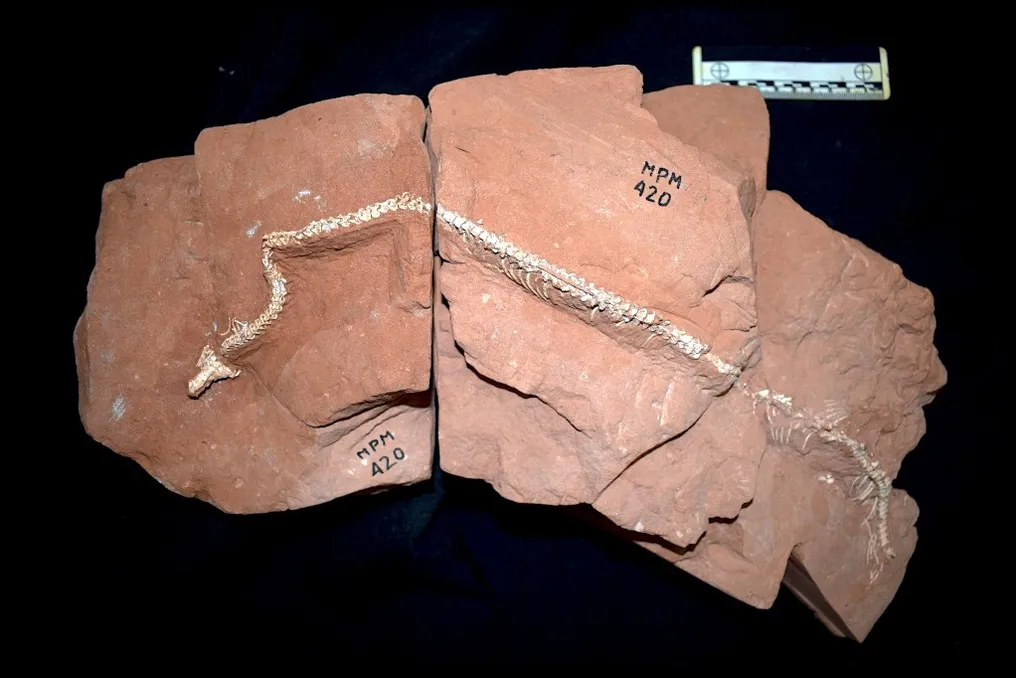
A fossil dated to 80 million years ago suggests that the evolution of snakes does not follow a strictly linear path, challenging previous scientific conceptions.
Discovery in São Paulo
In 2020, a team from the Museum of Paleontology of Marília located the fossil of the species Tametara mirim, an unprecedented snake, in the city of Presidente Prudente, located in the interior of São Paulo. This specimen measured approximately 42 centimeters and lived about 80 million years ago, found in the Adamantina Formation, a set of rocks from the Upper Cretaceous known for containing dinosaur fossils.
Importance of the Preserved Fossil
Due to its antiquity, this snake may offer crucial information for the paleontological debate on the origin of snakes, a topic where divergences persist between theories pointing to marine, subsurface, or terrestrial environments. What caught the scientists' attention was the state of preservation of the Tametara; unlike other snake fossils, which are generally fragmented into dozens of disarticulated bones, this specimen was preserved almost intact, keeping the bones connected. It represents the first Brazilian fossil of a snake with articulated bones.
Anatomical Analysis and Lifestyle
Globally, there are fewer than ten articulated Mesozoic snake fossils, making the fossil record scarce and hindering the investigation into the origin of snakes. After detailed analyses, researchers concluded that the Tametara probably had a subterranean lifestyle. These findings were published on July 22 in the scientific journal Nature.
The studies focused on the snake's skull, as it provides important data about the life mode of these animals. Fossorial snakes are adapted to dig and live underground, exhibiting rigid and reinforced skulls, while terrestrial species show greater cranial mobility. To analyze the internal anatomy without damaging the fossil, researchers used computed tomography, a high-resolution X-ray technique that generates a three-dimensional model. This methodology allowed for a meticulous visualization of the skull's internal structures from various angles.
Skull Characteristics and Comparison
The technique revealed a dense skull, with bone overlaps and an inner ear. Furthermore, the brain presented smaller and less developed regions related to visual processing compared to other snakes of the same period, suggesting that vision was not an essential sense for the animal. These characteristics confirm the traits of fossorial snakes. However, researchers clarified that this does not imply that all snakes originated underground. To test this hypothesis, they applied the same technique to the species Dinilysia patagonica, which lived in the region of modern-day Argentina around the same time as the Tametara. Although neither belongs directly to the lineage of current snakes, both are part of close evolutionary branches.
Evolutionary Conclusion
By comparing the skulls and other anatomical features, the team determined that the Argentine snake likely had a terrestrial lifestyle, without adaptations for the subsurface. This demonstrates that, about 80 million years ago, snakes already inhabited multiple environments and exhibited great ecological diversity. Instead of a single ecological origin, it is plausible that distinct lineages followed separate evolutionary paths early on. The study's authors concluded that the origin of snakes was not determined by a single linear event, as traditionally believed, but rather by recurrent changes in habitat use and sensory ecology, configuring a dynamic ecological history where multiple lineages independently explored fossorial and non-fossorial lifestyles.