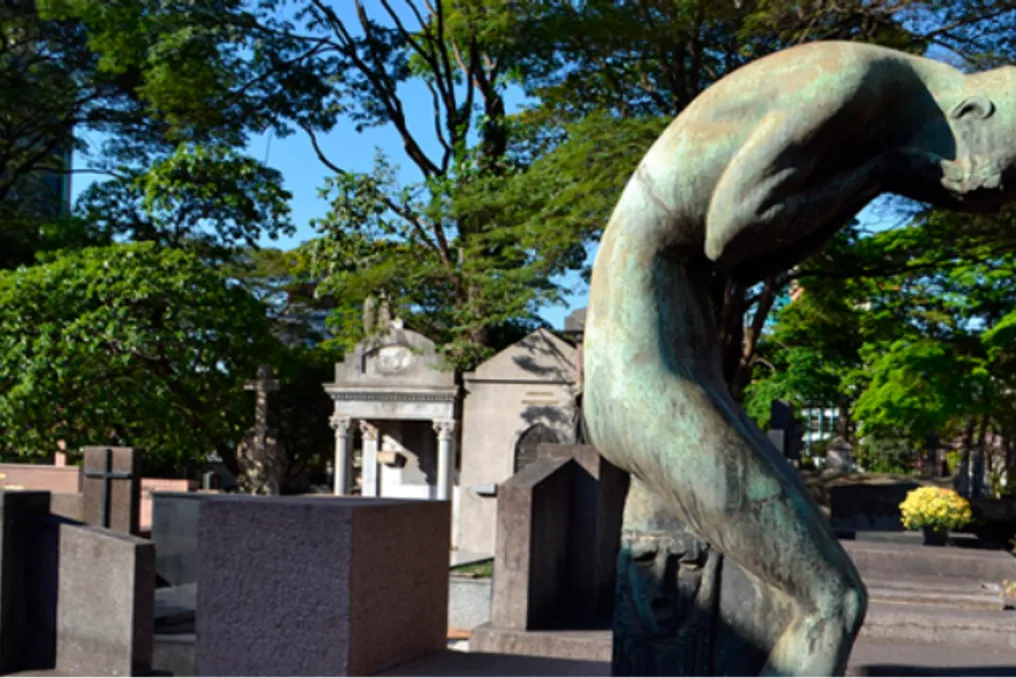
Sesc Consolação will organize the tour titled Brazilian Modern Project in Consolação Cemetery on August 15th. This free activity is part of the 2026 Heritage Journey program.
Sesc Consolação will organize the tour titled Brazilian Modern Project in Consolação Cemetery on August 15th. This free activity is part of the 2026 Heritage Journey program.
The route will be led by art historian Lisa Costa and researcher Victor Vigneron. He is dedicated to exploring how concepts of modernity and national identity in Brazil were shaped, using the history of one of the most relevant cemeteries in the city of São Paulo as a starting point.
During the guided visit, participants will have the opportunity to understand the role played by Consolação Cemetery in the changes that occurred in the urban, sanitary, and cultural areas between the late 19th and early 20th centuries, a period preceding the Modern Art Week of 1922.
The route also emphasizes the participation of artists, writers, and other figures buried there in debates about various projects for the country. By addressing themes such as visual arts, literature, and urbanism, the initiative aims to debate how the notion of a 'modern Brazil' was both constructed and questioned over this period.
The activity is carried out in collaboration with the Historical Heritage Department of the Municipal Secretariat of Culture of São Paulo, as part of the Heritage Journey, an initiative focused on valuing the memory and history of the city through thematic itineraries. Registrations will be available starting July 29th at 2 p.m. on the Sesc portal, limited to 25 spots, filled according to registration order. The meeting will begin at 10 a.m., with a meeting point at 9 a.m. at Sesc Consolação, located at Rua Doutor Vila Nova, 245, Vila Buarque, and is recommended for those over 12 years old.
Maha's story began at birth along with two brothers. Their parents, one a Syrian Christian and the other a Syrian Muslim, moved to Lebanon shortly after meeting to preserve a love that religious differences forbade in their home country.
Maha Mamo told the Lusa agency that in Lebanon, where a woman cannot pass citizenship to her children, there is only the concept that a person is Lebanese if their father is Lebanese. They had no homeland, birth certificates, IDs, passports, or any documents confirming their legal existence, although this did not affect their childhood.
Maha felt different when she became a teenager and was invited to a professional basketball team but could not join. Initially, she thought the reason was her Syrian background, but when a group of students went on a volunteer mission to Jordan and Maha was left behind, she realized this was not the case. The true reason became clear when she tried to enroll in university.
She wanted to study medicine, but the university refused her admission, stating that since she was not Lebanese, she could not study, despite having sufficient grades, because documentation was required. Even numerous services that had always helped her in Lebanon were unsuccessful. Eventually, she enrolled in a private university that did not have a medical course but allowed her to receive a diploma in her name, albeit unofficially invalid. She chose information systems.
From age sixteen, when the internet became widely available, Maha began submitting asylum applications to embassies worldwide, continuing this task for ten years, receiving only rejections. It was only in 2014 that she found hope. During the Syrian refugee crisis, Brazil introduced a special humanitarian visa for this nationality, which was her parents' nationality.
Maha Mamo recalls that someone read her story and suggested that a 'Brazilian way' might exist to help her. Since many refugees at the time had burned documents due to the war, the Brazilian embassy decided that the three brothers could move to this country, where they could obtain new documents. Although none of them spoke Portuguese, knew anyone in Brazil, or anything about the country, they went there, considering it their last hope.
Her parents remained in Lebanon, where her father managed a small truck and could send them money. Thus, their only contact in the new country was with a family from Minas Gerais, where one of her school friends visited once. Maha remembers saying goodbye to her parents on her last day in Lebanon and the uncertainty of starting everything over, having nothing to hold onto.
She said she took eight bags, packing things she wouldn't even think of today. She had never flown on an airplane or traveled, didn't know what to bring, and couldn't imagine what the climate in Brazil was like. The last thing she put in her pocket was a house key, knowing she would never return. That day was a mix of happiness and unhappiness: it was everything she had dreamed of for 26 years, but she was leaving behind everything: her community, friends, family, to go somewhere where she didn't know if there was a pharmacy or a supermarket.
She immediately started looking for ways to obtain Brazilian citizenship and, during this process, found a UN campaign called '#Ibelong'. This showed her that millions of people like her existed around the world, although she thought she was alone. Along the way, she met Bella, who is now her wife, and she told her that the only way was to become a refugee.
Bella, who volunteers for an NGO helping Haitians in Brazil, informed her: 'There is good news and bad news.' The good news was that applying for asylum provided access to basic necessities like healthcare and a driver's license, which was her dream, and also allowed her to work legally. The bad news was that naturalization could take 20 years due to the lack of laws for stateless persons. Maha admitted she was upset but saw light at the end of the tunnel.
Six months later, Bella contacted her about participating in a television documentary, and Maha agreed. This led to a series of conferences and lectures aimed at drawing attention to the issue of statelessness, which she continues to support. When she had been in Brazil for a year and a half, she received refugee status. She expressed joy, noting: 'How sad it is to talk about someone who dreams of becoming a refugee? But for the first time, we had a document.'
However, the revolution did not stop there. A month later, her younger brother died in a robbery. Maha grieved that he died without obtaining citizenship, and noted that since her existence was registered, his death was also nonexistent. She stated: 'What happens when you die without citizenship? Nothing. You are not buried.' Her brother was able to obtain a death certificate as a refugee, and the two sisters decided to bring his body to Lebanon so their parents could say goodbye.
It was at the moment of her brother's disappearance that Maha found herself. She stopped working and doing everything else, focusing on advocacy. She began participating in TV and newspaper interviews, telling her story. The UN started inviting her to events. In 2018, she and her sister became the first stateless persons in Brazilian history to gain citizenship. Since then, she has dedicated her life to this cause and contributed to legislative changes in 13 countries.
Her current goal is to help stateless persons in Portugal, where her sister and mother live. She has given lectures, met with judges, told her story in parliament, and strongly wishes to see the ratification of the new stateless persons status adopted by the President of the Republic earlier this month. Therefore, in August, she is going to Portugal to celebrate her sister's 40th birthday and try to speak with António Jesus Seguro.
Returning to Lebanon for a lecture at her old school, she met a stateless boy, the son of an illegitimate child. This boy, who later became an orphan, was raised by an aunt, a former schoolmate of Maha. This aunt followed her on social media and contacted her. They created a group and started raising funds for the boy's DNA test. Last week, they received confirmation that his grandfather was Lebanese. He does not yet know this. They are waiting for the documents to inform him that he is Lebanese and has citizenship.
Maha acknowledged that many more people need help in Lebanon and in many other parts of the world, as this problem reflects a 'strong lack of maturity and humanity.' She concluded: 'You don't choose where to be born, you don't choose who your parents will be, but no one should have to live without the possibility of existing.'
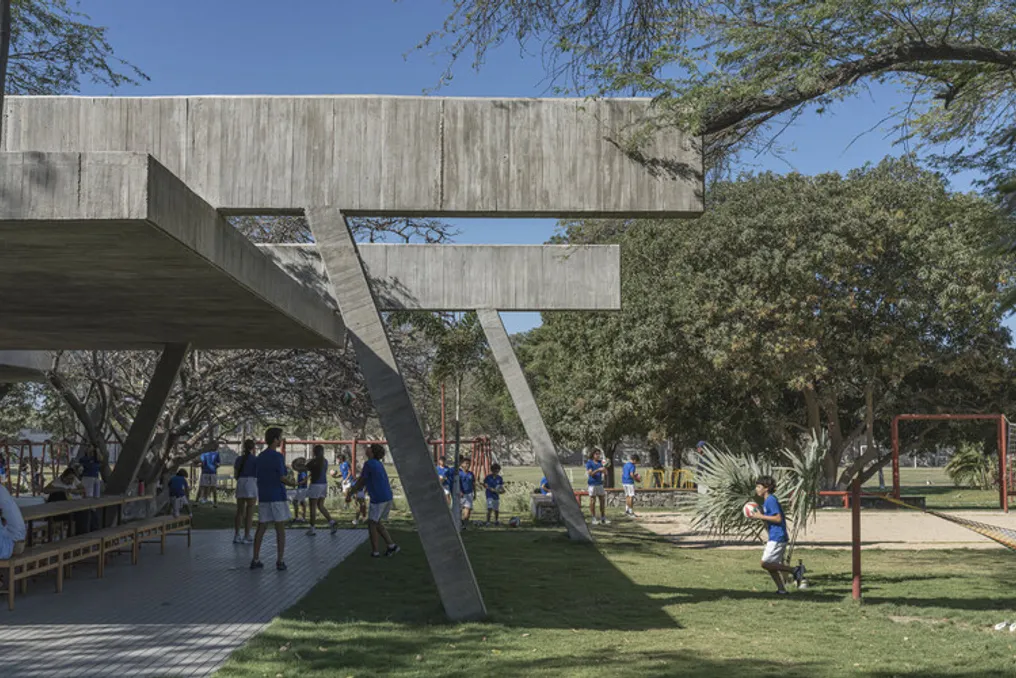
The project presented by the Santa Marta Student Center in collaboration with the Mazzanti Team aims to create an architectural space that deeply integrates with the site, appropriating the environment and dissolving among the trees, recognizing the existing vegetation.
The space's roof was designed to merge with the landscaping, resulting in an environment reminiscent of a grove. In this concept, the architecture not only accompanies but also enhances the natural characteristics of the terrain.
This space was conceived as a place for meeting and interaction, where activities such as resting, dialogue, and playing are presented as complementary methods of learning. Students have the opportunity to explore the outdoor environment in various ways, whether relaxing, swinging, climbing, lying down, or jumping, all immersed in nature.
To support the dynamics of the location, sound and interaction devices were incorporated, which serve both to host events and to create ambient sound and act as a communication channel between students, reinforcing the participatory nature of the project.
The proposal includes a flexible structure, designed to adapt to the existing trees and operate as a network capable of growing and adjusting to the specific conditions of the site. Shade, considered an essential meeting point in the city, gave rise to a space that is simultaneously airy, shaded, and pleasant.
The Student Center organizes various zones designated for studying, meetings, relaxation, meals, and leisure. Furthermore, it incorporates a module containing restrooms and a cafeteria, establishing itself as the main convergence point for the entire student community.