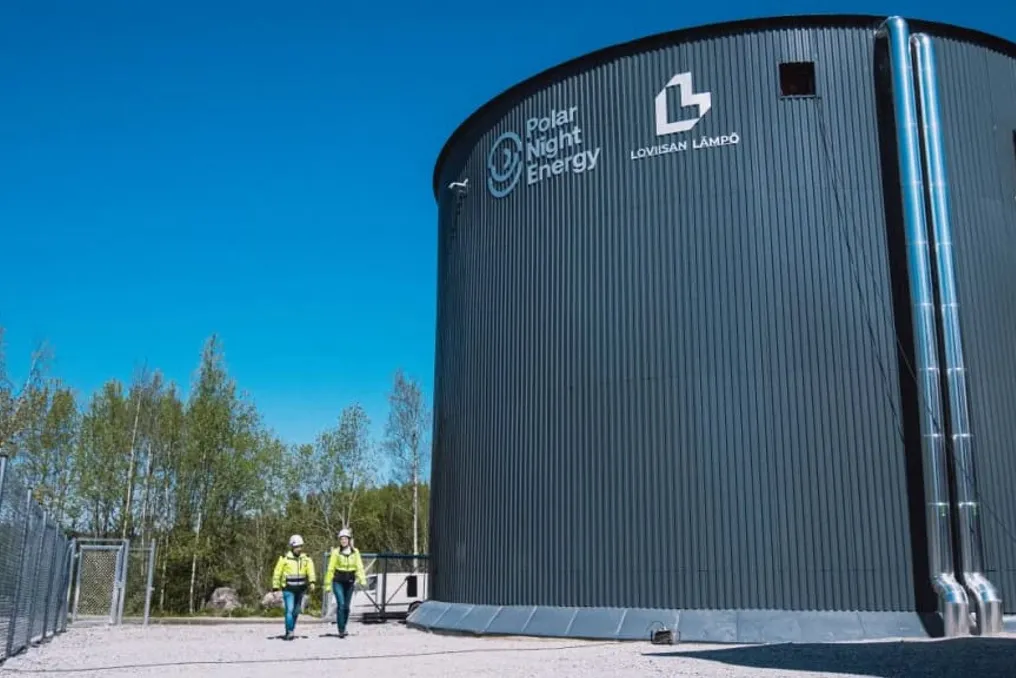
A small locality in southern Finland has adopted the world's largest commercial sand battery, aiming to mitigate one of the biggest challenges of the energy transition: the intermittent nature of renewable energy sources. This installation is located in Pornainen, a municipality with a population of five thousand, and was conceived by Polar Night Energy in collaboration with the local district heating distributor, Loviisan Lämpö.
Battery Structure and Capacity
The structure measures 13 meters high by 15 meters wide. Inside, two thousand metric tons of crushed soapstone are stored, which retains clean energy in the form of heat. This capacity totals 100 megawatt-hours of thermal energy, enough to cover almost a month of the city's heating needs during the summer and about a week during the winter period.
Storage System Operation
The system operates in three distinct phases. Initially, the facility absorbs electricity from the grid when there is a high availability of energy generated by solar or wind sources. Subsequently, this electricity is used to raise the temperature of the soapstone to very high levels. Finally, the highly insulated silo maintains this heat for several days or weeks, releasing it through heat exchangers to warm the water destined for the local district heating network.
Annette Höglund-Dönnes, Commercial Director of Polar Night Energy, explained the mechanism to CNBC, comparing it to a large silo. She emphasized that the difference lies in the time interval the sand provides between electricity consumption and steam usage. According to her, this interval represents a significant commercial advantage because it allows heating the sand when electricity is cheaper and using the steam when production from the grid would typically be costly, such as during the day when overall consumption is high. She drew an analogy to charging a mobile phone at night, when costs may be lower than during the day.
Benefits for Pornainen
Before the implementation of the sand battery, Pornainen relied on burning oil and wood chips for heating. Tommi Eronen, CEO of Polar Night Energy, reported that thanks to the new installation, the city receives heating without the need for combustion most of the year. The company stated that the project resulted in a reduction of nearly 70% in greenhouse gas emissions from the heating network and about 60% in the use of wood chips. A pre-existing wood chip power plant continues to operate as a contingency system and to cover peak demand.
Mikko Paajanen, CEO of Loviisan Lämpö, commented to CNBC that the battery allows the decoupling of electricity purchasing from the district heating generation process, thus enabling efficient utilization of low spot market prices. The company set a goal to produce between 55% and 60% of the municipality's district heating using the sand battery in the first months of this year, compared to approximately 30% planned for 2025. The venture started last year and is ten times larger than a previous version inaugurated in the country in 2022.
Technological Potential and Limitations
Eronen stressed that the transition from large power plants to sources like solar and wind requires a considerable amount of energy storage. He expressed hope that much of this storage could be achieved through the sand battery method, as it does not require rare earth materials, unlike many chemical batteries, such as lithium-ion batteries. Jan Rosenow, Professor of Energy and Climate Policy at the University of Oxford (UK), corroborated that electrothermal storage technologies, such as sand batteries, have the potential to be replicated globally.
Rosenow added that these technologies dispense with rare earths or critical raw materials, allowing the battery to be charged when electricity is accessible and discharged when heat is needed. Furthermore, he pointed out that storage can occur over long periods—days or even weeks—surpassing the limitations of a few hours observed in lithium-ion batteries. Despite the great potential, the technology faces significant criticism, including the difficulty of reconverting stored heat into electricity with high efficiency and its relatively low energy density compared to conventional batteries.
Höglund-Dönnes reported that Polar Night Energy has received inquiries from teams from 'all continents', notably from communities that rely on fossil fuels such as coal and oil. Sari Multala, the Finnish Minister for the Environment, described the Pornainen project as a 'very inspiring' example of a solution to the energy storage challenge. She mentioned that during her visit to the installation's inauguration, she understood that the company is also developing solutions for direct electricity use in the future, something she said 'would be revolutionary and that many people would value.'