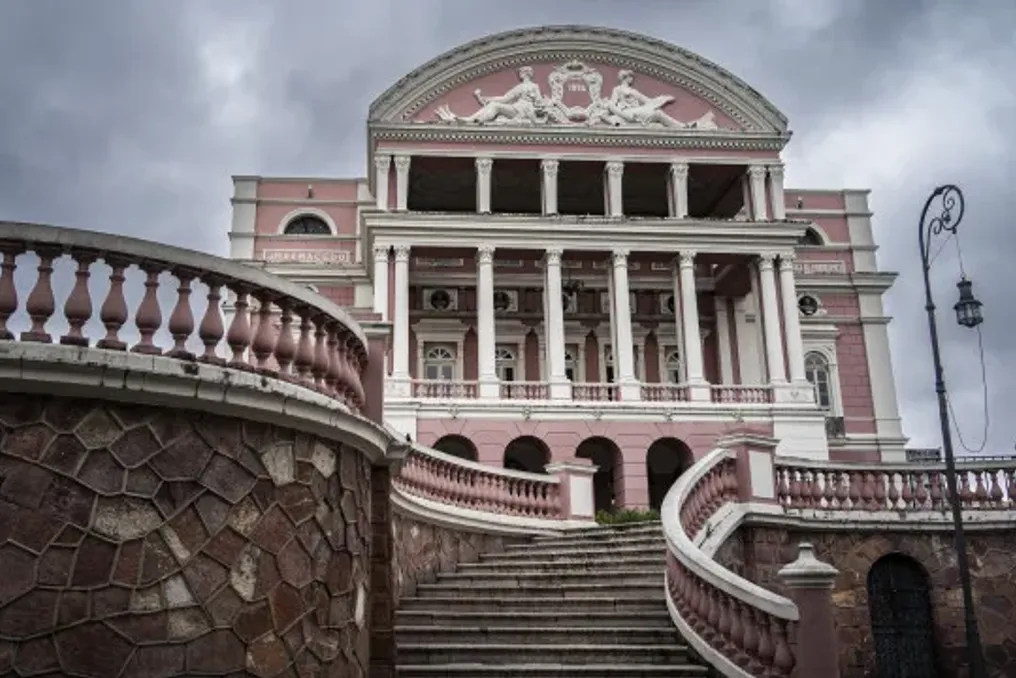
Brazil celebrated UNESCO's recognition that classified the architectural complex formed by the Amazonas Theater, dating from 1896, in Manaus, and the Theatro da Paz, from 1878, in Belém, as world heritage sites.
History and Classification
These two opera houses, located in the states of Amazonas and Pará, in the North region of Brazil, had already been classified as Brazilian cultural heritage by the National Institute of Historic and Artistic Heritage (Iphan) since 1960.
With UNESCO's approval, the two historic buildings are now jointly listed on the organization's register under the denomination 'Theaters of the Amazon,' alongside other Brazilian sites already recognized as World Cultural Heritage.
View on the Recognition
Deyvesson Gusmão, president of Iphan, emphasized that UNESCO's endorsement strengthens 'the essential dimension of the Amazon' and honors Amazonian society. In a comment to Lusa, he stated that the UNESCO seal not only recognizes the historical and economic relevance of the construction period but also projects these values into the present, highlighting the current significance of the Theaters of the Amazon for Amazonian society, Brazil, and the world.
Gusmão detailed that this recognition reinforces that the Amazon has a fundamental dimension: it is nature, but also a territory rich in culture, memory, creativity, and heritage, whose human wealth is intrinsically linked to its biodiversity.
Cultural and Economic Context
The Ministry of Culture informed that the theaters represented a common project of urban modernization and the integration of the Amazon region into global cultural and commercial markets, being considered some of the first major opera houses in the Americas and attracting European companies for performances in Belém and Manaus.
According to the Ministry, although conceived by an elite influenced by the ideals of the Belle Époque and built by local workers, the theaters evolved beyond the initial intention of the founders. Over time, these spaces came to host various manifestations of Brazilian popular culture, ranging from carimbó to jazz, from boi-bumbá to cinema, consolidating themselves as civic and cultural landmarks of the two cities and constituting the first World Cultural Heritage site in the North Region of Brazil.
Origin and Influences
Both constructions were erected at the end of the 19th century in the two largest urban centers of the Amazon, using resources generated by the peak of rubber exploitation. Global demand for latex transformed the region into an important economic hub for Brazil, enabling the replication of European architectural and cultural refinement in the tropics.
The logistical difficulty of erecting such structures in an isolated area, surrounded by the jungle, where almost all materials had to be transported by waterway after crossing the Atlantic and traveling up the Amazon River, served as inspiration for the famous German film 'Fitzcarraldo' (1982).
List of Brazilian Heritage Sites
In total, the list includes 16 cultural assets, nine natural assets, and one mixed asset site. Among the cultural ones are the historic center of Ouro Preto, in Minas Gerais (recognized in 1980), the historic center of Olinda (1982), the historic center of Salvador (1985) in the Bay, and the Pilot Plan in Brasília (1987).
In the category of natural assets, there are the Pantanal conservation area (2000), the Central Amazon conservation area (2000), and the Lençóis Maranhenses National Park (2024).
The last time UNESCO recognized a Brazilian site as world heritage was in 2025, with the Peruaçu River Canyon, in Minas Gerais, and Paraty and Ilha Grande, both in Rio de Janeiro, under the title 'Culture and Biodiversity.'