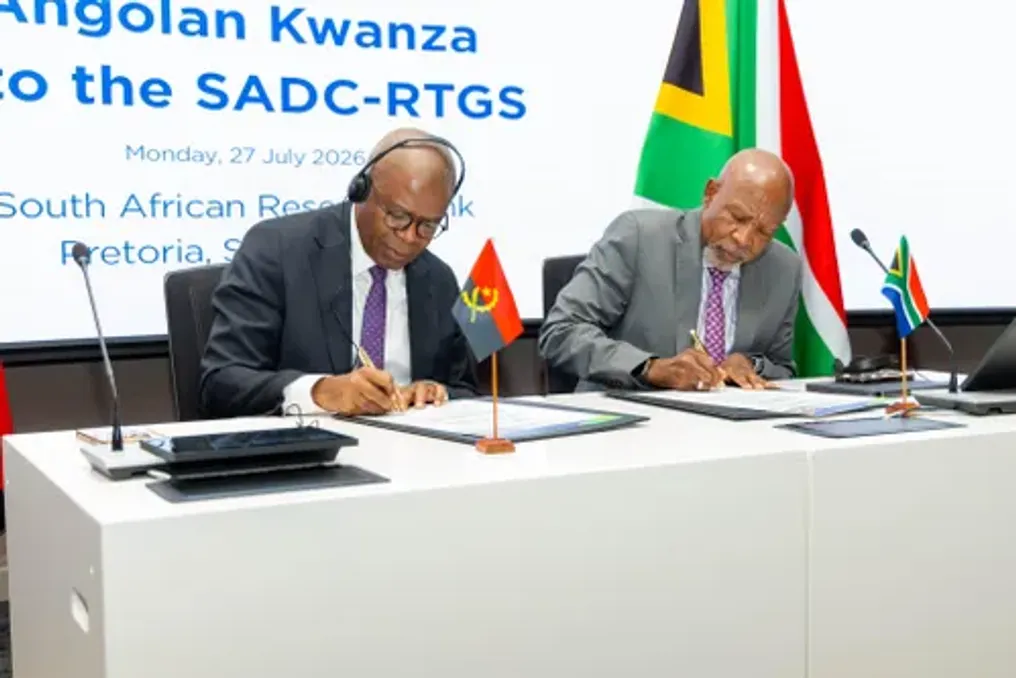
The Angolan Kwanza has been officially introduced as a settlement currency in the South African Development Community's (SADC) real-time clearing system (SADC-RTGS). This marks a significant step towards deepening financial integration in the region and enhancing the efficiency of cross-border trade.
Announcement and Integration Goals
This was announced by the Governor of the South African Reserve Bank (SARB), Lesetja Kganyago, who also chairs the SADC Central Bank Governors' Committee, alongside the Governor of the Bank of Angola, Manuel Tiago Dias. The inclusion of the Kwanza aims to modernize regional payments and aligns with the G20's objectives for faster, cheaper, and more efficient cross-border settlements.
Kganyago emphasized that adding the Kwanza supports efforts to modernize regional payments and is consistent with G20 goals to improve the efficiency of international transactions. He noted that this is not merely the addition of another settlement currency but a practical step toward creating a more integrated, connected, and trade-supporting ecosystem for investment, financial stability, and overall prosperity in South Africa.
Details of the SADC-RTGS System
Since its launch in 2013, the Kwanza has become the second settlement currency in the SADC-RTGS system, previously serviced solely by the South African Rand. Currently, the regional payment platform serves 15 SADC member states. SADC-RTGS, formerly known as SIRESS, is an automated real-time interbank clearing system within the SADC region, managed by SARB on behalf of participating SADC central banks.
Central banks and financial institutions, including banks and non-bank organizations in the SADC region authorized by their respective central bank, participate in SADC-RTGS. Allowing direct settlement in the Kwanza will enable businesses and financial institutions to rely less on foreign currency conversion when conducting transactions in Angolan currency, which is expected to reduce transaction costs and increase payment efficiency for companies trading in the region.
Expansion Strategy and Economic Impact
SARB stated that this move is part of a broader strategy to expand the multi-currency functionality of the system, with plans to introduce additional regional currencies in the future, including the Botswana Pula. The central bank noted that ensuring multi-currency capability in SADC-RTGS is a strategic initiative to strengthen regional financial integration, encourage greater use of local and regional currencies in cross-border trade, and reduce dependence on non-SADC currencies.
According to SARB, the wider use of regional currencies will simplify trade for businesses in SADC markets and improve cash flow through accelerated cross-border transaction clearing. The SADC-RTGS system, marking 13 years of operation this month, processes approximately 250.7 billion Rand transactions monthly and is managed by SARB on behalf of the SADC Central Bank Governors' Committee. In 2025, trade and interbank transactions between Angola and the other 14 SADC member states reached approximately USD 3.77 billion across nine currencies, with South Africa accounting for nearly USD 2.99 billion of these flows, representing about 60% of the transaction volume and 79% of its total value.