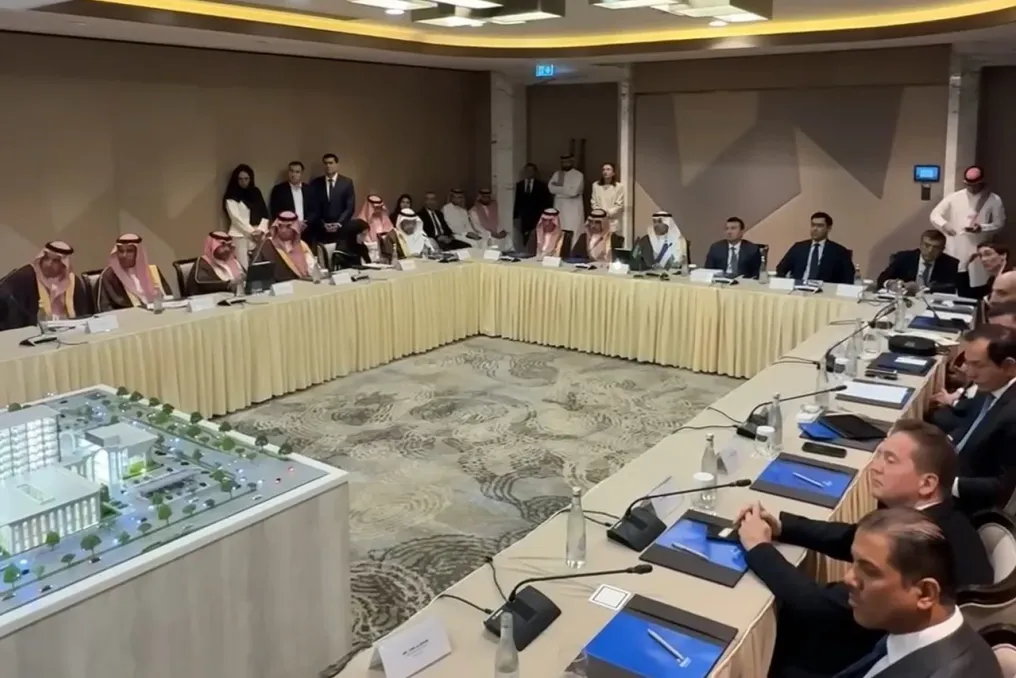
Uzbekistan intends to build a modern multi-purpose hospital with a capacity of 800 beds in the Fergana region. The implementation of the Fergana Hospital project will be carried out within the framework of public-private partnership.
Uzbekistan intends to build a modern multi-purpose hospital with a capacity of 800 beds in the Fergana region. The implementation of the Fergana Hospital project will be carried out within the framework of public-private partnership.
The Saudi company Vision International Investment Company will participate in the project, with the total investment amount estimated at approximately 300 million US dollars. The project presentation took place with the participation of Deputy Prime Minister of Uzbekistan Jamshid Khodjayev and a delegation from Saudi Arabia led by Minister of Health Fahad bin Abdulrahman Al-Jaladjel.
According to the agreements reached, the project will cover all stages: design development, financing, construction, equipment, and long-term technical maintenance of the hospital in accordance with international standards. It is expected that construction work will take 36 months.
The new medical center will combine five specialized medical institutions in the Fergana region, expanding access for residents of the region and adjacent territories to high-tech tertiary medical care. The hospital will have departments of cardiothoracic surgery, neurosurgery, organ transplantation, nephrology, and orthopedics.
The complex will also include intensive care and emergency medical care departments with a total capacity of 160 beds, as well as necessary auxiliary clinical services. Fergana Hospital is expected to become one of the largest medical facilities in Central Asia implemented through the PPP model. During the presentation, representatives of Uzbekistan and Saudi Arabia discussed further opportunities for implementing this project.
In laboratory investigations, venoms extracted from snakes of the genus Bothrops demonstrated the ability to reduce the viability, reproductive capacity, and locomotion of the parasite Schistosoma mansoni, one of the agents causing schistosomiasis. This scientific finding may support the development of new drugs to combat the disease.
Schistosomiasis is classified as the second most prevalent tropical disease globally, affecting approximately 200 million individuals, behind only malaria. The condition, which presents acute and chronic manifestations, is caused by trematode worms belonging to the genus Schistosoma. The visceral form, popularly known as 'water belly,' affects regions of Latin America and Sub-Saharan Africa through the worm Schistosoma mansoni, the focus of this study.
Currently, praziquantel is the only available treatment for the disease, and it is used preventively in endemic areas. However, the widespread use of this drug can generate selective pressure, favoring the emergence of parasitic strains that are less sensitive or resistant to therapy.
Murilo Sena Amaral, the study leader and researcher at the Butantan Institute, points out that the reduction in S. mansoni sensitivity to praziquantel is already observed in laboratory strains and in certain populations, where patients require higher doses to achieve a cure. This suggests a high risk of developing resistance in real populations, making the search for therapeutic alternatives urgent.
For this research, venoms from eight Brazilian species of the genus Bothrops were collected, including jararaca (Bothrops jararaca), caiçaca or cerrado jararaca (Bothrops moojeni), jararacuçu (Bothrops jararacussu), northern jararaca (Bothrops atrox), red jararaca (Bothrops brazili), cotiara (Bothrops cotiara), white-tailed jararaca (Bothrops leucurus), and spotted jararaca (Bothrops neuwiedi). The objective was to identify which vital processes of the parasite could be affected by these toxins and which non-coding long RNAs were involved. These RNAs have crucial regulatory functions, such as reproduction and physiological balance.
When adult worm pairs were exposed to low doses of the venoms for 24 hours, it was found that the venom of B. moojeni had the greatest impact, decreasing locomotion, attachment, and viability, in addition to almost completely stopping egg laying. The venom of B. jararacussu significantly reduced egg production.
After incubation with these two venoms, the genes expressed by male and female worms were sequenced separately. The analysis revealed a systemic collapse in males, who showed a much higher number of affected genes compared to females. The altered genes in males are linked to vital functions such as cell division and nerve impulse transmission, while in females, expression differences occurred in genes related to more specific processes, such as reproduction.
The researchers suggest that males may be more vulnerable to the mode of action of these venoms, possibly due to their larger size and greater exposure to the external environment during mating, or due to differences in tegument composition compared to females.
This study represents a phase of basic research aimed at identifying new therapeutic targets. Subsequent steps include deepening the understanding of the function of these RNAs in parasite biology. Subsequently, it will be necessary to design synthetic molecules capable of targeting these RNAs and inhibiting their essential functions. After success in the laboratory, these potential drugs must undergo functional tests in living organisms and, finally, rigorous clinical trials in humans before being made available to the public.
Marina Zenga Carrenho and Agatha Fischer Carvalho, undergraduate students from the Institute of Biosciences (IB) at USP, are the first authors of the article. Murilo Sena Amaral, the study leader, is a researcher at the Butantan Institute. The team also included the participation of Sergio Verjovski Almeida, senior professor at the Institute of Chemistry (IQ) at USP and researcher at the Cellular Cycle Laboratory of the Butantan Institute, and Solange Serrano, a researcher at CeTICS of the Butantan Institute.
The feeling of exhaustion mid-year goes beyond ordinary tiredness. Professionals, parents, and entrepreneurs across South Africa feel overwhelmed by overflowing inboxes and constant mental activity. This mid-year slump is a viral phenomenon that cannot be cured by a simple long weekend.
South Africans are experiencing a strong wave of fatigue—a state where one is simultaneously 'on but tired.' Anya van Beek, a leadership strategist and workplace coach, explains that this phenomenon has both biological and human roots.
Since life in the Southern Hemisphere means mid-year coincides with winter, shorter daylight hours and reduced sun exposure lead to lower serotonin levels and increased melatonin, causing natural lethargy. Van Beek notes that bodies react according to nature, yet people continue to expect performance levels characteristic of spring.
The nervous system registers expended effort. The motivational boost from January helped navigate the first and second quarters, but six months of continuous adaptation, problem-solving, and active engagement take a significant toll. The result is a 'recovery debt'—a biological deficit that occurs when expended energy consistently exceeds recovered energy.
This debt accumulates through daily habits: sleeping an hour less to check emails, combining work with lunch under the guise of multitasking, being constantly available on messengers after work hours, and skipping workouts or postponing deserved vacations.
The brain relies on dopamine, which is stimulated by achieving new goals in January. By July, novelty disappears: projects drag on, routine becomes monotonous, and the gap between January expectations and July reality leads to emotional burnout, self-criticism, and cognitive fatigue.
By mid-year, the 'stress reservoir' is full. Managing work changes, personal finances, family care, and absorbing societal uncertainty creates an invisible cognitive load. Difficulty concentrating or irritability over minor issues does not indicate decreased resilience, but complete mental exhaustion.
Attempts to combat burnout often focus on improving calendar planning, but time management is meaningless without energy management. High-drain factors, such as unresolved conflicts, back-to-back meetings, perfectionism, and endless notifications, deplete the battery by midday.
Many professionals take short five-day breaks but return to work with the same level of fatigue. Van Beek emphasizes that six months of depletion cannot be compensated for in five days. True recovery requires complete psychological detachment from work, quality sleep, meaningful connections, movement, and rest, rather than just changing workplaces.
For many working adults, especially women, fatigue extends beyond the office. Many belong to the 'sandwich generation,' simultaneously supporting growing children and caring for elderly parents. Coordinating medical appointments, managing household logistics, and providing emotional support while maintaining a career causes immense cognitive overload.
It is important to understand that mid-year fatigue does not signify failure, insufficient commitment, or inability. It is merely proof that for a long time, a person has carried heavy responsibilities without enough time for recovery. Before moving into the third quarter, it is necessary to pause and conduct a self-assessment:
Physically: How are sleep, nutrition, and daily activity?
Mentally: Where is cognitive overload occurring? What boundaries need to be set?
Emotionally: Which unresolved stresses or relationships require attention?
Energetically: What is currently giving energy, and what is draining it?
Achieving sustainable productivity should not be an individual feat. It is necessary to allow oneself to shed some burden, set time limits, and seek help where it is most needed.
Uzbekistan President Shavkat Mirziyoyev met with a delegation from Saudi Arabia, headed by Minister of Health Fahad bin Abdulrahman Al-Jaladjel, on July 28. The purpose of the meeting was to discuss issues of medical cooperation and prepare for the launch of new joint projects.
At the beginning of the negotiations, the minister conveyed greetings and best wishes to the Uzbek President from the King of Saudi Arabia, Salman bin Abdulaziz Al Saud, as well as from the Crown Prince and Prime Minister Mohammed bin Salman Al Saud.
The parties noted the active development of bilateral interaction in recent years. The successful implementation of major joint projects with the Saudi company ACWA was emphasized.
During the visit, discussions were also held with leaders of leading Saudi companies, which led to the conclusion of relevant agreements. The main focus of the meeting was on the digitalization and modernization of Uzbekistan's healthcare system, the regulation of the pharmaceutical sector, and the training of qualified specialists. Additionally, the construction of a multi-profile clinic in Uzbekistan was discussed.
As a result of the negotiations, the parties agreed to develop and adopt a 'roadmap' that will define the plan for implementing new initiatives and joint projects.