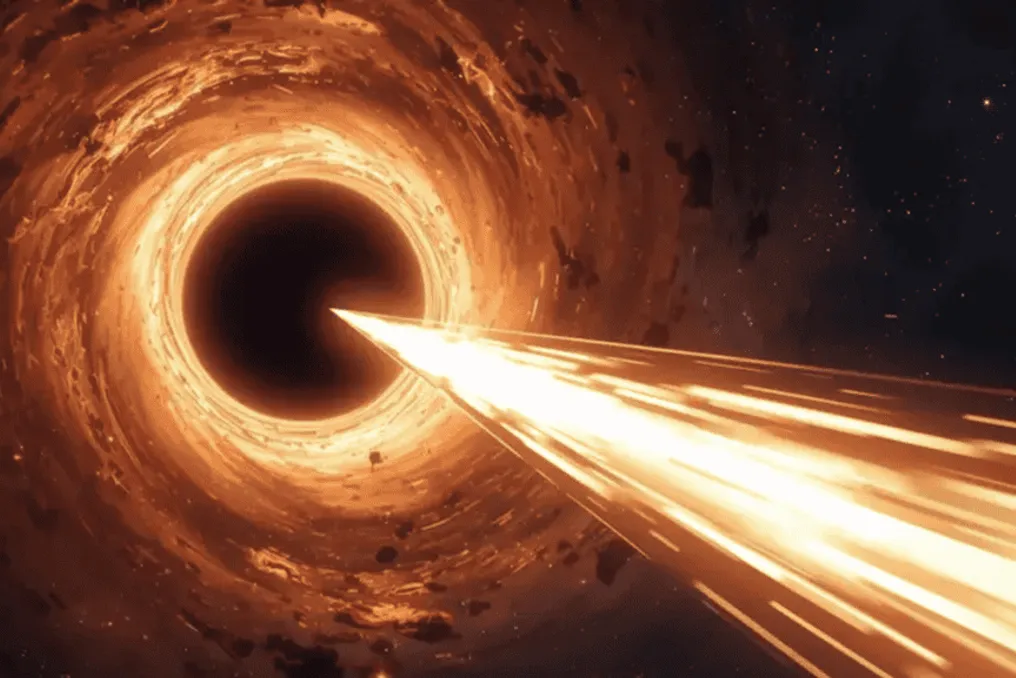
A recent study has reignited the possibility of a space mission aimed at one of the universe's most extreme objects—a black hole. The proposal suggests exploring how a small probe could reach such a celestial body and gather data directly from its vicinity.
Research Concept and Goals
This scientific work was developed by astrophysicist Cosimo Bambi from Fudan University in Shanghai and published as a preprint on the arXiv platform in July 2026. The research evaluates an alternative approach based on a laser-accelerated microprobe capable of traveling at interstellar speeds.
The initial phase depends on finding a suitable target. Although black holes are known within the galaxy, the nearest one is approximately 1,560 light-years from Earth, making travel with conventional means impractical.
Distinction Between Observation and Physical Visitation
These more than a thousand light-years might seem small compared to exoplanets and galaxies that astronomers study millions or billions of light-years away from Earth. However, there is a fundamental difference: these distant objects are only observed indirectly, through light reaching our telescopes. Reaching a black hole, conversely, would require the physical movement of a craft over a vast distance, which clashes with limitations in speed, flight time, communication, and equipment durability, rendering the mission impossible with current technologies.
Searching for the Invisible Neighbor
Calculations presented in the study indicate that there may be around 100 million stellar-mass black holes in the Milky Way. Of these, about 92% remain isolated, lacking a companion star that could reveal their presence. This characteristic complicates identification, as many do not emit their own light and remain hidden from standard observation methods. Nevertheless, the study suggests that some of them might be detectable through radiation generated when matter is captured while passing through nearby interstellar clouds.
The statistical assessment proposed by Bambi suggests that an isolated black hole might exist within 20–25 light-years of the Solar System. If such an object were found, it would become a potential candidate for a long-term scientific mission.
Laser Pulse Technology
Traditional rockets are not a viable option for achieving this goal, as the time required to traverse interstellar distances with this technology could amount to thousands of years, necessitating a completely different approach. The considered alternative involves a solar sail made of material that effectively reflects light, propelled by a powerful laser system. The concept envisions a structure consisting of a small electronic unit containing scientific instruments, orientation, and communication systems, attached to a sail measuring about 10 square meters.
According to the work, this combination can accelerate the probe to approximately one-third the speed of light in just 17 minutes. The flight to a black hole located 20–25 light-years away would take six to seven decades. Difficulties increase upon approach. The proposal does not include a mechanism to slow the craft before approaching the black hole, so the probe must make only a quick pass through the system, recording information during the trajectory and transmitting data back to Earth.
Since data transmission is also limited by the speed of light, the return of information would add another two or three decades to the schedule. In fact, the entire mission could last from 80 to 100 years, exceeding the lifespan of the researchers who planned it.
Current Limitations and Prospects
Despite the scientific potential, this proposal is still far from operational reality. Creating a device weighing only a few grams, capable of surviving decades in deep space, operating at high speed, and transmitting data across tens of light-years, exceeds current technological capabilities. Similarly, the necessary infrastructure to impart momentum to the craft is missing. A system of space lasers powerful enough to accelerate such a sail does not yet exist. Furthermore, one project aiming to develop similar technologies, Breakthrough Starshot, concluded in September 2025.
Nevertheless, researchers believe that obstacles can be overcome through gradual progress. Research groups are already working on solutions for propulsion systems, instrumentation, and communication, and an international conference on the topic is scheduled for 2027. The realization of a mission to a black hole will thus depend on two parallel achievements: finding a sufficiently close target and developing technologies capable of transforming the theoretical proposal into actual reconnaissance.
}))