In a New York park stands a tree that carries a history connected to space. The young specimen originated from a seed that traveled around the Moon during NASA's Artemis I mission before returning to Earth and growing in Manhattan.
In a New York park stands a tree that carries a history connected to space. The young specimen originated from a seed that traveled around the Moon during NASA's Artemis I mission before returning to Earth and growing in Manhattan.
This specimen, located in Madison Square Park, is part of a new group of 'lunar trees' created from seeds that participated in space missions. These trees help the public better understand NASA's plans to return to the natural satellite.
A small specimen of American sweet gum, a variety of American liquidambar, grew from one of the thousand seeds sent by NASA as part of the Artemis I mission in 2022. It traveled approximately 2.09 million kilometers before taking root in New York.
An unmanned capsule orbited the Moon during tests for the Artemis program, which prepares future crewed missions, including plans for human landings on the lunar surface.
Steph Lucas, Director of Horticulture at Madison Square Park Conservancy, requested the sapling from NASA in 2023. The request was approved in 2025, and the tree quietly grew for a year before being officially presented to the public. Lucas shared her excitement about this event with Space.com.
The history of lunar trees dates back much further. In 1971, astronaut Stuart 'Smokey' Russe took about 500 seeds with him during the Apollo 14 mission. After returning, these seeds gave rise to trees that were distributed in parks, botanical gardens, and historical sites around the world.
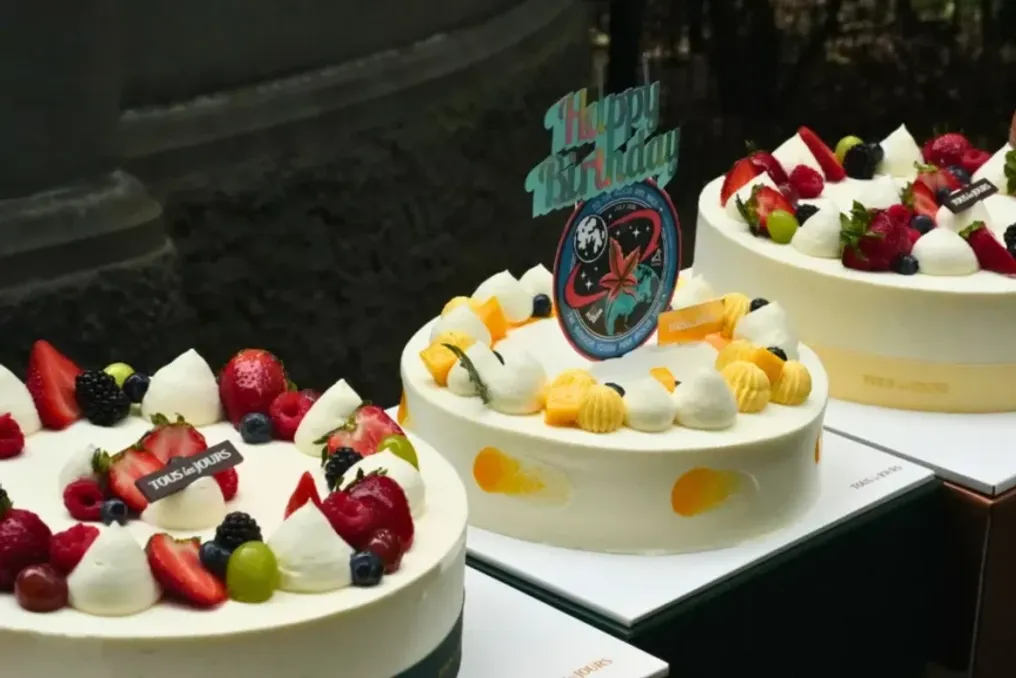
The new tree in New York celebrated its birthday with a space-themed party. The event included a universe-inspired garden, poetry readings, a children's drawing exhibition, foam rockets, and a cake for about a hundred people.
However, the celebration faced an unexpected circumstance: smoke from Canadian wildfires reached the city, coloring the sky orange and worsening air quality. Some attendees used KN95 masks for protection.
Of five tree species proposed by NASA, Lucas chose the American sweet gum. This choice drew attention because, although it is less cold-tolerant than other available species, it is capable of better adapting to expected climatic conditions in the coming decades. Steph Lucas told Space.com that she considers it the best choice for the evolving future.
The tree symbolizes the curious link between space exploration and environmental conservation. Among the features of this specimen: the seed traveled around the Moon during the Artemis I mission; the sapling is part of a new generation of NASA lunar trees; the tradition began with the Apollo 14 mission seeds; the project unites science, space, and nature.
After a year of growth, the tree has firmly rooted and developed without the need for supports. For Lucas, observing this development is a source of hope, as the director stated, 'Space inspires us, right? And plants can inspire too.'
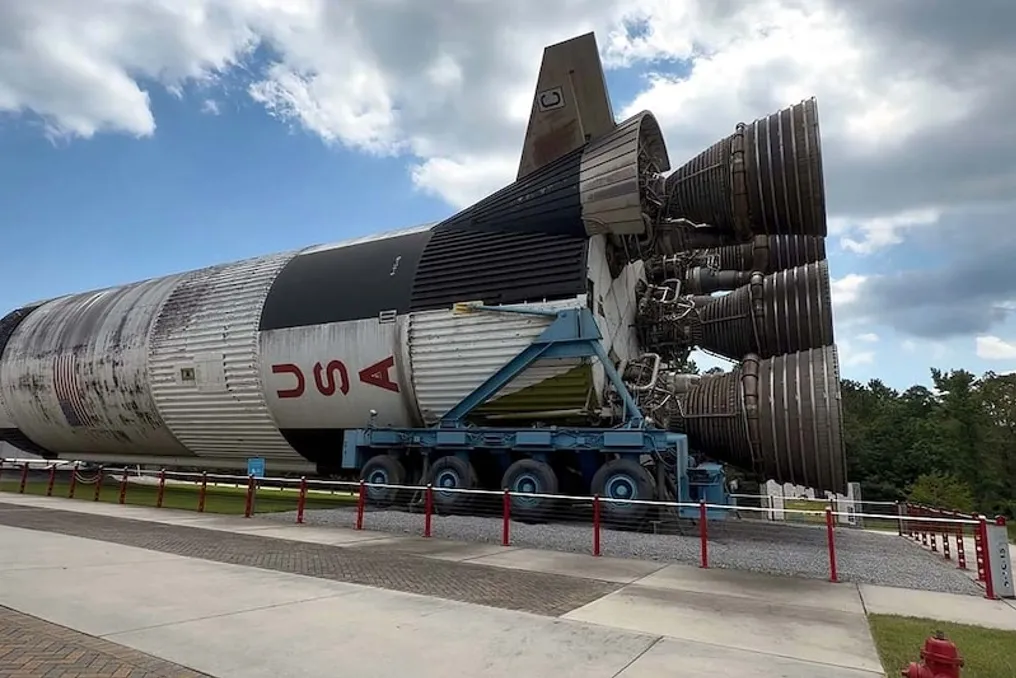
The Stennis Space Center in Mississippi, USA, houses exhibits including rockets, space modules, and spacesuits used in the first manned lunar mission. This center is one of the largest scientific laboratories, surrounded by an extensive buffer zone of about one hundred fifty thousand acres of dense forest.
Stennis Center is a repository of humanity's greatest space achievements. Visitors can see launch observation platforms and countdown clocks. Although it is quiet today, the massive F-1 engine from the Saturn V rocket, which once could reach temperatures of 3000 degrees Celsius, was the source of power that launched the rocket into orbit and delivered humans to the Moon.
The night of July 20, 1969, marked Neil Armstrong's step onto the surface of the Moon, after which Buzz Aldrin and Michael Collins landed on the Moon and continued orbiting in the command module. Although the Apollo 11 mission launched from the Kennedy Space Center in Florida, the foundation of this success was laid precisely at the Stennis Center in Mississippi.
It was here that the powerful F-1 engines of the Saturn V's first stage were repeatedly tested at full power to eliminate any errors in space. Five Rocketdyne F-1 engines propelled the Saturn V rocket to an altitude of about 70 km and a speed of 9800 kilometers per hour in approximately two and a half minutes. The S1c first stage of the Saturn V rocket was assembled in New Orleans and transported to the Stennis Center by river on special cargo ships.
To test the engines, NASA acquired about 13 thousand acres of land, creating a total acoustic buffer belt of about 125 thousand acres. It is hard to imagine how this area shook from the roar of the most powerful rocket engines. Currently, a sign reading 'Testing in Progress' is installed at the test site, located about 9 kilometers from the engine, indicating ongoing rocket engine tests.
While visitors could previously view the test sites and rocket stands through tours, access to these areas for the general public is temporarily closed due to heightened safety requirements and the sensitivity of technical operations. Stennis carries a legacy not only of the Apollo missions; future spaceflights are also being prepared here, such as testing RS-25 engines for the Artemis-II mission. Thus, the Stennis Center remains a pulsating heart of space operations, connecting the history of Apollo with the future of Artemis six decades later.
During the Apollo program, the Stennis Center tested 27 stages of the Saturn V rocket. Each such test firing was preparation for a historic mission that wrote the most memorable chapter in human history. The story of reaching the Moon began not at the launchpad, but through countless tests where engineers overcame all difficulties.
The Saturn V rocket stood 363 feet tall, equivalent to a 36-story building, and weighed about 2.8 million kilograms, comparable to the weight of approximately 400 elephants. For the launch of this giant rocket, five F1 engines were installed on the first stage of the Saturn V, generating a total thrust of about 7.5 million pounds. One such engine weighed approximately 8400 kilograms and was an engineering marvel measuring 18 feet high and 12.5 feet wide.
In the 1960s, the Saturn V was not just a rocket but the most ambitious engineering project of its time, costing about $18.5 billion USD, which corresponds to approximately $1.7–2 billion today. This project was made possible by the joint work of about four hundred thousand scientists, engineers, and technicians under NASA's leadership, as well as the cooperation of companies such as Boeing, North American Aviation, Douglas Aircraft, and Rocketdyne. The team of Marshall Space Flight Center and Wernher von Braun played a key role in realizing this dream.
At the Stennis Center, one can feel the atmosphere of the Apollo mission. Interactive displays, models, and documentaries demonstrate how a journey that started as an idea led to the creation of the rocket, its complex tests, and finally, the first step of a human on the Moon. The spacesuit prepared for Neil Armstrong and real moon rocks brought back from the Moon bring this history to life right before your eyes. This space center not only preserves the history of astronautics but also inspires future generations toward scientific aspirations and dreams.
The recent detection of a sugar molecule in the interstellar medium could be a significant step forward in understanding the chemical evolution of the Milky Way and the origin of life on Earth. The presence of erythrose—a four-carbon sugar—was recorded in deep space in the scientific journal Nature Astronomy.
According to the National Observatory (NO), this discovery is the result of research in astrobiology—the science that studies the emergence, evolution, and distribution of life in the Universe. This topic will be discussed at the VI National Observatory School of Astrobiology (AstrobiON), which will take place from September 14 to 17. Registration for the event is open until September 4.
Marcelo Borges Fernandes, a researcher at the National Observatory and coordinator of the VI AstrobiON, emphasized that this discovery strengthens the importance of astrochemistry for comprehending the genesis of life. He noted that the detection of complex chemical components in deep space is directly related to the goals of astrobiology and the content being prepared for this AstrobiON session.
According to Fernandes, the goal of the school is to bring students and researchers up to date with the latest data on this topic. He added that they want to demonstrate how astrochemistry and the evolution of the Milky Way are linked to the appearance of life in space, inviting participants to discuss these new frontiers.
The identified molecule is erythrose, a sugar composed of four carbon atoms. Although this substance is known on Earth due to its presence in berries such as raspberries, its significance in space is much greater. The National Observatory indicates that researchers studying the origin of life aim to understand how the chemistry of the Universe can lead to the formation of ribose—a five-carbon sugar that is part of the structure of RNA and DNA.
The identification of erythrose proves that the existing chemistry in space is capable of creating increasingly long and complex carbon chains entirely abiotically, meaning without the involvement of living organisms. According to NO, this process represents an important chemical stage that could potentially lead to the emergence of life.
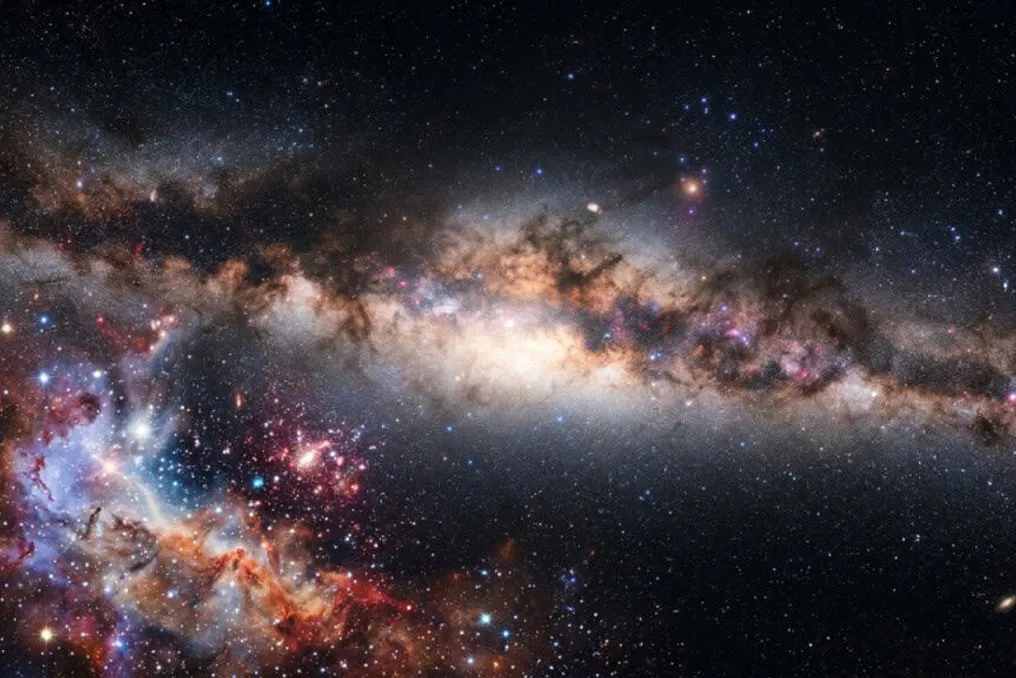
Despite the interstellar medium being extremely cold and rarefied, vast molecular clouds in the central part of the Milky Way function as natural laboratories and stellar nurseries where chemical reactions occur. To identify erythrose, a team led by astrochemist Isaskun Jimenez-Sierra from the Spanish Center for Astrobiology used two radio telescopes pointed at the center of the galaxy. The applied method was based on the spectroscopy of rotational molecular transitions.
Molecules constantly rotate and vibrate, emitting or absorbing radiation at specific frequencies. These frequencies serve as a unique 'fingerprint' for each chemical substance. Researchers detected this radiation emanating from the nebula and compared the signal with data previously obtained in ground laboratories where erythrose had already been studied. According to NO, the result showed a perfect match between the electromagnetic signature registered in space and the signature of the known molecule.
Despite confirming the presence of erythrose, the study revealed a paradox that challenges current models of astrochemistry. The radio telescopes clearly identified the four-carbon sugar but did not detect significant quantities of smaller sugars consisting only of three carbon atoms, which should theoretically be more common.
For Fernandes, this absence represents a serious scientific problem. He noted that this 'molecular vacuum' complicates the understanding of how organic matter accumulates and develops in space. In the researcher's opinion, current theories suggest that smaller molecules should appear more frequently. This paradox, he said, is the kind of real and intriguing problem they enjoy discussing at AstrobiON, as it demonstrates that there are mechanisms of molecular synthesis in the interstellar medium that still need to be deciphered.
Confirming the possibility of forming complex sugar molecules in space, even before the birth of stars and planets, also changes the perception of the origin of ingredients necessary for life. The National Observatory reports that estimates suggest that primitive Earth could have received up to 50 million tons of these sugars during the period known as the Late Heavy Bombardment, when the planet was frequently bombarded by meteorites and comets.
For scientists, if the fundamental components for the formation of RNA and DNA are present in molecular clouds distributed throughout the Milky Way, the probability increases that the so-called 'recipe for life' is also delivered to other forming planetary systems. This discovery reinforces the importance of astrobiology for understanding how complex organic molecules arise in the Universe and how they might contribute to the emergence of life in different parts of the galaxy.