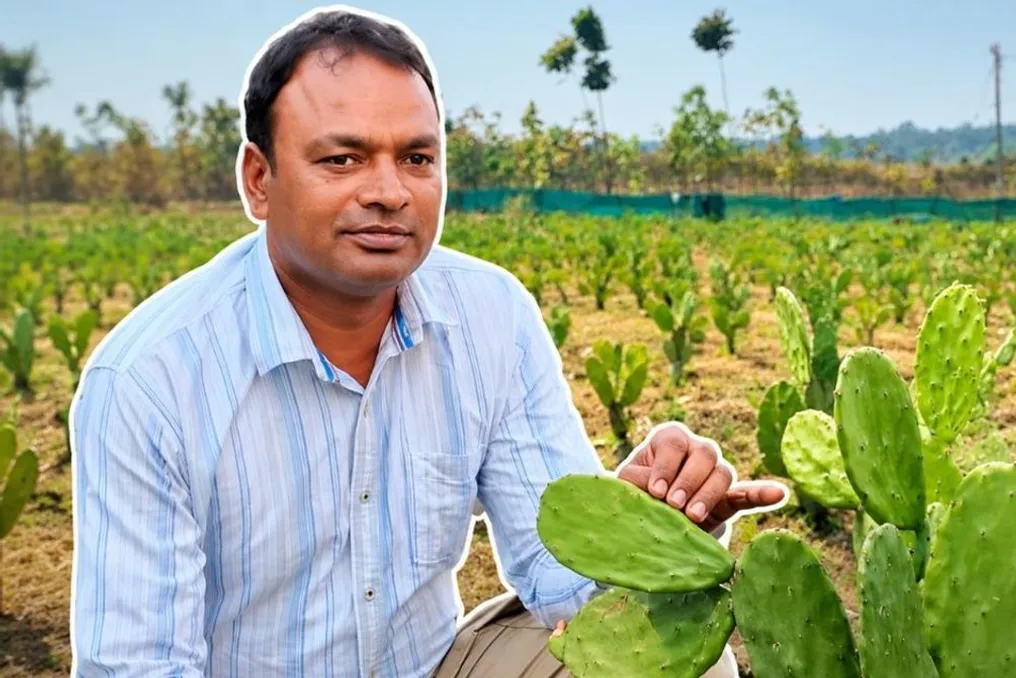
In 2020, a lush orchard covering 36 acres in Bichara village, Jharkhand state, featured one hundred litchi trees, three hundred mahogany trees, and nine hundred mango trees. This land was leased by 43-year-old farmer Chaitanya Kumar Gandhu, who aimed to establish a long-term enterprise.
Fire and Lost Hope
Every square meter of the land had been meticulously restored to create a thriving garden. However, just three years later, before the trees could mature, everything was destroyed by fire. To this day, Gandhu does not know who caused the fire.
After the tragedy, he could not receive insurance compensation because no police officer agreed to register a complaint. Gandhu told The Better India: 'I had neither insurance nor any documents to support my claim, and I returned home with nothing.'
The Beginning and Turning Point
His agricultural activities began much earlier. In 2015, he planned to start producing lacquer, but limited resources forced him to change his plans. Instead, he started planting hosta trees, including 1200 Indian jujubes, which also perished in the devastating fire.
Gandhu now views this fire as a turning point. Having lost vast territory, he was compelled to rethink his possibilities. In 2024, while exploring new prospects, he learned about central and state government efforts to promote cactus cultivation. Following advice from a friend who is an engineer, he decided to consider growing spineless cacti.
Research and Cactus Selection
Gandhu was interested because cactus gardening was an entirely new venture for him. During his research, he discovered that natural leather could be produced from the species Opuntia ficus-indica, which is a spineless cactus. He noted that their local cactus has spines, while this one does not.
To learn more, Gandhu spent weeks researching online before contacting the International Center for Agricultural Research in Dry Areas (ICARDA). He saw in the cactus not just an experimental crop. Unlike lacquer production, which yields income only twice a year, the cactus offered a more stable source of earnings. With government support, he approached the ICARDA center in Amlake, Madhya Pradesh, to understand how to begin.
Advantages and Project Launch
What impressed him most was the cactus's resilience. The spineless cactus requires minimal water, remains green even in hot summers, and grows well in poor soils. Since it lacks spines, it can also be used as nutritious fodder for livestock.
Having confirmed the crop's potential, Gandhu purchased 10,000 cactus cladodes from ICARDA at a price of 10 rupees per unit. In November 2024, he planted them on an area of 2.5 acres in Gamharia Jaltanda, becoming the first farmer in Jharkhand to cultivate spineless cactus on this scale.
Today, his nursery is capable of producing nearly two hundred thousand cactus saplings annually. He cultivates 25 different varieties. Among them, the varieties Oretha de Elefante Africana, IPA-90-73, Copena V1, Mexica Folder-1278, and Additional-1258, sourced from Brazil, have performed particularly well. Each yields about 10 cladodes per year, compared to two or three from many other varieties. Slower-growing varieties, he says, are better suited for research than commercial cultivation.
A solar pump is used for irrigation. In summer, plants are watered every five to six days due to the low soil quality, while in cooler months, watering once every 15 days is usually sufficient. Cow dung is applied twice a year.
Commercial Potential of Cactus
What started as an experiment soon turned into a business opportunity. Gandhu explains: 'The saplings are essentially cladodes. When I received an order for 30,000 saplings, I started pruning the mother plants, making them shorter. I spoke with Dr. Neha, who advised growing them in polyethylene bags. From one cladode, I managed to grow six to eight new saplings and fulfill the entire order.'
Each sapling takes about four months to grow in a polyethylene bag. To meet demand, Gandhu hired about 60 women from nearby villages to assist with the preparation and care of the saplings, creating an additional source of income for them.
He notes that the economics of the process are encouraging. One cladode costs him about 10 rupees. From this single cladode, he can grow six saplings, which together sell for approximately 60 rupees. Even after accounting for labor, polyethylene bags, soil, irrigation, and four months of care, he makes a profit of about 25 rupees per cladode.
The first year was mainly dedicated to recovering investments. He spent about 3 lakh rupees on purchasing planting material and earned almost the same amount through sales. He says: 'We reached the break-even point. Now the real profit will begin.'
Only last year did he sell about 30,000 cladodes and saplings at 10 rupees each, including transportation costs.
Multifunctionality of Cactus
The cactus also serves another function on his farm. 'I feed my goats with them. In the summer, when grass becomes scarce, the spineless cactus is a good source of nutrition because it contains a lot of protein,' he says.
Sector Development Prospects
Gandhu believes the timing for starting was ideal. The Government of India has designated spineless cactus cultivation as one of the priority areas under the Viksit Bharat concept. A project to cultivate nearly two hundred thousand cactus plants over 400 hectares across various districts is planned in Jharkhand.
For Gandhu, this could create a significant opportunity. He asks with a smile: 'If such projects need saplings, where will they get them?' His goal is to become one of the state's key suppliers. Based on the number of available cladodes, he estimates he can produce nearly four lakh saplings, creating a business worth almost 40 lakh rupees and providing employment for many rural women.
Impact on Neighbors
Gandhu's success has already begun to influence neighboring farmers. Last July, about 15 farmers from Ranian village, located about 40 km away in Khunti district, visited his farm after hearing about the cultivation of spineless cactus. They took saplings and started planting them on their own land.
These farmers participate in the state's initiative to promote cactus, launched in 2025, under which ICARDA supports producers with free planting material, fertilizers, and land preparation assistance. According to Gandhu, about 40% of the participating farmers have successfully established their plantations.
He notes that the department encourages farmers to form cactus producer associations. Even people visiting his farm often take 10 or 12 saplings to plant. Slowly, people are beginning to look at the cactus in a new light.
More Than Just a Decorative Plant
Most people associate cacti with decorative pots or desert landscapes. However, the spineless cactus possesses much greater agricultural potential. Cacti are generally classified into ornamental, fruit-bearing, and fodder types. Among these, the spineless cactus has become one of the most promising crops because it is easy to manage and multi-functional.
Researchers often describe it using the '5F' principle: food, fodder, fuel, fertilizer, and fashion. In addition to providing nutritious feed for livestock, it can contribute to biogas production, organic fertilizers, and even bioleather, opening up new opportunities for farmers.
Dr. Neha Tiwari, a National Scientist at ICARDA, states: 'The most suitable variety is Opuntia ficus-indica, widely known as nopal or spineless cactus.' She adds that it adapts well to India's agro-climatic conditions, including plateau regions like Jharkhand. It tolerates drought, temperature fluctuations, and poor soil, making it ideal for rainfed and degraded lands.
In field conditions, plants can reach heights of six or seven feet, depending on the variety and cultivation methods. Unlike seasonal crops, the cactus does not have a fixed maturity period. Nevertheless, farmers can start harvesting cladodes approximately 10-12 months after planting, once the plant has strengthened and formed four or five healthy cladodes.
A Culture Built for the Future
For Gandhu, the spineless cactus is not just a profitable crop. He believes it can help farmers utilize degraded lands more efficiently and open up new income streams. He emphasizes: 'Our local cactus has no commercial value because of its spines. But the spineless cactus can change that.'
He adds that the soil conditions in Jharkhand are similar to those in parts of Madhya Pradesh, Chhattisgarh, and West Bengal. If governments continue to promote it, many farmers could benefit.
Experts agree with this. According to Dr. Neha Tiwari, Opuntia ficus-indica is well-suited to Jharkhand's climate because it withstands drought, poor soil, and variable temperatures. Besides providing nutritious feed, the crop can be processed into biogas, organic fertilizer, and bioleather, and it can also contribute to carbon sequestration. Since it requires relatively little water and maintenance after rooting, researchers view it as a promising option for climate-resilient agriculture.
Initial investments are estimated at 80,000–1 lakh rupees per hectare, excluding fencing. However, since the crop remains productive for 15–20 years, long-term maintenance costs remain relatively low. For Gandhu, the biggest challenge is not cultivation, but market creation. He says: 'The biggest hurdle is finding buyers. Currently, most of the produce is sent to a processing plant in Uttar Pradesh. If there were a processing plant in Jharkhand itself, it would create jobs and increase farmers' income.'
Nevertheless, demand appears to be growing. ICARDA is collaborating with the Jharkhand government to promote spineless cactus cultivation by providing planting material and technical support. As more farmers adopt this crop and government projects expand, Gandhu hopes his nursery will become a key source of quality saplings across the state.