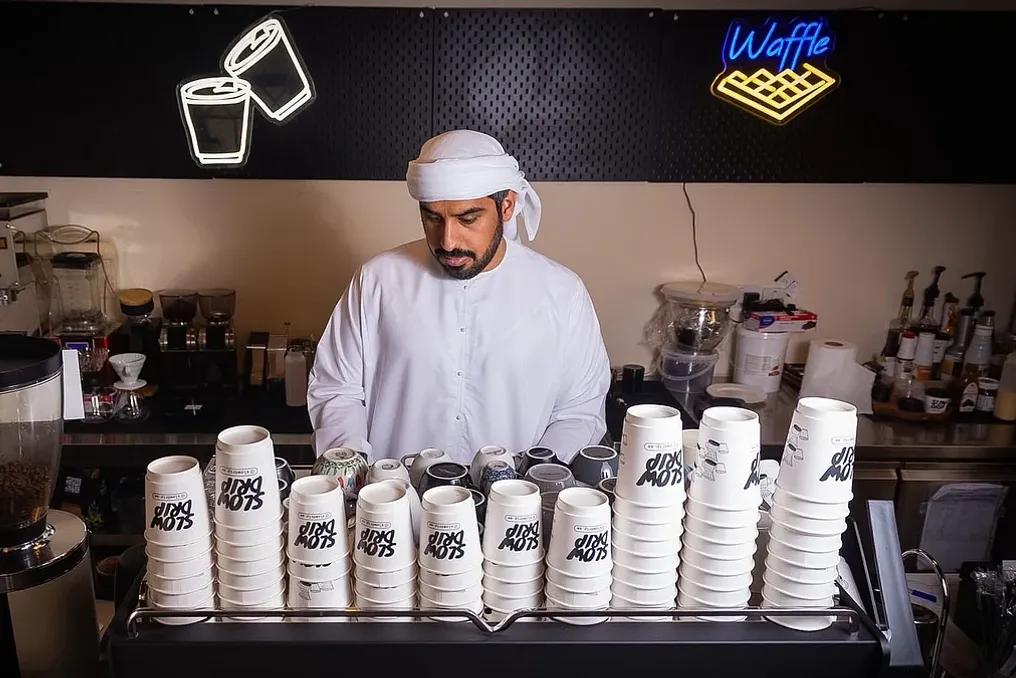
Obaid Atik Al Kaabi dreamed of opening his own coffee business for almost a decade. However, one harsh review nearly made him give up on this dream forever.
Obaid Atik Al Kaabi dreamed of opening his own coffee business for almost a decade. However, one harsh review nearly made him give up on this dream forever.
Coffee has always been an integral part of his life. In childhood, he watched his family prepare and roast Emirati coffee at home, where hosting guests was more than just a drink. He recalls: 'My family would roast and prepare Emirati coffee for us, and I grew up loving it.'
His interest deepened in 2015 after visiting a roastery that experimented with specialty coffee beans while preserving the traditions of Emirati coffee. This concept captivated him, and in the following years, he visited roasteries, took courses, and immersed himself in the world of coffee. He states: 'I just wanted to learn.'
His first attempt to turn this passion into a business took place in 2017 when he started roasting and selling Emirati coffee beans. Initially, customers reacted positively, but one sharp comment changed everything. A person told him: 'Your coffee is undrinkable. Even if it costs two dirhams, I wouldn't buy it.'
This feedback kept him awake all night. The next day, he radically changed his approach: he switched the bean, the supplier, and the roasting profile. Nevertheless, sales decreased after these changes.
Ultimately, he completely discontinued this project. Looking back, he felt that allowing one opinion to outweigh the experience of everyone who enjoyed his coffee was a mistake. Now he responds differently: 'Today, if someone says my coffee is bad, I answer differently. Coffee is a matter of taste. One opinion should not make you quit everything.'
Despite closing the business, his love for coffee remained. After getting married in 2021, Obaid used part of his marriage grant in the UAE to purchase professional coffee equipment. He practiced at home, perfected recipes, and continued to share his coffee ritual on social media. However, despite years of preparation, he hesitated to open a café due to the pressure related to rent, salaries, and operating costs.
Friends and guests who regularly visited his majlis constantly encouraged him, saying: 'Why don't you open it? It would be a shame if you didn't. Your coffee is excellent.'
The situation changed after the birth of their first child, when his wife fell ill with partial paralysis and went for treatment in the United States. She stayed there for several months, and Obaid joined her, expecting their time to be spent in hospitals and rehabilitation. Instead, the couple quietly began planning the business they had talked about for years. Between hospital visits, they visited cafés, refined the Slow Drip concept, developed its visual identity, and completed the licensing process before returning to the UAE.
When they returned to the UAE in 2024, Slow Drip began operating in an open area adjacent to their home. Within a week of opening, Obaid received an invitation to present his concept as part of an initiative related to the Ministry of Community Empowerment. This opportunity allowed Slow Drip to secure a spot at Global Village, introducing him to thousands of visitors and marking the beginning of a new chapter.
Visitors were attracted not only by the coffee itself but by the entire experience. Instead of standing behind a counter, Obaid worked alongside his team, conversing with customers about Emirati coffee, hospitality, and the traditions that initially inspired Slow Drip.
Shortly after, he placed second in the Emirati Coffee Championship organized by the Department of Culture and Tourism of Abu Dhabi. This recognition opened opportunities beyond the café itself. Government bodies invited him to conduct masterclasses, and later he represented Emirati coffee culture both in the UAE and abroad, including an event in China.
For Obaid, these opportunities relate to preserving culture as much as serving coffee. He asserts: 'I am teaching more than just coffee. I am teaching Emirati etiquette, traditions, hospitality, generosity, and respect. These values must be instilled in the hearts of our children.'
Beyond serving coffee, Slow Drip became a place where aspiring entrepreneurs sought advice. He notes: 'Honestly, my initial goal wasn't just about selling. I wanted to practice, learn, and build the concept correctly.' Many visitors wanted to know about coffee, while others wanted to start a home business. Since he operated from home, they saw him as an example of how a small project could begin. Questions ranged from suppliers and equipment to licensing and staffing. Obaid answered as much as he could, believing he was simply continuing the generosity shown to him by other professionals in the UAE coffee industry during his training.
He emphasizes that the community of business owners in the UAE is very supportive of each other. The philosophy that shapes his work at Slow Drip today is that 'I firmly believe that sustenance comes from Allah. I believe in what I offer, so I am not afraid to help. I even share the suppliers I work with. Of course, there are some private matters that the business cannot share with everyone. I can teach someone the basics without revealing all the private formulas.'
One of the most significant turning points for the business was the visit from Emirati content creator Ahmed Saif Al Kubaisi to the home café after watching one of Obaid's live streams. Previously, Obaid believed that constant video posting and live streams on social media would be enough for business growth. Ahmed's visit opened his eyes to how the business should be promoted. The video brought Slow Drip to a much wider audience, causing customers to wait up to 40 minutes, which forced him to urgently hire experienced staff to maintain the quality he had developed over years.
Today, Slow Drip is preparing to open its first permanent café in Baniyas, Abu Dhabi. His ambitions extend far beyond one location. He wishes for specialized kiosks with Belgian waffles and Slow Drip coffee points to appear in shopping malls across the UAE, making the brand widely accessible.
However, for Obaid, business is not just about expansion. 'What started as a story about a home business has become something bigger. We are not just selling coffee; we are also trying to support people who want to learn and build something of their own.'
Mostafa El-Sheikh, Head of the Coffee Department at the Cairo Chamber of Commerce, issued a grave warning about the widespread circulation of counterfeit coffee across Egypt. He estimated that falsified products account for approximately 80 percent of the domestic market.
In a televised interview, El-Sheikh stated that seventy percent of cafes, including high-end establishments, serve customers substandard, non-compliant coffee to increase profits. These fraudulent businesses substitute real coffee beans with cheap fillers.
El-Sheikh also noted that cases of food poisoning and severe diarrhea linked to these contaminated beverages have already been recorded. This prompted him to demand strict regulatory measures and the immediate closure of illegal artisanal production facilities.
These warnings coincided with a recent raid on an unlicensed facility in Fayoum Governorate. Authorities seized nearly two tons of pitted dates and peas that were roasted, ground, and mixed with small amounts of real coffee and dark chocolate. This mixture was then packaged under fake trademarks and distributed in the market.
This raid marked the first official inspection addressing public concerns regarding the use of pitted dates and peas as coffee additives—a practice that has intensified amid rising prices. For months, consumers have voiced worries on social media about noticeable changes in the taste, appearance, and aroma of their daily drink.
This crisis has been exacerbated by a sharp increase in coffee market prices. Despite a decrease in import volumes, the cost of Egyptian coffee imports reached $89 million in the first quarter of 2026, directly reflecting a significant jump in global commodity prices.
Concurrently, domestic coffee consumption in Egypt has risen significantly in recent years. Egyptians now consume approximately 80 thousand tons of coffee annually, compared to only 6 thousand tons in 2004. This surge is attributed to the flourishing culture of specialized cafes and the immense popularity of modern coffee drinks.