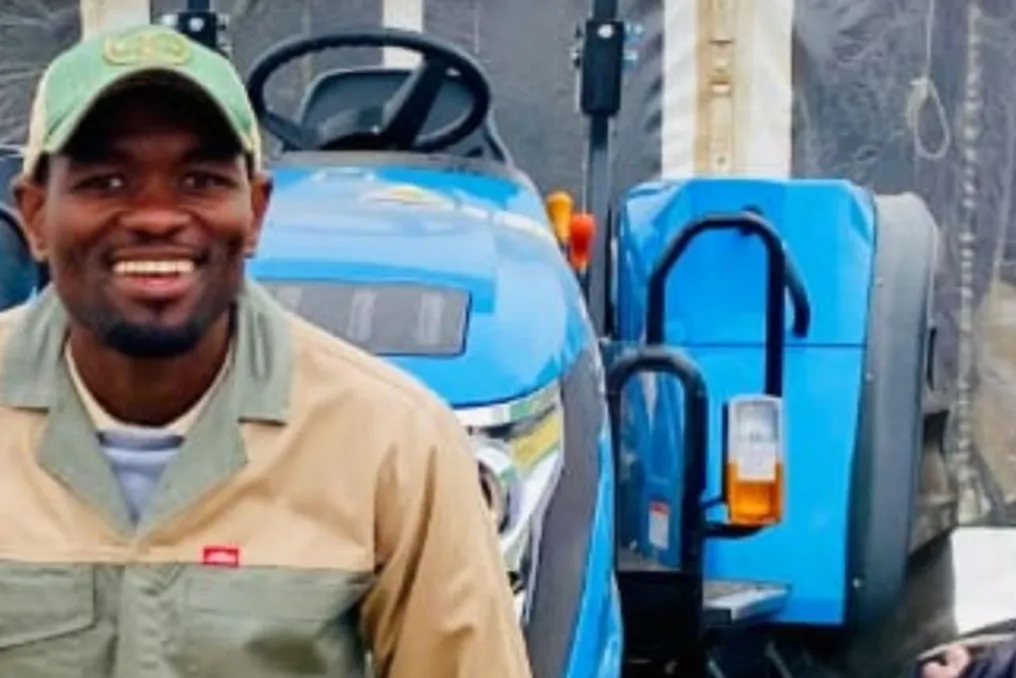
Horticulturist Mtutuzeli Sontsele transformed communal land into a successful commercial enterprise, starting his journey as an unemployed graduate.
>Horticulturist Mtutuzeli Sontsele transformed communal land into a successful commercial enterprise, starting his journey as an unemployed graduate.
>Sontsele's passion for agriculture was shaped by his upbringing in the village of Mpunzi Drift in Bizane, Eastern Cape. His family always had a strong agricultural heritage: his father and grandfathers farmed, growing maize, pumpkin seeds, beans, sorghum, and raising livestock, although his activities were informal.
As a child, attending Mpunzi Drift secondary school, Sontsele participated in daily farm work. He recalls that despite the difficulties, observing the work on the land instilled in him a deep connection to the soil. Family trips to Port Shepstone and visits to large commercial farms also strengthened his resolve to pursue agriculture professionally.
To turn childhood chores into a scientific career, Sontsele chose relevant subjects at Mpondombini high school. After graduating, he enrolled at Fort Hare University, where he studied horticulture and gardening, earning a Bachelor of Science degree, and later, a Master's degree in Horticulture in 2018.
Initially, Sontsele expected to enter the agricultural sector quickly, but due to a lack of formal vacancies, he had to temporarily step away from farming. He worked as a facilitator for a year and a teaching assistant for two years. Nevertheless, his farming instincts did not fade: in 2018, he started a small informal livestock project at home, acquiring only one local goat.
The turning point came in 2021 when he received an interview invitation from the Future Farmers Fund. During the meeting, one profound question from the interviewer changed his career plans: would he be willing to work on the land at home with funding? This question prompted him to abandon the search for formal employment and dedicate himself entirely to farming.
However, he understood that transitioning from one cow and a big dream to a commercial enterprise required resources and trust. When he first presented the idea of creating a cooperative to the community, neighbors were hesitant, viewing farming as a risky venture. Sontsele turned to his family network, using his academic knowledge and conviction to persuade relatives to join his mission. He recruited five young people from his community, including core family co-founders Mondekazi, Moisi, Sanelisive, and Masibulele Sontsele, to form the Rich Valley Cooperative.
The family-founded cooperative took a significant risk by planting cabbage seedlings on their uncultivated land without a guaranteed buyer. Sontsele explains: 'We started with 5,000 cabbage seedlings, despite the absence of a confirmed market.' However, their bold move attracted the attention of Nonhlalani Boyce from the Boxer Market, a small business incubator. Boyce became a mentor to the young team, officially assisting them with company registration in 2021 and providing necessary training to transition from a village project to a proper retail supplier.
After establishing an official commercial channel, the family expanded its operations. 'We also cultivate spinach, pumpkin seeds, green peppers, potatoes, and green corn cobs. They are grown to meet both domestic and commercial needs,' says Sontsele.
Three years of continuous work without external funding completely transformed the enterprise. Today, the Rich Valley Cooperative occupies an extensive area of 15 hectares of communal land. Cabbage production has increased astronomically from the initial 5,000 to over 100,000 heads, and the family has been able to purchase its own commercial truck for transporting harvests to markets.
Alongside crop cultivation, the one goat Sontsele bought in 2018 has grown into a thriving herd of over 100 local goats. Pigs and chickens have also been integrated. The Department of Agriculture provided the cooperative with a tractor and a production tunnel, and the Alfred Nzo District Municipality included them in a three-year development program that provides 40,000 cabbage seedlings, as well as regular resources for production and support for heavy machinery.
Currently, the family business employs six permanent staff members and over 20 seasonal workers from the village. Nevertheless, battling nature remains a serious challenge. Sontsele notes that climate change is the main operational obstacle, as unpredictable weather conditions complicate planning and decision-making regarding planting times and crop selection.
The vision of the Rich Valley Cooperative is to further increase production, expand its presence in the local economy, and ultimately transition from communal land by purchasing private property. Sontsele believes that resilience is the main secret to success in agriculture: 'Once you are in it, don't give up. It may take some time before you see a profit, but keep moving forward no matter what, and be creative.'
When Vanessa Simelane started working with the family garden in her backyard in Mpumalanga, her goal was not to create a business, but to preserve part of her mother's legacy. Thanks to a vital investment from her neighbor, CM Mills, she transformed from a backyard gardener into a commercial force producing up to 1500 broilers per cycle.
Simelane grew up in Chrisismere, Mpumalanga, a region known as the Sunrise Place. Growing up among a family of small farmers shaped her connection to agriculture at an early age, awakening a curiosity that grew with her. Despite focusing on her studies, she completed primary school at Laerskool Chrisi and then graduated from Secondary School Nederland Park in 2017, but her deep love for the land never left her.
After graduating from school, Simelane faced a period of unemployment, unaware that daily quiet household chores were preparing her for a future career.
The true foundation of her entrepreneurial journey began in 2019 after the death of her mother, Babsi Simelane. Her mother always maintained a special backyard garden, growing spinach, carrots, potatoes, lettuce, and tomatoes for the family. After the loss, Simelane took full responsibility for maintaining this garden.
During her period of unemployment, the garden quickly became a vital source of financial support. Most of what she ate came directly from the garden, helping to save valuable family funds. Over time, this daily chore transformed into a commercial opportunity through a simple, firm decision. When neighbors came asking for free tomatoes or other vegetables, Simelane told them she was selling the harvest.
Simelane notes: 'The decision to grow vegetables not only for home use but also for sale became one of the best decisions I ever made. Since every meal requires at least one or two vegetables, there is always demand for fresh produce. Growing vegetables allowed me to support my household, generate income, and contribute to providing healthy food for my community.'
Alongside maintaining the home garden, a new opportunity arose shortly after the Covid-19 pandemic. In 2021, her growing passion for agriculture led her to participate in a development program that allowed her to attend the Bubble Farmers Academy, where she received specialized training in broiler production. This program gave her initial momentum, supplying the first 100 chicks and enough feed for a full production cycle. She recalls: 'It was during this training that I discovered my true calling and decided to pursue poultry farming as a career.'
Working in the same backyard where her garden grew, Simelane successfully raised poultry for six weeks and sold it directly to the local community. She continued this combined activity of raising poultry and vegetables in the backyard, gradually building her customer base until in 2024 she took a major step—registering the enterprise as Avesanda Poultry Farm.
By 2025, the backyard operation officially exceeded the available space. Simelane made a calculated business decision and leased a 4.4-hectare plot to expand both poultry and crop production. However, the new land lacked the necessary commercial infrastructure, threatening to halt her progress.
This obstacle was overcome thanks to an unusual relationship with her new neighbor, CM Mills, located directly opposite her farm. Recognizing her hard work and determination, the neighboring business provided significant capital investment to accelerate the growth of Avesanda Poultry Farm. Instead of a standard loan, the neighbor completely renovated the infrastructure on the plot. They installed perimeter fencing, equipped specialized curtains in the poultry houses, provided waterers and feeders, supplied professional slaughtering equipment, and ensured the farm had proper access to water and electricity.
To allow her to immediately utilize the new facilities, the neighbor also financed her initial production cycles. They purchased her first batch of 200 chicks and feed for the entire cycle, and later financed a second batch of 400 chicks with full feed cycle. Simelane says: 'This support allowed me to expand production, strengthen my operations, and lay the foundation for the growth that Avesanda Poultry Farm experiences today.' She adds: 'I am deeply grateful for their belief in my vision and their commitment to supporting emerging farmers.'
Thanks to solving infrastructure problems through the neighbor's intervention, Simelane's daily management has led to significant operational growth. Today, Avesanda Poultry Farm has scaled up from domestic 100 chicks to producing between 1200 and 1500 broilers per production cycle. More importantly, she has secured a stable commercial market for supplying 1200 slaughtered chickens every week.
The 4.4-hectare plot also allowed her to expand her vegetable business, which she inherited from her mother. In addition to the original crops, Simelane now grows green peppers, chili, and sweet potato for the market. The growing enterprise supports the local economy by employing two permanent staff members, including Simelane herself, and two part-time workers.
However, operating at this scale involves significant risks that Simelane must carefully manage to maintain business sustainability. Her biggest hurdle is the rising cost of feed, which accounts for 65% to 75% of poultry farming expenses. To protect her profit, she buys feed in bulk, collaborates with neighboring farmers to negotiate better prices, and vets suppliers to ensure consistent quality.
Biosecurity is another daily priority due to the threat of highly pathogenic avian influenza. Simelane maintains strict hygiene on the farm, using foot baths and disinfecting all vehicles and equipment entering the farm. This meticulous attention to detail pays off, as each milestone brings her closer to achieving her ultimate family goal.
For aspiring agricultural entrepreneurs, Simelane emphasizes that business discipline must always come first. She advises young producers to view farming as a business, not just a passion; to start small with what they have and gain practical experience on an established farm before starting their own venture. She concludes: 'Starting a farming business is rewarding, but it requires commitment, discipline, and sound business management.'