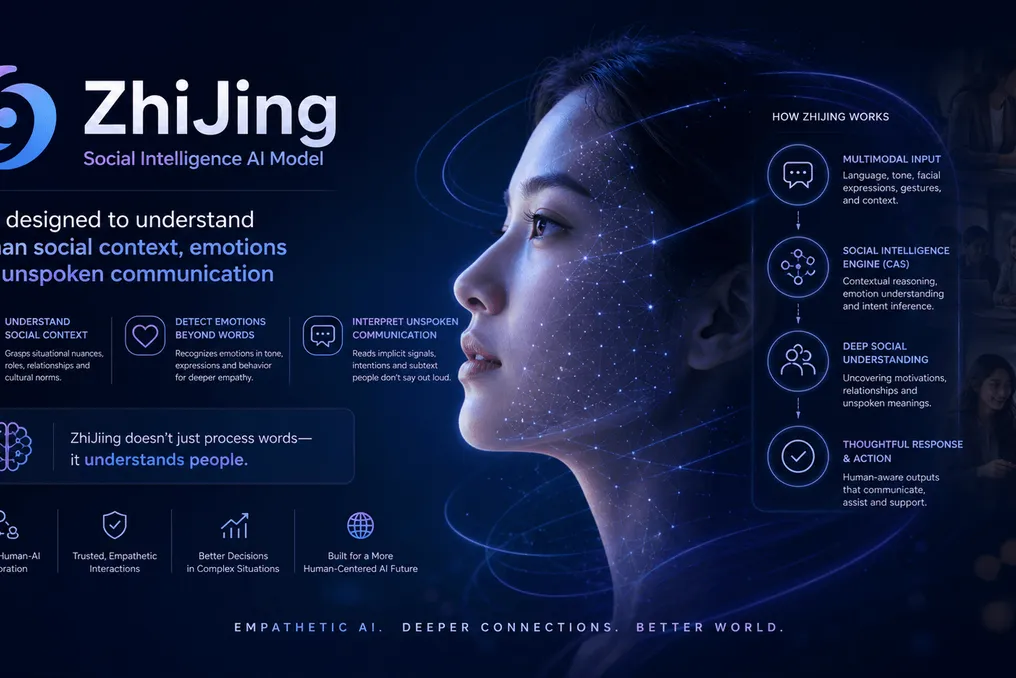
The Chinese Academy of Sciences (CAS ICT) has introduced the ZhiJing social intelligence system, which incorporates the Zing model and the SoMBench evaluation benchmark. This development aims to address the issue of artificial intelligence's inability to comprehend social context, emotions, and unspoken signals.
Overcoming AI Social Gaps
Unlike models such as GPT-5.5, which demonstrate high performance in professional writing, or DeepSeek in coding, AI often produces awkward responses in social situations. ZhiJing treats social cognition as an independent engineering problem.
SoMBench Benchmark
The first component of the system is SoMBench, which serves as a standard for evaluating social intelligence. It decomposes the abstract concept of human understanding into three main domains, 17 sub-dimensions, and 71 detailed tasks. These tasks cover relationship modeling, emotion comprehension, societal norms, and belief reasoning. The benchmark contains 3481 meticulously verified examples, utilizing multi-type cross-validation, including multiple-choice, single-choice, judgment, and open-ended questions, as well as option perturbation and label detection methods for precise error identification.
Testing Results and Challenges
Testing across 20 leading models showed that the strongest model achieved only 72.08% accuracy, with none approaching the 90% threshold, confirming that social intelligence remains an under-researched area. The most complex challenges involve simultaneously reasoning about implicit intentions, emotional shifts, social norms, relational dynamics, and unstated words.
Zing Methodology Innovations
The Zing methodology includes three key innovations. The first is the FLARE data cycle: when weaknesses are identified, FLARE generates new samples targeted at closing this capability gap. The second is two-stage training, which first establishes a general foundation through distillation from multiple teachers and Mixed-Reward GRPO, followed by specialized reinforcement for emotions, intentions, and social norms. The third innovation, On-Policy Distillation (OPD), resolves the classic risk of catastrophic forgetting in reinforcement learning. OPD introduces constraints on teacher token distributions in online trajectories, allowing the training model to explore more efficient paths without deviating from established reasoning patterns. Thus, the framework operates holistically: FLARE determines what needs to be learned, two-stage training determines when to do it, and OPD determines who to learn from and what not to forget.
Zing-27B Performance
The Zing-27B model demonstrated a composite score across five benchmarks at 79.80%, surpassing GPT-5.5, which scored 78.44%. Zing-27B shows advantages in tracking recursive beliefs (HiToM) (4.08 percentage points higher) and EmoBench (5.62 percentage points higher). It is the first model under 100 billion parameters to outperform GPT-5.5 in the HiToM task, thereby asserting social intelligence as a distinct engineering discipline.