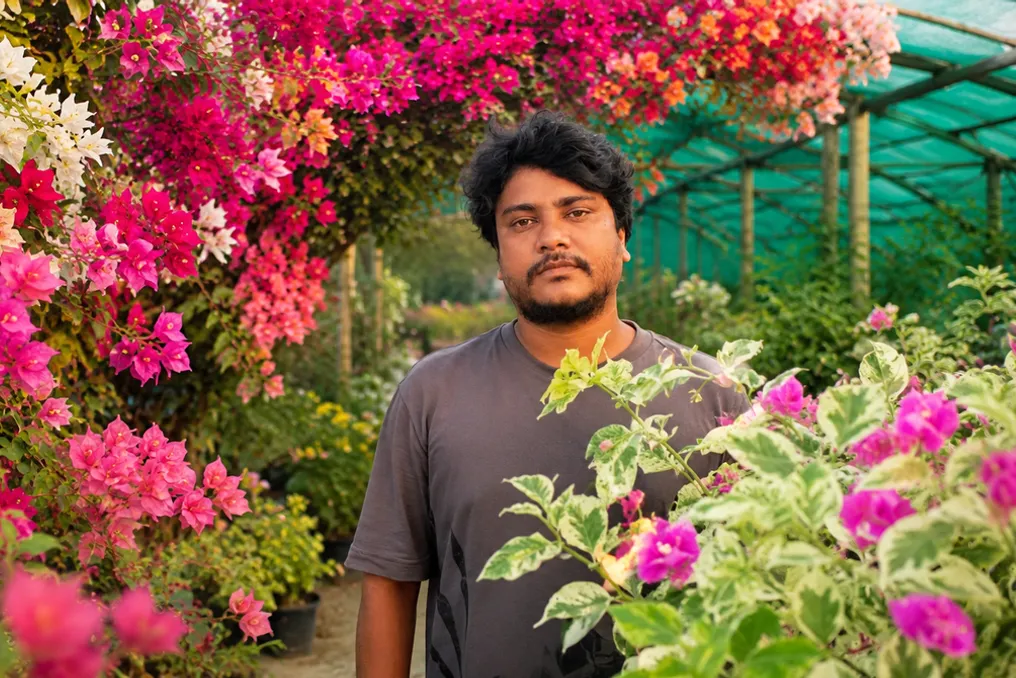
At the age of 35, Chiranjit Maiti enthusiastically calls himself a mad fan of kagoz phool, which is the Bengali name for bougainvillea. He is ready to talk for hours about the plant, sharing stories about its bracts, flowers, and cultivars with infectious enthusiasm.
Growth in popularity through social media
During the Covid-related quarantine, Maiti launched a Facebook page called World of Bougainvillaea. Within a week, this page attracted over one hundred thousand people from around the world. Numerous inquiries came regarding rare cuttings and valuable varieties. Maiti interacted with gardeners, nursery owners, breeders, collectors, and institutions, making him an authoritative voice in this community.
Bougainvillea in the urban landscape of Bengal
This surge of interest reflects broader changes occurring in Bengal. For generations, Bengali homes were defined by the fragrance of bel or jasmine and the vibrant canopy of Krishnachura. These plants served as both decorative elements and cultural markers woven into the rhythms of festivals, seasons, and daily life.
Today, a walk through South Kolkata, Barrackpore, or the suburban areas of Howrah shows that another plant has taken its place in the urban landscape of Bengal. Bougainvillea cascades in shades of purple, violet, orange, and white down balconies, walls, and terraces.
Social media has amplified this enthusiasm. On Bengali posts on Facebook and Instagram, gardeners exchange photos, growing tips, and information about cultivars.
Reasons for gardeners' choice of bougainvillea
This trend is linked both to the gardening boom post-pandemic and the plant's ability to adapt to urban growing conditions. Nursery owners note that sales of bougainvillea have exceeded sales of traditional creeping plants by almost 40% in the last three years.
The plant's appeal is partly due to its minimal maintenance requirements. Unlike Madhabilata, bougainvillea can thrive in warm temperatures, bright sunlight, pronounced dry spells, monsoon rains, mild winters, and well-drained soil. These conditions suit most of Bengal. The plant is also capable of growing in polluted city air and in tight corners of urban balconies.
Over 250 cultivated varieties are grown in the region, most of which are hybrids of B. spectabilis, B. glabra, and B. peruviana. They are valued for their bright bracts in shades of pink, red, violet, orange, white, and variegated hues. The bright pink bush, long familiar in Indian gardens and urban landscapes, is called Camarillo Fiesta—a favorite among landscape designers and one of the most common bougainvillea varieties.
From colonial import to Bagan Vilas
The journey of bougainvillea to Bengal began in the 19th century. The Indian Society of Agriculture, founded in 1820, imported cultivars such as B. spectabilis and B. glabra from Europe and South America. Over time, the plant moved beyond institutional gardens and spread across British India thanks to the efforts of private gardeners. Hybrids like the bi-colored 'Mary Palmer' also became popular.
In Santiniketan, bougainvillea acquired a distinctly Bengali identity. Afternoon sun fell on the red earth while cascades of bougainvillea swayed in the wind. Rabindranath Tagore, walking with students, stopped near the flowering arches. He named them 'Bagan Vilas', meaning garden decoration. Tagore's influence on the cultural landscape of Bengal helped this name spread among Visva-Bharati students and become more widely known. Today, gardeners and collectors continue to use the name Bagan Vilas for this plant. Through this name, bougainvillea has become part of Bengal's cultural lexicon, representing accessible beauty and resilience.
A nursery with hundreds of thousands of saplings
Maiti's bougainvillea nursery, located in Ratnapura in Singur, is one of the few in India entirely dedicated to this plant. Spanning four bighas, it cultivates over 400 varieties. Although Maiti maintains a modest online presence, most of his business is conducted offline. At any given time, the nursery holds about one hundred thousand saplings. Their bracts—bright, paper-like, leaf-like structures often mistaken for flowers—bloom in shades ranging from familiar magenta and violet to rare yellow and gold. Across India, pink, red, orange, white, and variegated combinations are most common. Collectors worldwide are also seeking coral, cream, and multi-colored hybrids, turning this hardy ornamental plant into a horticultural treasure.
Prices start at approximately 50 rupees for common saplings and can reach 1000 rupees depending on the plant's age and variety. Rare collector plants can cost over 8000 rupees, depending on their age, rarity, and cultivar uniqueness. Recently, Maiti donated 100 cultivars to the Acharya Jagdish Chandra Bose Botanical Garden in Howrah, known for its historical plant collections and Great Banyan. These cultivars are now part of the Botanical Garden's collection for future generations.
Some bougainvillea cultivars also possess a subtle fragrance. Their true flowers, which are small and partially hidden within the bracts, can emit a honey-citrus scent with notes of jasmine. Maiti hopes to acquire fragrant cultivars such as Raspberry Ice, Double Pink, and Glabra Sanderiana.
Terrace replacing orchids
In Rahara, Dr. Partha Pratim Biswas, a retired zoologist, tends a 2500 square foot terrace garden. His roof was previously known for orchids, but today it hosts about 30 bougainvillea cultivars collected over 20 years. Biswas notes that he gradually gave up orchids because they required too much care, whereas bougainvillea thrives even with neglect.
His roof reflects the practical choice of many urban gardeners. Alongside bougainvillea, the terrace grows hebeas, anturiums, succulents, and ferns, helping to keep cool in the hot summer. For Biswas, bougainvillea serves as both a decorative element and a climate companion, adapting to stressful conditions and continuing to delight with color.
How drought promotes more flowering
Botanists find bougainvillea fascinating due to its ability to survive stress. Structurally, it is a thorny, climbing vine. It is also xerophytic, meaning it is adapted to environments with very little water, including desert conditions. Dr. Anjan Kumar Sinha, an assistant professor of botany at Raghunatpur College in Purulia, is known for his work on conserving agro-biodiversity, especially the traditional rice landraces of Bankura and Purulia. He is a recipient of the Plant Genome Saviour Recognition Award for preserving rice landraces and is also an avid bougainvillea collector.
He explains that the true secret of bougainvillea lies in the fact that its bright 'flowers' are actually paper bracts—modified leaves surrounding tiny, almost hidden true flowers. The plant produces the most abundant flower clusters under stress conditions, especially drought. When all requirements are met and drought stress is relieved, it simply transitions into a stable vegetative state. Its ability to grow in hot, dry, and poor soils explains its popularity among gardeners who have little time, space, or water for demanding ornamental plants.
Business opportunities after seminars
In February 2021, CSIR-NBRI held its first seminar on bougainvillea care and propagation at the Botanical Garden of India. Two years later, the institute organized another seminar at Maiti's bougainvillea nursery. Both seminars attracted hundreds of nursery owners from across West Bengal. Dr. Biresh Kumar Banerjee, former director and head of the Floriculture Department at CSIR-NBRI in Lucknow, notes that after these seminars, many began viewing bougainvillea as a serious business opportunity, collecting named cultivars from all over India. Today, Bengali nursery owners maintain impressive and diverse collections of documented varieties.
Banerjee was awarded the Bougainvillea Society of India and elected as a member of the Indian Society of Ornamental Horticulture. He has developed eleven cultivars, including the famous 'Abhimanyu', all of which are internationally registered. The seminars helped nursery owners move beyond the usual roadside and garden forms of the plant, creating opportunities to run bougainvillea as a separate horticultural enterprise.
Personal significance of the plant in homes
Bougainvillea also holds deep personal significance in the homes where it grows. In the Purabasha residential complex in Salt Lake, Dr. Mitu Dey, an academic and advocate for autistic rights, maintains a terrace garden where her autistic son chose three colors of bougainvillea. She says she took up gardening at her son's insistence, and over time, it became a healing landscape. Her roof features hibiscus, roses, primula, adenium, wisteria, vegetables, and bougainvillea. The garden originated from her son's interest and became a space they could shape together. For Dr. Dey, its colors and adaptability reflect the values of care and inclusivity that guide her human rights work.
New life after the pandemic
Bougainvillea cultivation methods have not changed since the pandemic, but its popularity has increased. Social media has allowed gardeners, collectors, and home gardeners to discover named varieties, exchange tips, and connect with sellers. Its low maintenance requirements have made it particularly attractive to people who started gardening at home. Bougainvillea grows beautifully on small balconies and adapts to polluted air. Its bracts in magenta, red, orange, violet, white, and variegated shades align with Bengal's long affection for bright ornamental plants.
Collectors propagate the plant through cuttings, grafting, and air layering. Common saplings remain widely available, while rare hybrids attract specialized collectors willing to spend much more. This range allows a beginner to start with a plant for 50 rupees, while a dedicated collector might seek a rare cultivar worth several thousand rupees.
Names referencing Bengal icons
In Barrackpore, Amitava Mukherji has been shaping another part of Bengal's bougainvillea history for decades. As an independent plant breeder, he has developed over a hundred cultivars since the mid-1980s. His varieties bloom profusely, are disease-resistant, and suitable for Indian growing conditions. Mukherji does not disclose details of his breeding methods, stating that his work relies on years of observation and experience. The names he gives his cultivars make his collection particularly unique. Each one carries an act of cultural remembrance. His flowers pay tribute to prominent figures of Bengal: J. C. Bose, the polymath botanist; Nazrul, the rebellious poet; Suchitra Sen, the iconic actress; Manna Dey, the master singer; and Ramkrishna, the mystic saint. One cultivar is named Ahimsa in honor of Gandhi's principle of non-violence. His recent cultivar Maumita commemorates a medical student from R.G. Kar Medical College who was a victim of sexual violence. Mukherji also looked beyond India. He recently developed the cultivar S.Z. Hualao in honor of a distinguished Chinese expert on bougainvillea. His creations, such as Balaka, Suchitra Sen, Ravi Shankar, and Nandlal Bose, have become very popular abroad. He is also an author.