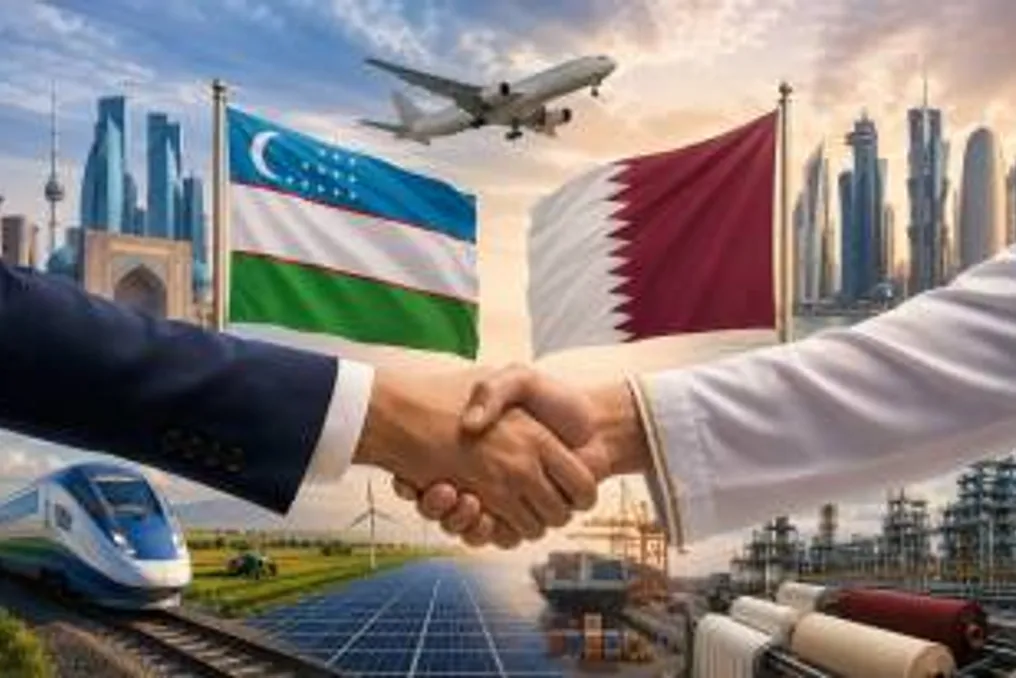
Interaction between the two states is now defined not by geographical borders, but by mutual interests, which is clearly demonstrated by the relations between Uzbekistan and Qatar. On one hand, there is a major Central Asian economy, and on the other, one of the influential financial and political states of the Persian Gulf. The trust formed between the two countries in recent years has elevated their partnership to a new level, transforming it into a full-fledged strategic cooperation that goes beyond mere diplomatic contacts.
Strengthening Bilateral Ties
The recent visit of President Shavkat Mirziyoyev to Doha once again emphasized the strength of these relations. Although the official visit was made to express condolences on the passing of the former Emir of Qatar, Sheikh Hamad bin Khalifa Al Thani, it also confirmed the continuity of the political dialogue between the heads of state. During the meeting with Emir Sheikh Tamim bin Hamad Al Thani, the current state of cooperation and future plans were discussed.
According to Madinabonu Mamazhonova, a doctoral student at Tashkent State University specializing in Oriental Studies, the history of relations between these two countries is quite long. Qatar recognized Uzbekistan's independence on December 30, 1991, and diplomatic relations were established on November 27, 1997. For a long time, cooperation was limited to formal diplomacy. The situation began to change radically after 2016, when Uzbekistan's new foreign policy course, based on openness, practical cooperation, and multi-vector diplomacy, activated interaction with Gulf states, among which Qatar became one of the most active partners.
Turning Point and Institutionalization
A real turning point occurred in 2023 when Emir Sheikh Tamim bin Hamad Al Thani visited Samarkand, marking a new chapter in the partnership between the two countries. During this visit, 15 bilateral documents were signed. Shortly after, the reciprocal visit of the President of Uzbekistan to Doha and his participation in the 'EXPO Doha-2023' further energized the political dialogue.
The institutional framework of diplomatic relations was also strengthened relatively quickly. In December 2023, the republic's embassy in Doha began operations, and in February 2024, the first ambassador was appointed to Qatar. Thus, contacts moved from temporary initiatives to a permanent diplomatic mechanism.
From Investments to Strategic Partnership
Political trust serves as the foundation of any cooperation, but true value is manifested in economic results. This process is what is observed in the relations between Uzbekistan and Qatar recently. Today, ties between the two states have gone beyond diplomatic negotiations and have transformed into a partnership covering investment, industry, energy, transport, and education.
Although Qatar is not yet among Uzbekistan's largest trading partners, the growth rate of its trade exceeds that of many other countries. According to official information, by the end of 2025, trade turnover is expected to increase by 30.1% compared to the previous year, and Uzbekistan's exports will grow by 36.5%. Over the past year, total trade turnover increased by 45%. While these figures do not yet reflect enormous scale, they clearly show a steady expansion of relations.
Uzbekistan primarily supplies agricultural, food, and textile products to Qatar, while petrochemical products and high-tech equipment are imported from Qatar. Particular importance is given to working on a preferential trade agreement. Its signing will reduce customs barriers, speed up the movement of goods, and open new opportunities for business in both countries.
Investment and Sector Development
Investment is an even more important area, as Qatar is one of the world's largest investment centers, and Uzbekistan aims to become an attractive market through its economic modernization and private capital attraction policies.
The visit of the Minister of Investment, Industry, and Trade of Uzbekistan, Laziz Kudratov, to Doha contributed to the development of this process. During negotiations with major companies such as 'Qatar Investment Authority', 'Qatar Mining', 'Qatar Pharma', 'Global Infrastructure Partners', and 'Retaj Group', investment programs in pharmaceuticals, construction, 'smart city' projects, electric bus production, mineral exploration, and tourism were discussed.
Cooperation will expand this year. Prospects for attracting long-term capital from 'Thirty Five Investment Holding' were considered. Furthermore, an agreement was reached to implement joint projects in seven strategic areas, including transport, energy, logistics, education, and tourism. Thus, Qatari capital is beginning to flow into sustainable sectors of the Uzbek economy.
Energy, Transport, and Agriculture
The energy sector is also becoming an important aspect of the partnership. Uzbekistan's 'green' energy programs are of serious interest to Qatari entrepreneurs. Initiatives to build solar and wind power plants and modernize energy infrastructure strengthen the country's energy security and increase the share of renewable energy.
New opportunities are emerging in the field of transport and logistics. Uzbekistan's transit potential is being harmonized with Qatar's global logistics strategy. Specialists are discussing a number of projects related to the development of transport hubs, the creation of digital communication lines, and the formation of new supply chains, which increases the country's significance in the international transport network.
For Qatar, ensuring food security is of strategic importance, and Uzbekistan has the potential to meet this need due to its agricultural potential. Therefore, creating agro-clusters and directing local products to the Middle Eastern market is of particular importance.
Tourism and Human Capital
Tourism is also a rapidly developing area in bilateral relations. Qatari companies are interested in investing in Uzbekistan's hotel business and tourism infrastructure. Simplification of the visa regime and the opening of direct flights create favorable conditions for increasing tourist flows.
Cooperation in human capital is taking on a new dimension. Joint programs in the education system and initiatives to train specialists meeting labor market needs are clear evidence of this. It is particularly noteworthy that 'Qatar Airways' has developed a plan to employ up to 1600 specialists from Uzbekistan in fields such as aviation, mechanical engineering, and electrical engineering.
Cooperation between universities, joint research, and academic exchange programs has not yet been fully realized, indicating science as the next stage of partnership development.
Conclusion on Partnership
Analysis shows that relations between Uzbekistan and Qatar have ceased to be limited to quick political meetings and have transformed into a long-term partnership model based on economic interests, investments, technology, and human capital. Provided reforms continue, this cooperation could become a model of successful integration not only between the two countries but also between the regions of Central Asia and the Persian Gulf.
By 2025, relations were elevated to the status of strategic partnership. This step is significant not only as a political statement but also due to the formation of new cooperation mechanisms, such as the Coordination Council under the chairmanship of Foreign Ministers, the Intergovernmental Commission, and the Businessmen's Council, which ensure regular coordination of contacts.
It is worth noting that over the last three years, leaders of Uzbekistan and Qatar have met in person five times. These meetings took place in various formats—during state visits, international summits, and humanitarian events. This indicates that the relationship is not limited to official protocol but is based on mutual trust and long-term partnership.
Parliamentary diplomacy is also gaining momentum. In April 2025, meetings were held with the heads of parliaments of Arab countries, including Qatar, at the Parliamentary Assembly held in Tashkent. This opened up new opportunities for cooperation in the legislative sphere and further strengthened bilateral agreements from a legal perspective.
Uzbekistan and Qatar support each other not only bilaterally but also internationally, participating in platforms such as the United Nations, the Organization of Islamic Cooperation, and the 'Cooperation Council of Central Asian States and Gulf States'. Initiatives promoted on these platforms lay a solid foundation for joint projects in areas such as innovation, artificial intelligence, 'green' economy, and digital transformation.