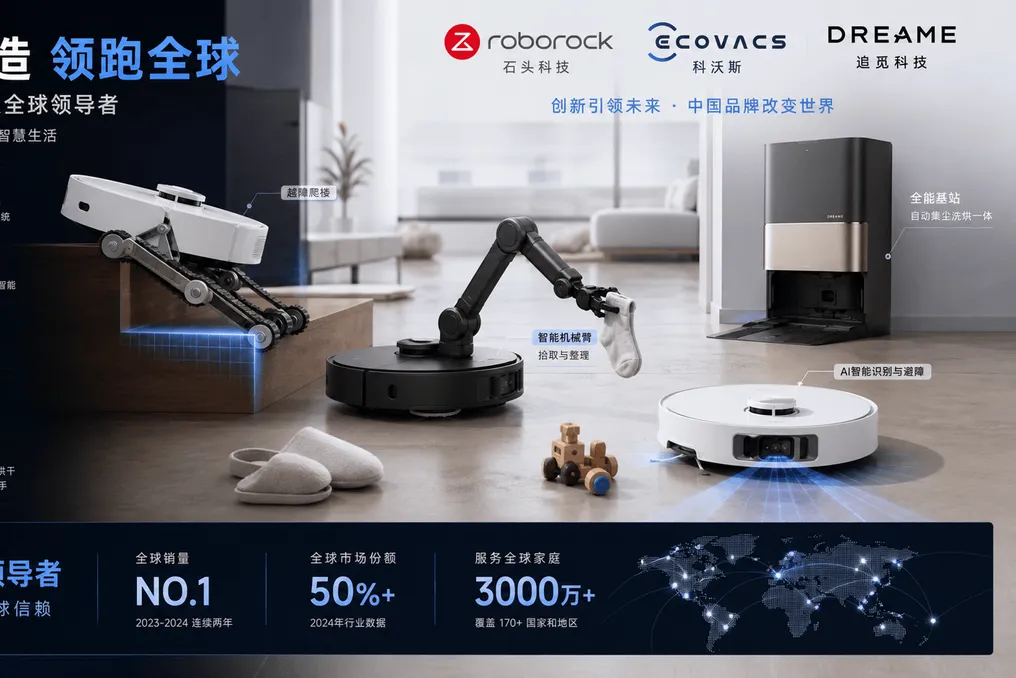
Home robot vacuum manufacturers from China now control 70% of the global market. Leaders in this segment include Roborock, Ecovacs, and Dreame. Competition in this industry is shifting from price wars to the implementation of advanced technological features, such as the ability to overcome steps and the presence of robotic manipulators.
Dominance and Innovation of Market Leaders
Roborock holds a leading position with a 27% market share. The company demonstrated revenue of 18.7 billion yuan, with 56% of this income generated outside of China. Among Roborock's achievements is the creation of the world's first Saros Rover robot capable of climbing stairs.
Ecovacs, which is the market leader in Japan, and Dreame are also actively promoting feature-based competition. Ecovacs, initially acting as an OEM manufacturer for foreign vacuum brands, later transitioned to creating its own brand. The company realized that constant participation in price wars limits both innovation and profitability, so it introduced solutions such as integrating wet mopping with sweeping, self-cleaning dustbins, and automatic mop washing and drying, thereby forming new product categories.
Technological Breakthroughs by Dreame
Dreame is developing a robot vacuum equipped with a robotic manipulator. This manipulator can extend approximately 33 centimeters and move objects weighing up to 500 grams, such as toys or shoes, to designated places before cleaning begins. This solves a major user problem related to the need to prepare the floor for the robot to operate. Dreame executives emphasize that consumers are purchasing unique technologies, and the company consciously avoids participating in price conflicts.
Competitive Landscape and New Players
Premium prices set in Japan exceed those of iRobot, reflecting significant investments in research and development (R&D), including LiDAR-based navigation, AI object recognition, and intelligent route planning. Chinese firms compete based on functionality, not discounts.
New participants have entered the market. The Chinese smart equipment company Anker Innovations and the global drone leader DJI have also entered the robot vacuum sector, strengthening the presence of the Chinese industry. DJI's entry has brought sensory technologies and AI perception capabilities inherent to drones into home cleaning, which could potentially accelerate feature development. These changes in competitive dynamics led to iRobot, the pioneer in US home robot vacuums, filing for bankruptcy protection and being acquired by a Chinese company at the end of 2025.
Market Development Trends
Unlike smartphones or electric vehicles, in the robot vacuum segment, Chinese manufacturers demonstrate leadership through premium innovations rather than cost reduction. There is a sharp increase in patent share. The trajectory from OEM manufacturer to proprietary brand and subsequently to standard setting reflects the evolution of the Korean and Japanese industries, which was compressed into a shorter timeframe.