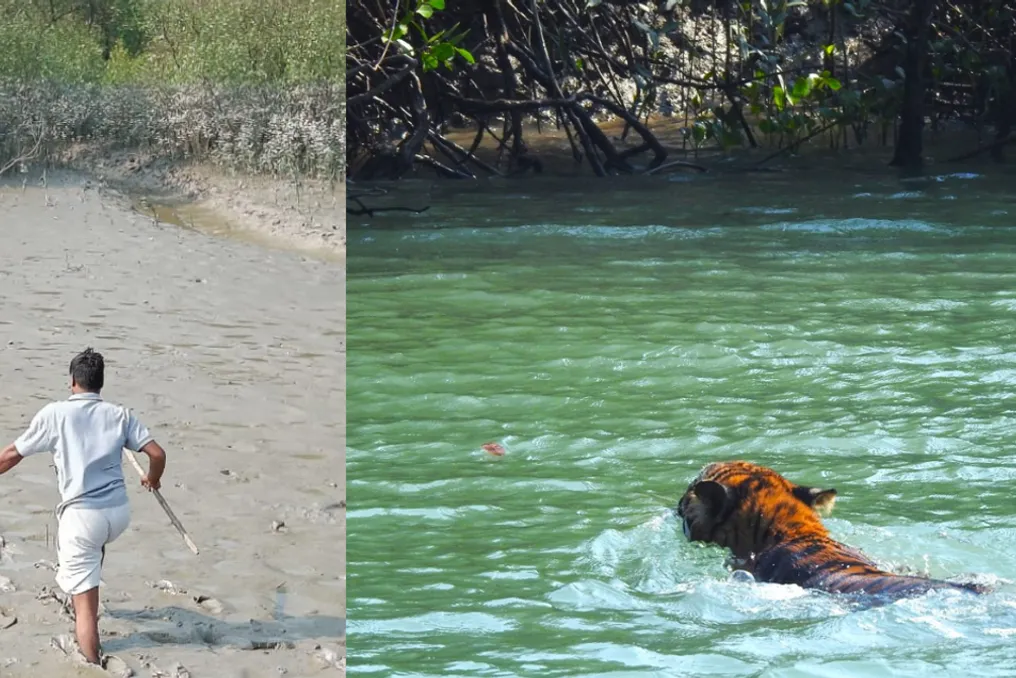
In the Sundarbans delta, a vast area where settlements meet tiger habitats, a complex animal rescue operation is underway. Local residents and trained volunteers work in tropical conditions to safely escort a tiger back into the forest.
Coexistence in the Delta
Local residents acknowledge the necessity of coexisting with tigers. As Pinto Mondal, a member of the Primary Response Team (PRT) of the Wildlife Trust of India (WTI), notes, 'The tiger lives on this side of the river. We live on this side. We must coexist.' This shared life is an everyday reality in the Sundarbans.
However, just decades ago, any appearance of a tiger in a village would cause fear and a reaction aimed at eliminating the threat. The Sundarbans delta covers about 10,000 square kilometers across India and Bangladesh, making it one of the world's largest continuous mangrove ecosystems and a zone of highest priority for tiger conservation.
Habitat Characteristics
The delta is crisscrossed by hundreds of rivers, streams, and estuaries formed by the Ganges, Brahmaputra, and Meghna river systems. It hosts the largest population of Royal Bengal Tigers. According to the 2022 tiger census across India, approximately 101 tigers were recorded, with a density of 4.27 tigers per 100 sq. km.
These tigers differ from their continental counterparts: they are smaller, and adult males weigh an average of 97 to 115 kilograms. Life in the saline swamps has made them strong swimmers, capable of easily crossing tidal rivers, and their fur often appears darker and glossier.
Rescue Operation in the Riverine Environment
The main difference in rescues in the Sundarbans is that the rivers here function as roads for both people and tigers. In this largest mangrove forest, the sole habitat of the Royal Bengal Tiger, there are no forest trails or dry land for pursuit; a tiger can simply swim across a stream and end up in the middle of a village.
The first stage of the operation begins when someone spots tiger tracks, such as fresh prints near a cattle shed or dog barking before dawn. Information is relayed to the Forest Department, the police are notified, and PRT members, trained local volunteers supported by WTI, move toward the scene. The initial goal is to guide the tiger back into the forest.
Planning and Intervention Methods
Because the Sundarbans landscape constantly changes with the tides, teams meticulously plan routes. As explained by Samrat Paul, a field officer for the WTI tiger project, if a tiger enters from the river, that side is not blocked; but if it is driven out of the village, there must remain a way for it to return to the water. Instead, teams block possible escape routes into human settlements, leaving the path leading to the forest open.
Non-lethal methods are used in rare cases. The initial attempt is always to give the tiger a chance to leave on its own. Volunteers and Forest Department staff take safe positions while the Forest Department coordinates actions. To gently drive the tiger away from habitation, drums are used to create a sound barrier, followed by powerful lighting and firecrackers (locally known as potka) after dark. The goal of these measures is not to frighten the animal, but to make the village unfamiliar and uncomfortable for it, while keeping the path to the forest open, as the tiger instinctively prefers the safety of dense cover.
When Intervention is Required
Most operations conclude with the tiger returning to the mangroves on its own. However, sometimes the tiger refuses to leave, hiding in vegetation or a rice field. Only then do teams prepare for the next stage—the use of nets. These nets are strong barriers that gently guide the tiger into a safe enclosure or transport crate. In extreme cases, the Forest Department may use a steel cage with an automatic closing mechanism. Chemical immobilization is considered only in exceptional circumstances.
Reasons for Tigers Appearing in Villages
There is no precise scientific evidence pointing to a single reason for tigers wandering in the Sundarbans. Although people often speculate that it is related to hunger, this cannot be stated definitively. Reasons can vary: territorial movements, pressure from another dominant tiger, or seasonal migrations. Sometimes the landscape itself is to blame: a tiger swimming across a river might mistakenly perceive the shoreline with mangroves as an extension of its territory, unaware that it is actually entering a populated area.
Unlike elephants, which move in herds led by matriarchs, the tiger is a solitary animal and does not have such an inherited 'roadmap.' Samrat Paul recalls a rare case involving a radio-collared tiger around 2008–2009 that repeatedly returned to the same spot near Pahiralay until it was eventually transported to a zoo.
Long-Term Operations and Community Role
Some rescue operations last for weeks. Pinto Mondal recalled an operation in the Kultali area that lasted seven days. During this period, teams used drones at night to search for movement tracks over dense vegetation, as waterways constantly changed with the tides. Despite the multi-day search, the tiger eventually found its way back to the forest, which is considered the best outcome.
According to Mondal, in 2025, 37 instances of tigers appearing in villages were recorded in the Kultali block, and only two required capture. He emphasized that the key factor in success was the cooperation of the villagers. The creation of local PRT groups, known as Bagbondhu or 'Tiger Friends,' allowed the community to respond to incidents first, helping to divert people away from the animal.
Bagbondhu perform functions beyond emergency response: they help maintain fences, participate in Forest Department rescue operations, and advise neighbors on calm behavior when wild animals appear. Samrat Paul notes that people trust advice coming from members of their own community more.
Historical View of Conflict
Basudev Mondal, a PRT member, recalls how the situation was previously perceived solely as a danger. Before organized teams, a tiger meant only a threat, and the first thought was self-preservation. He remembers hearing the phrase 'Baghe khabe' (the tiger will eat you) in childhood, which fostered fear of the animal. Once, a lost tiger wandered six kilometers into a village, and crowds surrounded it, unintentionally blocking all escape routes. As a result, the Forest Department administered a sedative, but the frightened tiger attacked the veterinarian.