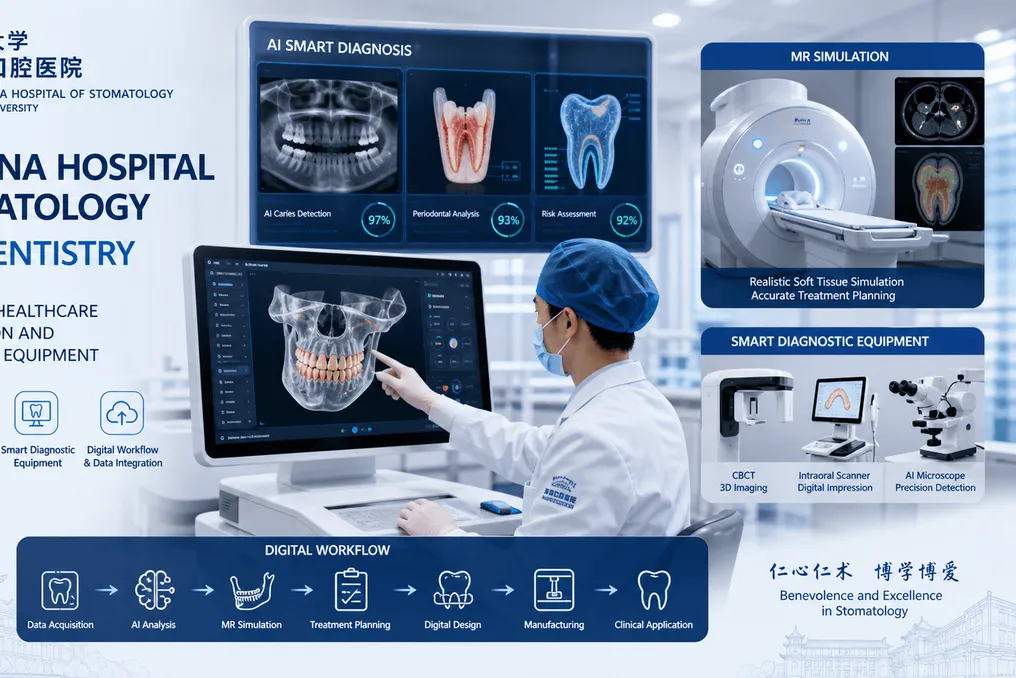
As part of the Digital Technology Week, delegates from Singapore, South Korea, Brunei, and Hong Kong visited the Sichuan Western China Dental Hospital on July 26. They gained practical experience in the transformation of digital dentistry in China.
As part of the Digital Technology Week, delegates from Singapore, South Korea, Brunei, and Hong Kong visited the Sichuan Western China Dental Hospital on July 26. They gained practical experience in the transformation of digital dentistry in China.
International officials lined up to try out mixed reality simulation stations. These stations allowed for the practice of surgical procedures using virtual patients who had a complete three-dimensional reconstruction of their oral cavity in an immersive environment. Jailani Buntar, the official representative of Brunei, expressed surprise, noting that such technologies are usually associated with Western countries, while the demonstration in Western China showed Chinese digital medical equipment at the forefront of global development.
The hospital holds a high position in mainland China and is included in the top 10 of the QS World University Rankings by subject, as well as being the first in China and fifth in the world according to the Shanghai Ranking. It functions as the national experimental training center, IDEA Future Learning Center. This visit was part of four thematic tours organized from July 26 to 29 as part of the APEC Digital Technology Week. The opening session was dedicated to digital healthcare, highlighting Chengdu's status as a center for the digital economy, where healthcare digitalization has reached clinical implementation maturity.
The hospital's technological foundation is based on three main areas: firstly, standardized data management across eight specialties; secondly, the vertical model of Western China's intelligent dentistry, which reduces orthodontic diagnosis time from 30 minutes to less than one minute; and thirdly, the creation of the world's first clinical multimodal pathological big model for joint diagnosis by humans and artificial intelligence.
The technology ecosystem serves over one million outpatient appointments annually through a smart diagnostic system. Furthermore, a 5G platform network covers more than 3,000 medical institutions across the country. The national AI-based virtual simulation center allows medical students to develop clinical thinking in highly immersive digital environments. Research results have generated over 100 million yuan in technology transfer, supporting China's dental industry cluster. The hospital also utilizes multi-omics data databases, AI-based molecular screening platforms, and medical record quality control systems, demonstrating comprehensive digitalization across services, education, research, and industry.
The Western China Hospital has extended its digital dentistry technologies to 40 countries under the Belt and Road Initiative through ongoing international medical technology training programs. President Han Xianglun stated the hospital's intention to share the Western China solution as a scalable and reproducible model of smart dental healthcare via the APEC cooperation platform. The visit by APEC delegates demonstrated the transition of China's dental digitalization from academic research to routine clinical application, creating a complete ecosystem through integrated data management, AI vertical models, and international technology transfer. For the visiting delegates, the demonstration served as a concrete example of how comprehensive data management and AI integration can transform a traditional medical specialty into a digital precision healthcare service.
A new Ebola epidemic is being recorded in the Central African country facing ongoing conflict in the east. According to officials, medics have registered over 3000 cases of the disease, including 1354 fatalities, as part of the seventeenth Ebola outbreak in the Democratic Republic of Congo.
These figures were announced on Sunday after the number of infections increased by approximately 1000 in just ten days. The total number of confirmed cases reached 3075 across five provinces, following the outbreak surpassing the 2000 case mark on July 15. Authorities noted that improved detection and testing methods contributed to identifying a larger number of infections.
The epidemic was declared on May 15 and is caused by the Bundibugyo strain of Ebola, for which there is currently no approved vaccine or treatment. According to the World Health Organization, nearly 90 percent of cases have been recorded in the northeastern province of Ituri, which borders South Sudan and Uganda.
There is a risk that this outbreak could last for several more months. The situation is complicated by strikes among healthcare workers demanding unpaid wages, which disrupts operations in some hospitals. The Ebola virus itself, transmitted through contact with bodily fluids and causing hemorrhagic fever, has claimed the lives of over 15,000 people across Africa in the last fifty years.
Scientists are actively working on developing vaccines and treatments against the Bundibugyo strain. On Friday, Oxford University reported that the first group of volunteers received an experimental vaccine specifically designed to combat this virus. Furthermore, several other potential vaccines are undergoing accelerated preparation for clinical trials, and two possible treatments are also being developed.
Officials from the KwaZulu-Natal Health Department (KZN) are discussing strategies to manage the shortage of medicines that has arisen due to supply chain disruptions.
According to the KwaZulu-Natal Health Department, periodic issues with medicine availability in the province are solely related to disruptions in external logistics processes. To ensure the continuity of healthcare provision, the province is actively managing stocks by using redistribution between clinics and hospitals, as well as employing therapeutic substitutes.
The KZN Health MEC, Nomagugu Simelane, emphasized that the absence of medicines does not mean they were not procured, but rather indicates that suppliers do not have them. Simelane explained that the production of some drugs requires numerous ingredients, and although some medicines are produced in South Africa, many components are purchased abroad.
She clarified that sometimes manufacturers do not have the required drug, or foreign buyers have exhausted their stocks, or one of the necessary components is missing, making further production impossible. Last year, the province faced a shortage of anti-epileptic drugs, but doctors and nurses agreed on the possibility of combining other medications to achieve a similar effect.
The Provincial Pharmaceutical Warehouse Manager, Thandeka Ndjafa, reported that the department has not exhausted its stocks of the affected medicines, but is receiving them in smaller quantities than required. There is currently an issue with the anti-epileptic drug Phenobarbital. A circular letter has been issued by the National Department of Health.
Ndjafa noted that the problem is not limited to KwaZulu-Natal, and they are taking all possible steps to confirm that the root of the problem lies deeper within the supply chain. She linked the disruptions to transport and import issues caused by global wars, which lead to delays in goods arrival.
To resolve this situation, stock redistribution is being used, including mutual borrowing between different provinces, as all regions are facing the same problem. Furthermore, Ndjafa explained that if Phenobarbital cannot be obtained, there are alternative treatment methods.
Ndjafa also mentioned problems with the availability of Rifampicin for tuberculosis treatment, noting that there is also a substitute here. Low supplies have also affected contraceptive pills. She explained that while some types of pills are unavailable, other types are available, as well as other methods of preventing pregnancy, such as injections and implants.
She assured that suppliers promised to resume the supply of all affected medicines. Although some drugs were acquired from alternative suppliers, most suppliers guaranteed that the situation would return to normal by July.
According to official data published on Saturday, the number of confirmed Ebola cases in the Democratic Republic of Congo (DRC) has surpassed the mark of 3000.
Official health authorities in the DRC reported that the outbreak has registered 3075 confirmed cases. Among them, 1354 people have died, and 556 have recovered. Currently, 755 patients are in hospitals or in isolation.
The outbreak has affected five provinces: Ituri, North Kivu, South Kivu, Auto-Uele, and Tshopo.
Prime Minister Judith Suminwa Tuluka stated on Friday that researchers are working on creating a treatment and vaccine against the Bundibugyo virus, which is the strain responsible for the current epidemic in the DRC.
Expressing hope that the vaccine and treatment could appear 'within two to four months,' she announced that the government has allocated funds for research, but did not provide further details on the stage of development or the expected approval process.
Currently, there is no approved vaccine or specifically licensed treatment for the Bundibugyo virus. Several experimental vaccines and therapeutic agents are currently undergoing clinical evaluation.