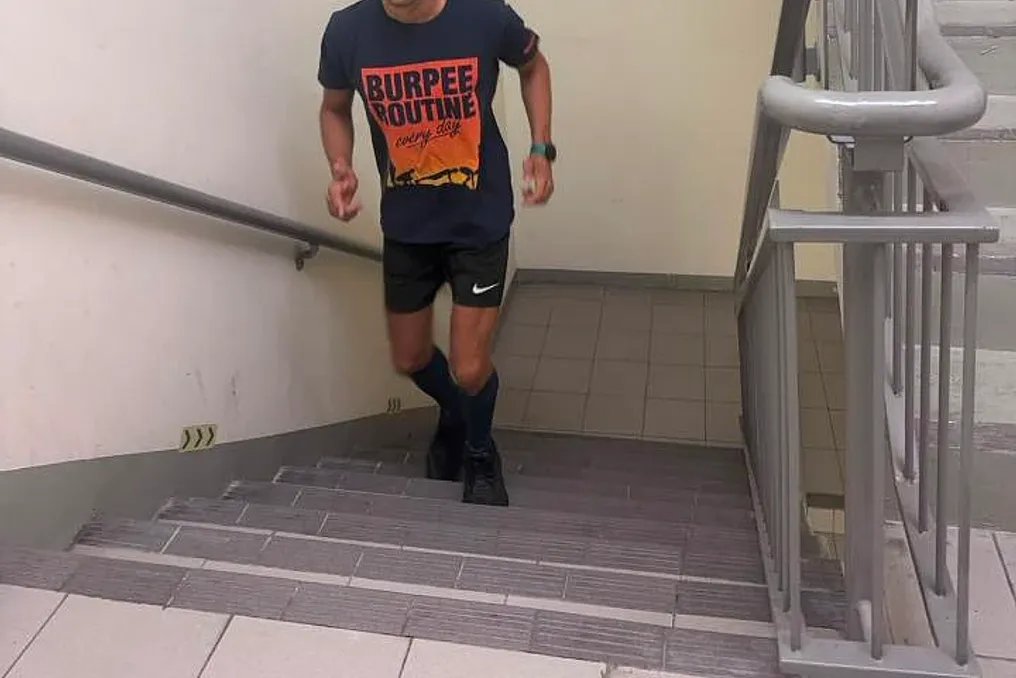
A physical trainer from Abu Dhabi, Velko Vukicevic, spent nearly 16 hours climbing the same staircase to reach the height of Mount Everest, achieving a vertical ascent of 8848 meters.
Conquering the Summit Indoors
During this time, the walls, doors, the staircase itself, and the routine actions remained unchanged. The Serbian trainer decided to transform an ordinary staircase in Rome Island into his own Everest, aiming to demonstrate that exceptional challenges do not require extraordinary conditions. He wanted to show that the biggest obstacles are often mental, not physical, and that any person is capable of taking the first step toward an ambitious goal.
Details of the Record Achievement
To complete this feat, Vukicevic climbed to the 49th floor 59 times, covering approximately 54,000 steps. In almost 16 hours, he burned an estimated 7000 calories, maintaining a pace of about four ascents per hour. Between each climb, he used the elevator to return to the ground floor, minimizing breaks for water, dates, bananas, almonds, and walnuts before starting the next cycle.
Focus on Mental Strength
Vukicevic told Khaleej Times that his goal was not a beautiful landscape, but an environment that demanded complete reliance on mental strength. Unlike traditional Everesting attempts, which are done outdoors using GPS tracking for running, cycling, or hiking, Vukicevic's challenge took place entirely indoors. He noted that while inspired by the concept of Everesting, he was not seeking official recognition because internal stair climbs are not yet accepted for verification due to GPS limitations.
Preparation and Strategy
Planning this challenge took almost a year. Although he did not follow a specific training program, he prepared through rucking exercises, cycling, hill walking, VO2 max training, bodyweight strength exercises, and weekend stair climbing sessions, while simultaneously working as a fitness trainer at the Abu Dhabi Police College.
Instead of chasing speed, Vukicevic focused on consistency. He maintained a steady pace of about four ascents per hour for most of the challenge, using every elevator ride down as a short recovery before the next start. He emphasized: 'My greatest strength was not climbing fast. It was recovering fast enough to start each ascent with almost the same intensity as the previous one.'
Overcoming the Inner Barrier
Nevertheless, he insists that physical effort was only half the battle. He stated: 'The body is capable of much more than we often think. The biggest obstacle was not the height of the floors or fatigue in my legs, but the voice in my head telling me I had done enough.'
As the hours passed, the repetition became relentless. He recalled: 'By the end, I stopped counting floors; I started counting steps. At one point, I paused on a landing, looked up, and thought, 'Do I really have to do this again?' I smiled at myself, took a deep breath, and continued.'
This moment, he said, marked the transition of the challenge from physical to mental. He realized he was no longer fighting the stairs, but his own thoughts. He deliberately avoided listening to music or podcasts during the climb, preferring to remain completely focused. He explained that he divided the day into small goals, one ascent at a time, and that discipline and full concentration, rather than entertainment, would lead him to the finish line.
Logistics and Support
The setting itself amplified the difficulty of the task. He noted: 'The view never changed: the same walls, the same staircase, and the same corridors again and again. That was part of the essence.'
His only companion throughout the day was his colleague Srđan Ostojić, who handled logistics: monitoring his pulse, counting ascents, preparing food and water, calling the elevator after each climb, and helping him maintain concentration. Other people who crossed paths with him were less sure how to react to this unusual sight. He laughed: 'I felt like people were looking at me strangely, but honestly, I was just focused on the next ascent. If I started telling someone what I was doing, I think they wouldn't believe me. They probably would have thought I was crazy or joking.'
Final Message
Despite the physical strain, Vukicevic reported that his body recovered within a few days, feeling only the expected soreness in his calves, quadriceps, and glutes. He hopes this challenge leaves people with a simple message: 'Everyone has their own Everest. Not everyone chooses the same path, but everyone chooses their difficult path.'
For him, this achievement was never about climbing a mountain. He concluded: 'If it inspires even one person to believe they are capable of more than they think and to take the first step out of their comfort zone, then it achieved much more than a sporting result.'