Researchers have discovered geological evidence on Mars dating back more than 3.9 billion years. These rocks were found near the Jezero Crater by NASA's Perseverance rover. This discovery may help scientists understand a period of the Solar System's history that has largely disappeared on Earth due to plate tectonics and erosion.
The Oldest Explored Section
The rocks were found at the edge of Jezero Crater, an area already attracting scientific attention due to signs of a past lake. However, according to the study, these formations are older than the crater itself, making this section the oldest ever explored by a rover on Mars.
Structure and Origin of the Rocks
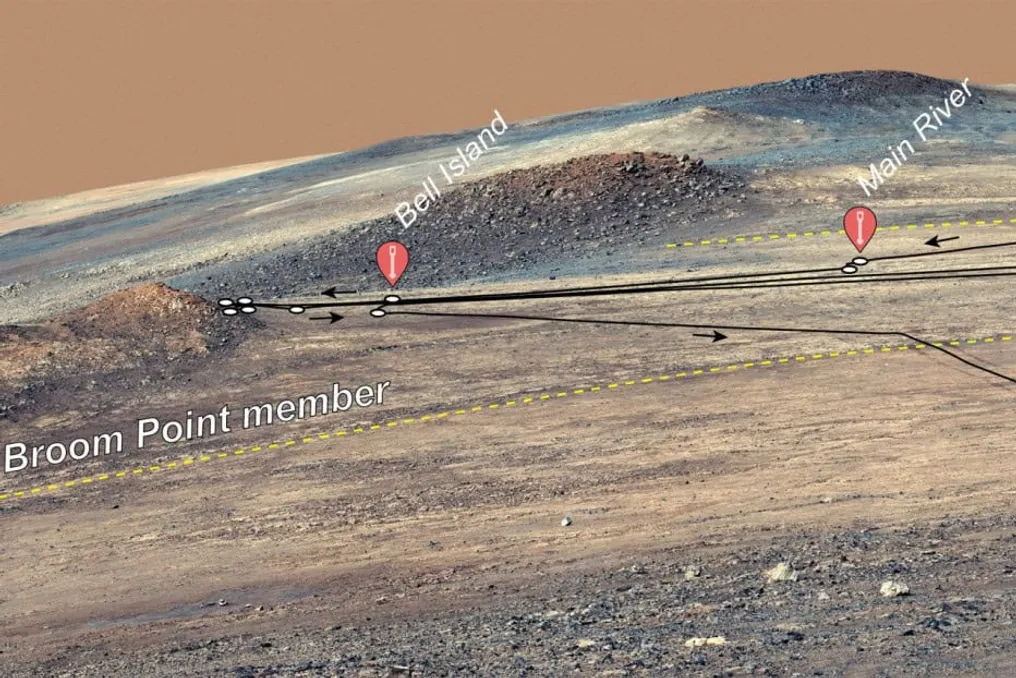
The studied structure is known as the Broom Point member. It consists of a sequence about 75 meters thick, made up of numerous rock layers accumulated over a long period. Researchers believe these layers did not form from a single geological event but developed gradually from debris caused by successive asteroid impacts during one of the most turbulent periods in the Solar System's history.
Ken Farley from the California Institute of Technology (Caltech) in Pasadena (USA) told Earth.com: 'Since leaving the crater, Perseverance is exploring a completely new boundary, both geographically and geologically—a chapter of Martian time preceding the crater itself.' He emphasized that Mars has preserved records that have vanished on Earth. 'On Earth, our oldest geological history has been fundamentally fragmented, deformed, and erased by plate tectonics. Since Mars lacks plate tectonics to recycle its crust, this ancient record remains untouched, offering us a rare glimpse into a geological period absent on our own planet.'
Six Types of Rocks Discovered
After landing on the western rim of Jezero Crater in early 2025, Perseverance used its scientific instruments to study the Broom Point formation. During the investigation, the rover identified six different types of rocks. Among them were breccias, composed of fragments of fractured rocks mixed with thin layers of stony dust.
Some of these fragments contain small cavities left by ancient gas bubbles, indicating they were once in a molten state. Scientists also found a large amount of fine dark, glassy particles distributed throughout the formation. Although volcanoes can produce similar materials, researchers argue that this does not typically happen in such large volumes, making the hypothesis of asteroid impacts the most likely. According to the study, the largest particles are comparable in size to material ejected into the atmosphere during the Chicxulub asteroid impact about 66 million years ago, which led to the extinction of dinosaurs on Earth.
Layers as Evidence of Impacts
The repetition of different rock types led researchers to conclude that the region was subjected to multiple impacts over time, rather than a single major collision. Each impact presumably deposited a new layer of debris over the previous ones, forming the observed thick sequence. Alex Jones from Imperial College London (UK) explained: 'The different rock layers are a record of variable-sized impacts occurring at different distances from where this rock sequence accumulated. Some large impacts happened very far away, while some smaller impacts were nearby. All their debris fell here, building up this thick layer of rock.'
Researchers also found signs that some layers might have formed from rapid flows of debris moving close to the surface. On Earth, similar phenomena can occur when extremely hot material contacts water or ice, rapidly producing a large amount of steam. This raises the possibility of water or ice involvement in the formation of these rocks on Mars.
Two Major Impacts Shaped the Region
Another aspect that caught the team's attention is the tilt of the rock layers. Some have angles exceeding 80 degrees and are nearly vertical today. Researchers concluded that the impact responsible for forming the Jezero Crater, which is about 45 kilometers in diameter, cannot explain this deformation. The proposed hypothesis is that the region was shaped by two major impacts occurring at different times.
The first impact likely created the massive Isis Basin, a structure about 1930 kilometers in diameter, whose collision probably tilted and deformed the initially horizontal layers. Later, another asteroid struck the area, forming Jezero Crater and fragmenting the already tilted rocks, leading to the observed structures.
Samples Will Help Reconstruct Chronology
To determine when these events occurred, the Perseverance team collected two samples of rock core, named Bell Island and Main River. If a future mission can deliver this material to Earth, researchers will be able to use laboratory instruments to accurately date the rocks. These analyses will also help estimate the frequency of asteroid falls on both Mars and early Earth.
While much of this chronicle has vanished from our planet due to the constant recycling of Earth's crust by tectonic plates, Mars has preserved this evidence thanks to its much older and less altered surface. Alex Jones noted: 'During this turbulent epoch, what fell from the sky was not rain or snow, but almost a constant bombardment of droplets of molten rock and pulverized dust ejected by asteroid impacts. If we can date these layers, it will be like reading a cosmic meteorological report from 4 billion years ago.'
}, {