A new study suggests that the Milky Way may be generating a considerably higher amount of antimatter than current estimates. This possibility arises after researchers identified indications that positrons are leaving the galaxy before being destroyed.
First Extragalactic Detection
The research, conducted by Thomas Siegert from Julius Maximilian University of Würzburg and Hiroki Yoneda from Kyoto University, presents evidence that could constitute the first detection of the gamma ray signature resulting from the annihilation between matter and antimatter outside the boundaries of the Milky Way.
The authors argue that if the findings are validated, it would imply that a portion of the positrons generated in the galaxy manages to travel beyond its disk before colliding with electrons and annihilating. Siegert told ScienceAlert that such an event would be the first detection of extragalactic positron annihilation, which in itself would indicate a much larger positron content in the Milky Way than what has been observed internally.
The Positron Enigma
Positrons are the antimatter counterpart of electrons, possessing the same mass and spin but with the opposite electric charge. When a positron encounters an electron, annihilation occurs, releasing a flash of gamma rays with a specific energy of 511 keV.
Astronomers have monitored this gamma ray emission in the Milky Way for decades to locate annihilation points. However, the amount of positrons observed exceeds what known astrophysical sources can justify. Even accounting for production by radioactive isotopes from stellar explosions, black holes, and neutron stars, the detected signal remains above predictions.
INTEGRAL Data Analysis
The new indications were obtained through a complete analysis of data collected by the INTEGRAL space telescope, belonging to the European Space Agency (ESA), which observed the sky in gamma rays between 2002 and the end of its mission in 2025.
While creating the most detailed maps of the 511 keV emission from the Milky Way, Siegert and Yoneda noticed unusual signals. Siegert explained that by dividing the data into three-year intervals and comparing the accumulated images, the signals remained constant and appeared to intensify over time, which would not be expected from a systematic equipment error.
Signals Outside the Galactic Disk
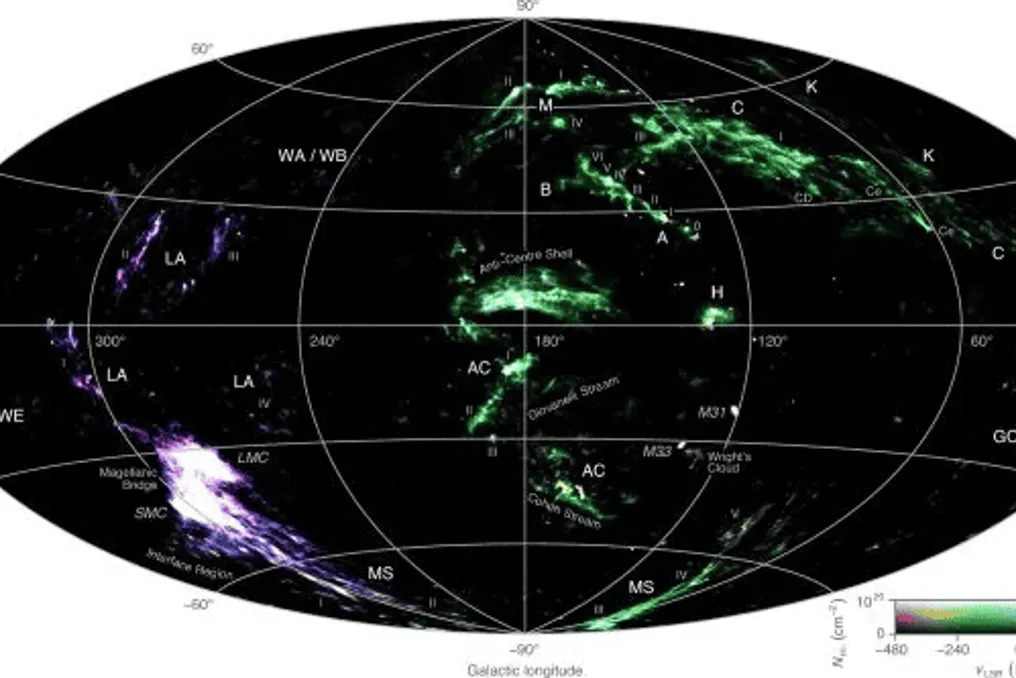
The most robust signal was located in Complex C, a vast cloud of hydrogen falling towards the Milky Way disk. Additionally, a preliminary indication emerged in the Magellanic Stream, an extensive band of gas associated with the Large and Small Magellanic Clouds during their orbit around the Milky Way.
The researchers point out that none of these areas should generate a significant amount of positrons on their own, suggesting that these particles might have migrated to these locations before undergoing annihilation.
Implications and New Challenges
The hypothesis that positrons escape the Milky Way imposes a new scientific dilemma. Siegert clarified that for annihilation to be efficient, the positrons must be slow, which contradicts the common idea of antimatter violently destroying matter in space. Therefore, escape implies the existence of a population of positrons with higher energies, capable of leaving the galaxy before losing speed.
This unexpected escape suggests that the Milky Way produces much more antimatter than previously thought. Scientists estimate that the galaxy may emit about 100 undecillion positrons per second, a value two to three times higher than previous projections. However, Siegert emphasized that the fundamental problem lies in explaining the total amount of positrons in the Milky Way, as conventional astrophysical sources may not be sufficient.
Need for Future Confirmation
Despite the potential of the discovery, the authors warn about uncertainties in the results. The strongest signal reached a statistical significance level of 4 sigma, representing an error probability of about one in fifteen thousand, while physics requires 5 sigma for definitive confirmation.
Siegert expresses confidence in the existence of a real signal but stresses that additional observations are crucial. An important expectation rests on the Compton Spectrometer and Imager (COSI), a NASA mission planned for 2027, which should verify the authenticity of these signals and aid in locating the production of galactic positrons. If future observations corroborate the findings, the mystery of antimatter in the Milky Way may require the adoption of unconventional models, such as light dark matter particles.