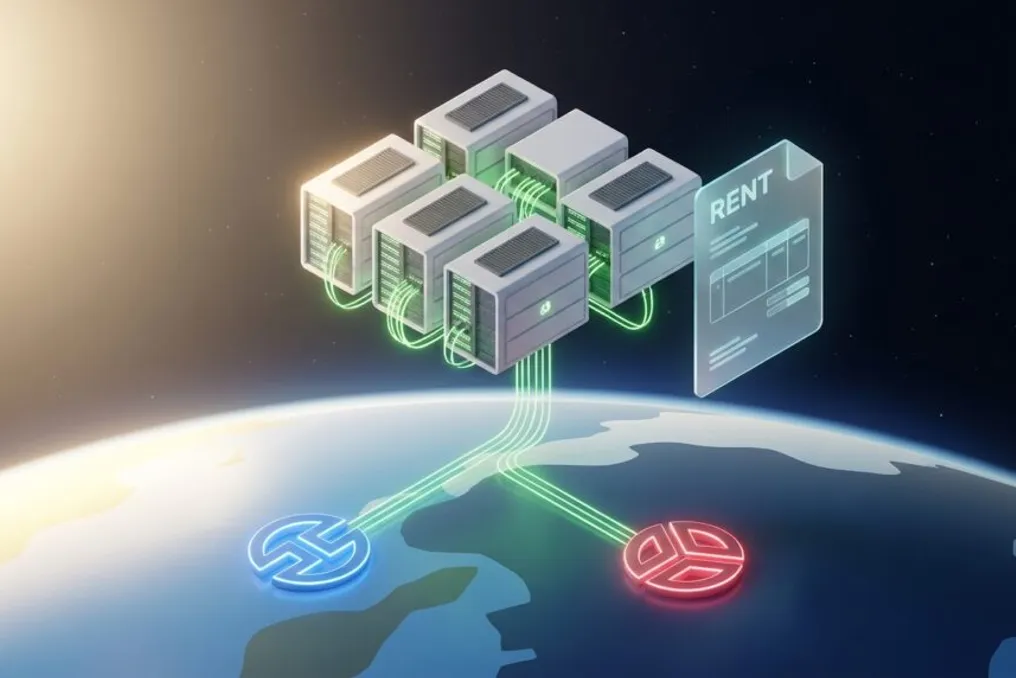
SpaceX has begun generating significant revenue from renting out data center capacity provided to major players in the artificial intelligence sector. Contracts with Anthropic and Google secure a monthly income for the company that exceeds SpaceX's annual turnover in 2025.
Agreement with Anthropic
Anthropic has signed an agreement with SpaceX to pay $1.25 billion monthly (equivalent to 22.9 billion riyals) over three years. This deal, signed in May, grants Anthropic access to over 220,000 Nvidia GPUs and computing power exceeding 300 megawatts, comparable to the energy consumption of a small city. These capacities are located in the Colossus 1 data center in Memphis, Tennessee.
Contract with Google
Several weeks later, the search giant Google also signed a lease agreement. Under the terms, Google will pay SpaceX $920 million (or 16.8 billion riyals) monthly, starting in October. This contract is estimated at 110,000 GPUs and will run until June 2029. In total, both contracts bring in $2.17 billion (or 39.7 billion riyals) per month, amounting to about $26 billion (or 476 billion riyals) annually. This sum surpasses SpaceX's entire annual revenue for 2025, which was $18.67 billion (or 341.7 billion riyals), according to the company's S-1 report.
Infrastructure and xAI
Both companies are paying for infrastructure that was originally built for Musk's venture project—xAI. SpaceX acquired xAI in February through an all-stock deal valued at approximately $1.25 trillion (or 22.9 trillion riyals). After the merger, the combined entity went public in June at a price of $1.77 trillion (or 32.4 trillion riyals), and on its first day of trading on Nasdaq under the ticker SPCX, its value exceeded $2.1 trillion (or 38.4 trillion riyals), making it the largest initial public offering in history.
Revenue vs. Starlink
SpaceX is building data centers, and AI companies are paying to use them. The rental fee now surpasses all other sources of company income. The satellite internet business, Starlink, which was previously SpaceX's main source of revenue, generated $11.4 billion (or 208.6 billion riyals) in 2025. Just these two AI capacity rental contracts will provide an annual income more than double this amount.
Reasons for Growing AI Demand
The existence of these deals is due to the fact that the AI industry faces a problem that financial aspects alone cannot solve: there are not enough chips, electricity, or data centers on Earth to meet the growing demand. Anthropic needs capacity for its Claude models, while Google requires so-called 'bridge capacity' for its Gemini Enterprise agent AI platform, which is growing faster than Google's own infrastructure can handle.
The Future: Space Data Centers
In January, SpaceX applied to the U.S. Federal Communications Commission for permission to launch and operate up to one million satellites as part of its orbital data center system, internally named Starmind. The AI1 satellite design features a 70-meter wingspan and a peak computing load of 150 kilowatts, with the ability to swap equipment for various processors. Musk stated his intention to begin launching these satellites by 2028 using Starship, describing space as 'the only way to scale AI.'
Technology and Implementation
The justification for this is continuous solar energy and reduced cooling costs, which are the two largest operational expenses for ground-based data centers. Nvidia has already developed a specialized chip for this purpose. The Space-1 Vera Rubin module, announced at GTC 2026, is designed to provide data center-level computing power in space, offering up to 25 times greater AI computing power per GPU compared to the H100. It is expected to be available in 2027.
Financial Outlook
The question of whether orbital data centers will be implemented on time remains open. However, terrestrial revenue is already real. The Anthropic contract alone could generate over $40 billion (or 732 billion riyals) over the three-year period. Additionally, if the Google contract is fully executed, it will add another $30 billion (or 549 billion riyals). The termination conditions of the agreements are quite flexible: Google can exit the deal with 90 days' notice after December, and the ramp-up period for Anthropic has already concluded. Thus, Musk has found a way to charge rent to companies creating the future, and regardless of whose model wins—Claude, Gemini, or its own Grok—the landlord gets paid.