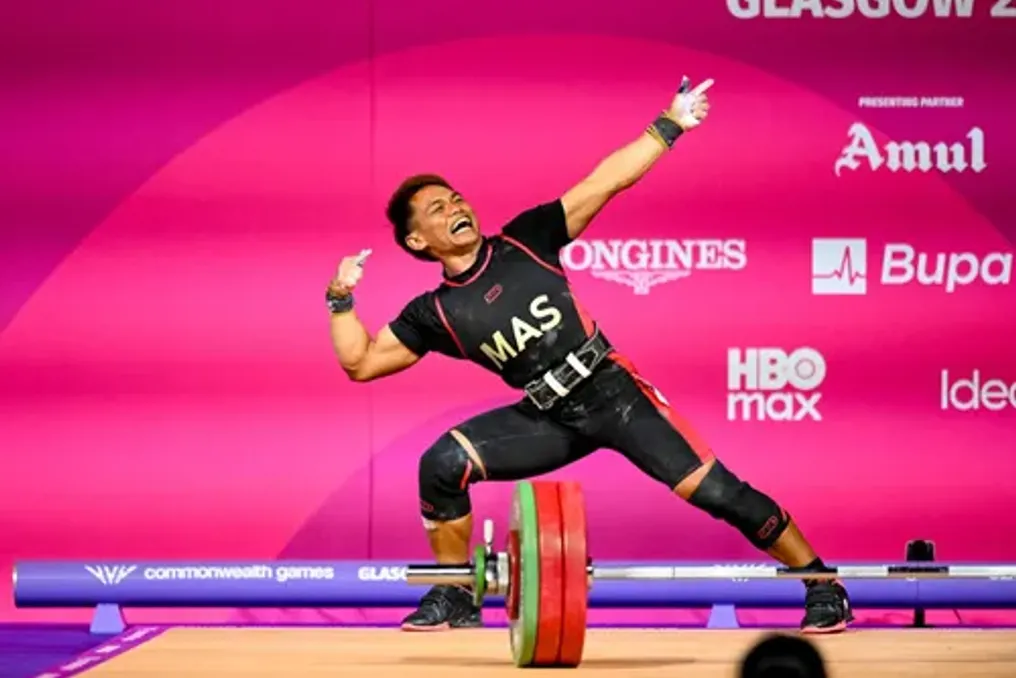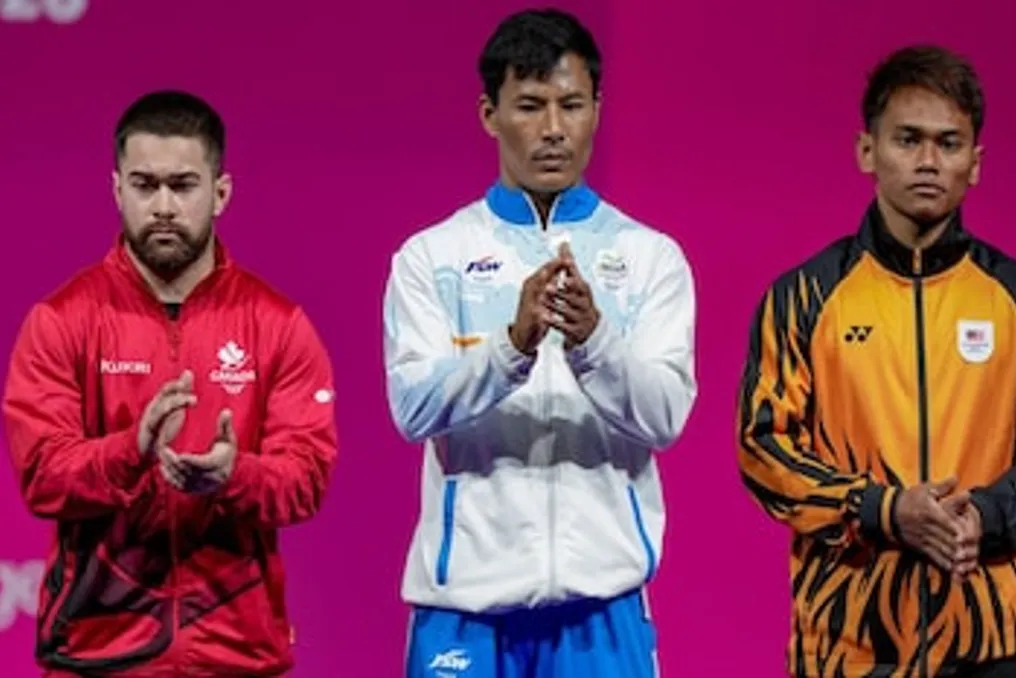
Rishikanta Singhambam won a silver medal at the 2026 Commonwealth Games in Glasgow, becoming the first athlete from India to achieve such an award. He placed second in the men's 60 kg weight division in weightlifting.
Rishikanta Singhambam won a silver medal at the 2026 Commonwealth Games in Glasgow, becoming the first athlete from India to achieve such an award. He placed second in the men's 60 kg weight division in weightlifting.
Furthermore, Rishikanta set a new Commonwealth Games record in the snatch discipline, successfully lifting 121 kg in the final of the men's 60 kg category. He later achieved a lift of 143 kg in the clean and jerk, reaching a total of 264 kg. Mohammad Anik Kasdan from Malaysia won the gold medal with a total of 273 kg, while Joshua Amung Mboya from Kenya was awarded bronze with a total of 260 kg.
Rishikanta's silver medal increased India's total medal count to two, after para-weightlifter Jandu Kumar opened the country's account with a bronze medal on the opening day of the Games.
Born on July 5, 1998, in Imphal West, Manipur, Rishikanta began training in weightlifting at one of India's leading centers. He trained at the National Sports Academy (NSA) in Human Lampak, graduating in 2018, after which he joined the Sports Service Control Board (SSCB).
The rigorous training environment helped him establish himself at the domestic level, where he consistently showed high results in light categories and made it into the Indian squad. His debut at the Commonwealth Games was at the Birmingham 2022 Games in the men's 55 kg category. Although he did not win a medal, this experience proved invaluable as he competed against some of the best Commonwealth weightlifters.
After the restructuring of international weight categories, he moved to the 60 kg division, where he quickly became India's main contender. His consistent performances at the national level paved the way for more significant international achievements.
A turning point in Rishikanta's career was the 2025 World Weightlifting Championships in Ahmedabad. Competing in front of a home crowd, he lifted 120 kg in the snatch and 151 kg in the clean and jerk, setting a national record of 271 kg and winning the gold medal. This result also set Commonwealth Championship records in the clean and jerk and total, securing his spot at the Glasgow Commonwealth Games.
Later that year, Rishikanta participated in the World Weightlifting Championships, where he finished 11th among elite world-class athletes, demonstrating his ability to compete with the best in the sport.
Rishikanta continuously updated Indian records. He set the Indian national record in the men's 61 kg snatch at the 2024 Indian Weightlifting Championships, lifting 124 kg. He then set the Indian national record in the total for men's 60 kg (271 kg) by winning the 2025 Commonwealth Weightlifting Championships.
At the Glasgow Commonwealth Games, he reached another milestone by lifting 121 kg in the snatch, becoming the first athlete to lift this weight at the Games and setting a new Commonwealth Games record. Despite ultimately receiving a silver medal, this record remains his.
Rishikanta Singh was awarded the Commonwealth Games snatch record for successfully lifting 121 kg, even though his closest competitor and future gold medalist, Mohammad Anik Kasdan from Malaysia, also lifted the same weight in the men's 60 kg competition. The Indian weightlifter was recognized as a record holder because he was the first athlete to successfully lift 121 kg, surpassing the previous Games record of 120 kg.
Although Anik later repeated the 121 kg lift, his effort was registered as an equality with the Commonwealth Games record, not a surpassing of it. According to the rules of the International Weightlifting Federation (IWF), when multiple athletes lift the same record weight, the record belongs to the first athlete who achieved it, and subsequent ones are recognized as having reached that level.
As a result, Rishikanta retains the official status of Commonwealth Games snatch record holder in the men's 60 kg category with a weight of 121 kg.
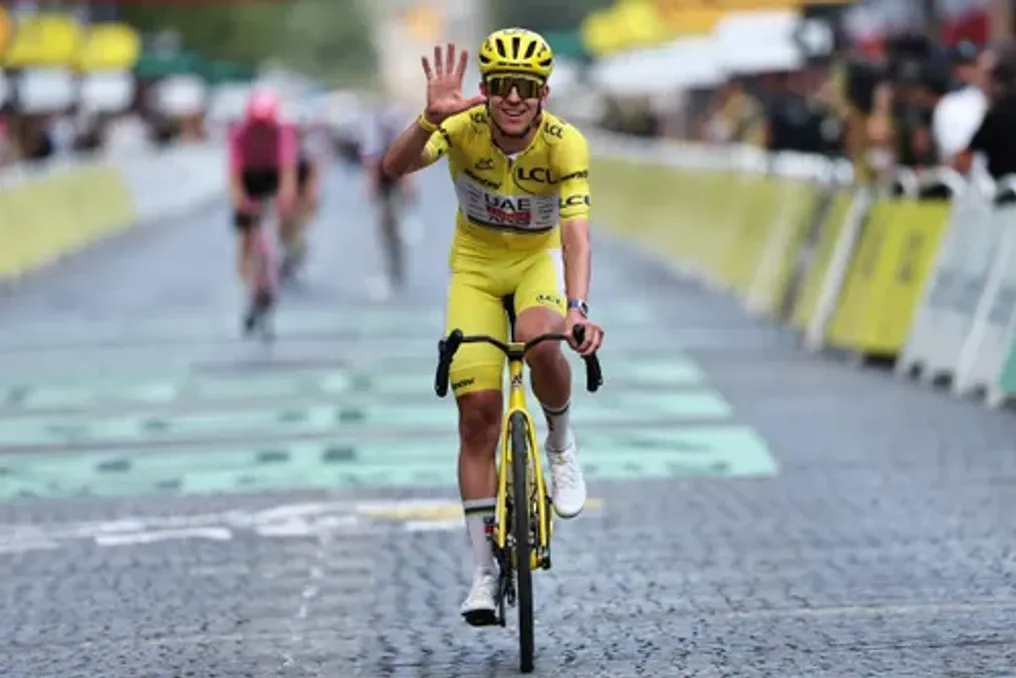
Tadej Pogačar secured his record-equalling fifth Tour de France title following a sensational 21st and final stage near Paris on Sunday, which was won by Mathieu van der Poel.
Pogačar, a two-time world champion, now joins the ranks of the most successful riders in Tour history alongside Jacques Anquetil, Eddy Merckx, Bernard Hinault, and Miguel Indurain. He had effectively clinched his historic title during the preceding two mountain stages concluding on the famous Alpe d'Huez climb.
The 27-year-old Slovenian rider managed to win five stages throughout the race and had worn the yellow jersey since his victory on the sixth stage in the Pyrenees. His total count of stage victories reached 26, placing him fourth on the all-time list, behind only Mark Cavendish (35), Merckx (34), and Hinault (28).
Furthermore, Pogačar surpassed both Indurain and Chris Froome regarding the total number of days spent in the yellow jersey, accumulating 70 days, though he remains behind Hinault (75) and Merckx (96). He holds the distinction of being the youngest rider to achieve five Tour victories, surpassing Merckx by over a year, and is the first athlete to reach the podium for seven consecutive years. Additionally, he is the sole rider to have been on the podium in nine successive Grand Tours.
The Slovenian participated in the dramatic final stage, which was shortened to 88.7km due to wildfires occurring in the southwest region. On the final ascent of Montmartre, Van der Poel and Pogačar managed to escape together with 10km remaining, subsequently battling against a group of sprinters closing in towards the finish line. As Pogačar's energy waned in the final 700 meters, and with the pursuers mere seconds behind, Van der Poel managed to break away alone.
The specialist in cobbled classics successfully maintained his lead to win by half a wheel length in a photo finish against his Alpecin–Premier Tech teammate, Jasper Philipsen, with Mads Pedersen securing third place. This marked Van der Poel's second stage victory in the 113th edition of the Tour and his fourth overall.
Remco Evenepoel, an Olympic champion, finished second overall, trailing by nearly six and a half minutes, while Isaac Del Toro from Mexico placed third. Dane Pedersen had a successful Tour, winning the sprinters' green jersey competition. Richard Carapaz of Ecuador triumphed in the polka dot King of the Mountains jersey category, having won two mountain stages, and was also recognized as the Tour's most combative rider. Isaac Del Toro earned the best young rider's white jersey.
Julian Alaphilippe, a two-time world champion from France, announced that he was participating in his final Tour. The 34-year-old had previously held the prestigious yellow jersey for 14 days in 2019 before relinquishing it two days prior to arriving in Paris.
The Tour proved historic in several respects. It was only the third time in 113 editions, following 1926 and 1999, that no French competitor won a stage. More remarkably, it is the first instance in 302 Grand Tours—including the Giro d'Italia and Vuelta a España—where no rider from France, Italy, or Spain has won a stage. In contrast, stages were won by riders from Slovenia, Mexico, Ecuador, and Denmark, illustrating the expansion of cycling beyond its traditional Western European origins.
The entire peloton established a new record for the fastest road stage ever recorded. The 11th stage, running from Vichy to Nevers, was completed at an average speed of 50.9km/h, surpassing the previous record of 50.35km/h set in 1990. By finishing third, Del Toro became the first Mexican rider to reach a Tour podium, while 19-year-old Paul Seixas became the youngest participant in the Grande Boucle since Adrien Cento in 1937.
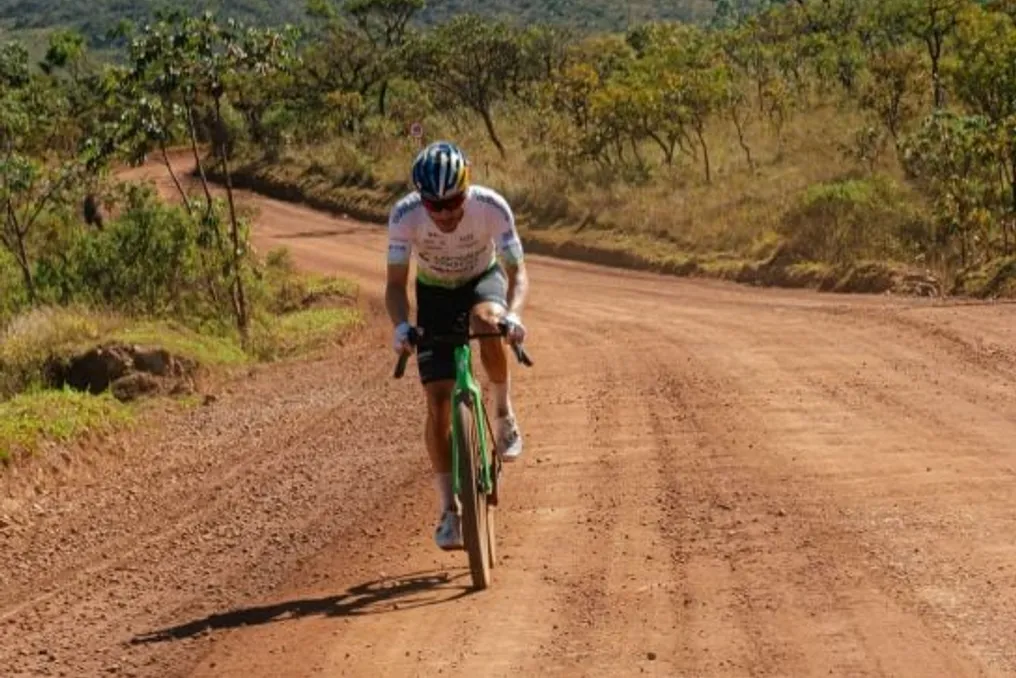
The Brazilian Gravel Championship, held in Rio Acima, Minas Gerais, on the first Sunday of July (the 5th), marked a new phase for national cycling, consolidating Gravel in the Brazilian sports calendar. The competition was organized by the Brazilian Cycling Confederation (CBC) in collaboration with Avelar Sports.
Gravel, which spontaneously emerged in the United States by merging the speed of road bikes with the freedom of dirt roads, has moved beyond being just a trend to establishing itself as a major bet in the sports sector. The inaugural event crowned the first national champions: Henrique Avancini in the Elite men's category and Flávia Oliveira in the Elite women's category.
Although it may seem like a fusion between mountain biking and road cycling, Gravel has its specific characteristics. Its bikes are visually similar to road bikes but feature wider tires, more comfortable geometry, and suitability for various types of terrain. Races typically include sections of asphalt, dirt, gravel, and rural paths, demanding endurance, technique, and adaptability.
This versatility drives its growth, as it attracts cyclists from different backgrounds, including mountain bikers, road cyclists, and beginners. This advancement has gained global sporting recognition, with the Union Cycliste Internationale (UCI) establishing the World Gravel Championship in 2022 and the UCI Gravel World Series circuit.
The choice of Rio Acima, a city in Minas Gerais known for its rural roads and mountains, was strategic, as it offers the ideal terrain for the discipline. The Elite course totaled about 95 kilometers, covering extensive sections of dirt, gravel, secondary roads, and paved roads, totaling an accumulated descent of almost 3,000 meters, making the race physically challenging.
In the men's field, Henrique Avancini reaffirmed his dominance, finishing the course in 3 hours, 36 minutes, and 40 seconds, securing the unprecedented Brazilian Gravel title. Sherman Trezza came in second place, followed by André Gohr on the podium. Avancini's achievement comes during a transition period in his career, after building a notable trajectory in Brazilian mountain biking, including world titles and leadership in the UCI rankings.
Regarding the women's category, Flávia Oliveira became the first Brazilian Gravel champion, completing the race in 4 hours, 34 minutes, and 18 seconds. She surpassed Isabella Lacerda and Ana Laura Moraes, who obtained silver and bronze, respectively. Oliveira's victory also symbolizes the convergence of disciplines, given that her main competitors came from mountain biking.
José Luiz Vasconcelos, Secretary-General of the CBC, highlighted that the creation of this championship transcends the simple addition of a race to the calendar. He considers the event a crucial step in following the international expansion of Gravel and strengthening the development of the discipline in the country. According to him, this is a historic moment that integrates Brazil into the global movement with a structured national championship.
The future points to constant growth, evidenced by the increase in specific Gravel bike models in the Brazilian market and the emergence of dedicated events in different states. The discipline also benefits from the growing interest in cycle tourism and outdoor experiences, solidifying the first Brazilian Gravel Championship as the turning point for the sport in Brazil.
Ruben Ward achieved a historic victory by winning the gold medal in the men's all-around gymnastics event for Scotland at the Commonwealth Games held in Glasgow. This win marked the first medal for his country in the men's all-around event at the Commonwealth Games.
On Sunday, Ward won the men's all-around gymnastics final. He managed to edge out Felix Dolci from Canada by only 0.200 points, while Jesse Moore from Australia secured third place. Ward expressed his joy after the results were announced, noting that it felt like climbing a mountain, and thanked his family and teammates.
Dolci, who was part of the Canadian team that won gold, fell twice from the parallel bars early in the competition but then delivered five near-flawless performances to nearly clinch the victory. Highly anticipated Luke Whitehouse from England finished seventh after a disappointing day.
A few hours after winning bronze in the 100-meter breaststroke, Ramsey-Pity returned to the pool, aiming to rectify his setback in the 50-meter freestyle. The three-time Olympic champion cried after failing to secure gold at the fourth Commonwealth Games on Saturday evening. Ramsey-Pity even questioned the continuation of the 100-meter event, believing that the shorter, more explosive 50-meter freestyle better suited his strengths. However, the Englishman only placed fifth in the qualification for the semi-finals the following Sunday, once again losing to Sam Williamson from Australia, who won gold in the 100-meter freestyle. Australian Olympic champion Cameron McEvoy also participated in the 50-meter freestyle final.
In the biggest group stage match in volleyball, Australia secured a convincing victory over England with a score of 66-47. The defending champions took a 35-24 lead at halftime, but England managed to keep hope alive through a tense final quarter, which they won 12-10, minimizing the damage. England, which will play Malawi next Monday, started its competition with an impressive 84-35 victory over Northern Ireland. They will likely need to defeat South Africa in the final group match on Thursday to have a chance of reaching the semi-finals and maintaining medal hopes.