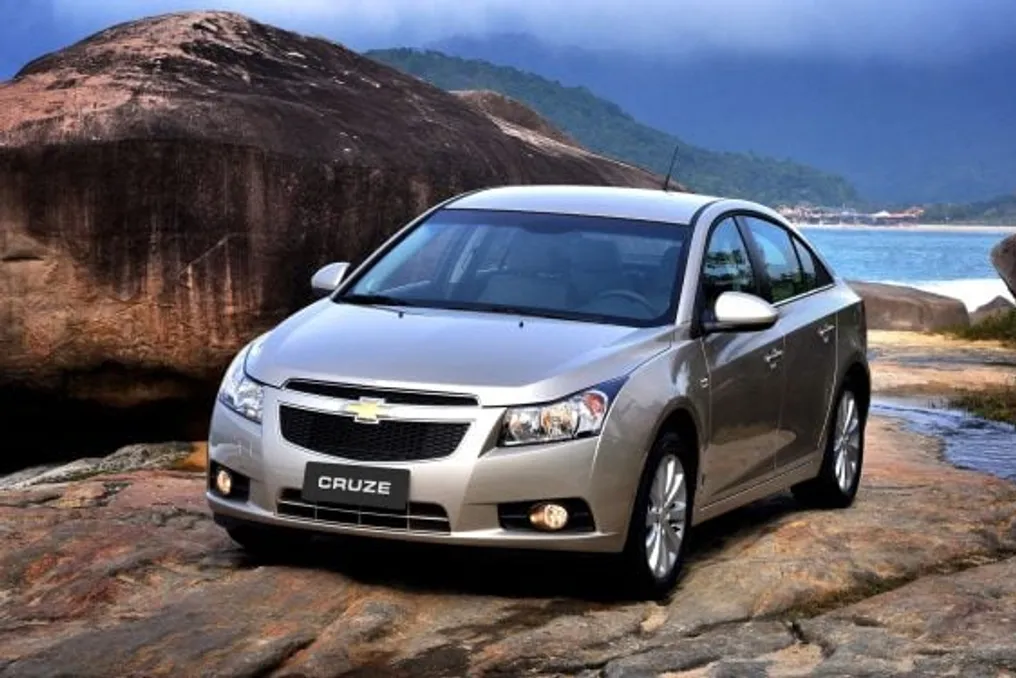
The Chevrolet Cruze, a mid-size sedan, presents itself as a spacious and well-equipped alternative for those seeking a comfortable used vehicle for daily use, offering a more accessible cost compared to models like the Honda Civic and Toyota Corolla.
Positioning in the Mid-Size Sedan Segment
Although the mid-size sedan segment has been challenging for non-Japanese brands, the Chevrolet Cruze managed to establish itself as an intermediate option between the popular Honda Civic and Toyota Corolla. This car had two generations and was manufactured over 13 years, maintaining a more advantageous cost-benefit ratio against its Japanese rivals, which kept it as the third best-selling model in the category for a long period.
Cruze History and Generations
The global launch of the Chevrolet Cruze occurred in 2009, and it was once the best-selling car for the brand worldwide. In Brazil, the General Motors mid-size sedan was introduced in September 2011, replacing the Astra Sedan. Produced in Rosario, Argentina, the vehicle initially came in two versions, using the same naturally aspirated 1.8 engine, with options for a manual or six-speed automatic transmission. The manual option was discontinued in 2015. In November 2014, the Chevrolet Cruze received a cosmetic facelift. The second generation, named Project Phoenix, was launched in June 2016, equipped with a 1.4 turbo engine. Following the pattern of few versions, it had a special series and was updated in 2019, being discontinued after exceeding 200 thousand sales in Brazil, combining both generations.
Hatch Version and 1.8 Engine Performance
In addition to the sedan, the Cruze line also generated a mid-size hatchback, even at a time when the segment showed signs of decline. In the first generation, nicknamed Sport6, the hatchback shared the same mechanical setup and options as the three-volume model. It is important to note that the number after the name refers to the six-speed transmission, not a six-cylinder engine.
Focusing on the first generation, the 1.8 naturally aspirated Ecotec engine produces 144 hp with ethanol and 140 hp with gasoline. These horsepower figures are well utilized by the six-speed automatic transmission during initial accelerations. The 0 to 100 km/h time exceeds 11 seconds, which does not imply slowness; rather, the driving demonstrates agility and a somewhat 'sporty' character compared to its Japanese competitors of the time, especially the Corolla.
However, during overtakes, the same automatic gearbox that performs well in take-offs can be disappointing, as it is slow to respond and frequently downshifts two gears to propel the sedan. The torque, which ranges between 18.9 and 17.8 kgfm, is available at 3,800 rpm. A positive aspect is the performance on steep climbs, as the GF6 gearbox had an inclination sensor that activated engine braking when detecting a descent without driver acceleration.
Consumption and Dynamics of the Cruze 1.8
The fuel consumption of the Chevrolet Cruze 1.8 (2011-2015 model) is considered high. The averages recorded for the 2013 model year of the General Motors sedan are: 6.6 km/l in the city with ethanol; 8.6 km/l in the city with gasoline; 9.1 km/l on the highway with ethanol; and 11.8 km/l on the highway with gasoline.
In terms of dynamics, the Cruze stands out for its sportier posture within a traditional segment. The driver feels control over the vehicle, aided by precise steering. The suspension, which uses a torsion beam at the rear, is also firmer. In curves, the sedan appears balanced, attacking well and minimizing body roll.
Interior Space and Comfort
With dimensions of 4.60 meters in length, 1.79 m in width, 1.47 m in height, and 2.68 m wheelbase, the Chevrolet Cruze accommodates its occupants well. The driver has a good driving position, and the steering wheel allows for height and depth adjustments. There is good legroom for the driver, although the door trim slightly limits the knee space. In the back seat, there is adequate space for two adults and one child, but the low roof makes it difficult for people taller than 1.75 m to enter.
The interior finish uses a lot of good quality plastic with correct closures most of the time. The first-generation LTZ version still incorporates elements that simulate metallic finishes and soft upholstery. However, the stiffer suspension does not provide much comfort to the occupants, especially with low-profile tires (225/50 R17), causing discomfort to passengers when going over bumps and speed bumps. Other negative points include the low ground clearance, at 13.1 cm, and the front deflector, which can cause scrapes on garage ramps, in addition to poor acoustic insulation, allowing the engine vibration to be felt in the cabin.
Recommendation and Equipment for the 2013 Model
For the year 2013, the top-of-the-line LTZ version of the GM mid-size sedan is recommended. In terms of safety, the car features six airbags, electronic stability and traction control, a rear parking sensor, four-wheel disc brakes, electrochromic rearview mirror, and headlight height adjustment. The air conditioning system is automatic, and the version came equipped with a basic multimedia center that included native GPS, CD player, USB input, and Bluetooth connectivity, in addition to steering wheel controls with height and depth adjustments. Other standard items include a proximity key for door unlocking, electric power windows, light and rain sensors, leather seats, front and rear armrests, trunk and glove box lighting, and cruise control.
Used Price Comparison
When comparing the Cruze with the top-of-the-line versions of its competitors in the same year, the Chevrolet model proves to be significantly more economical in the used market. According to KBB Brazil (July 2026), the average prices are: Chevrolet Cruze LTZ 1.8 16V 2013 costs R$ 59,059; Honda Civic EXS 1.8 16V 2013 costs R$ 72,604; and Toyota Corolla Altis 2.0 16V 2013 costs R$ 69,273.
Maintenance Costs and Common Problems
Considering the 2013 Chevrolet Cruze with an automatic transmission, parts replacement costs are quite competitive. Some average values include: set of four front brake pads between R$ 110 and R$ 200; set of four spark plugs between R$ 180 and R$ 310; fuel pump between R$ 350 and R$ 480; oil change kit (5 liters 5w30 + filter) between R$ 380 and R$ 520; rear shock absorber (pair) between R$ 460 and R$ 800; rear bumper between R$ 490 and R$ 930; and right headlight between R$ 260 and R$ 550.
Owners of this initial phase of the Chevrolet Cruze report various complaints on forums and sites like Reclame Aqui. Among the most cited problems are unstable idle caused by lambda sensor failure, the automatic transmission entering safety mode causing excessive jerking, defects in the air conditioning compressor, and brake problems characterized by vibration and noise. The only recall registered for this initial generation of the Chevrolet Cruze was related to the replacement of the fuel filter in units manufactured in 2013 and 2014.