When people imagine prehistoric life, they often think of giant dinosaurs or fossils. However, some of Earth's most ancient evolutionary lines never disappeared but simply continued to exist. Throughout southern Africa, travelers can encounter plants and animals whose ancestors lived on the planet with dinosaurs or even existed long before them, dating back hundreds of millions of years.
These amazing species, often called 'living fossils,' serve as a window into Earth's distant past. Although evolution has never completely stopped, these organisms have retained many traits very similar to those of their ancient ancestors. Observing them is akin to visiting a natural history museum where the exhibits are alive.
Coelacanth: The Fish That Stunned the World
Scientists believed this deep-sea fish had gone extinct with the dinosaurs about 66 million years ago. However, in December 1938, museum curator Marjorie Courtenay-Latimer discovered an unusual catch brought in near East London and realized she had made a remarkable discovery. This fish turned out to be a living coelacanth, one of the greatest zoological discoveries of the twentieth century.
Today, coelacanths are extremely rare and inhabit deep-sea caves along certain parts of the East African coast, including waters near Sodwana Bay in northern KwaZulu-Natal. Divers cannot simply see them because they live at depths exceeding recreational diving limits. Nevertheless, the history of this animal can be studied through exhibitions at the South African Institute of Marine Biodiversity in Makhanda and by visiting East London, where the initial discovery took place.
Cycads: Older Than Dinosaurs
Among the most unusual plants of South Africa are cycads. These ancient seed plants first appeared over 280 million years ago, long before flowering plants evolved and even before the landscape was dominated by dinosaurs. Today, there are dozens of cycad species in South Africa, many of which are found nowhere else on Earth.
Their thick trunks and impressive crowns of stiff leaves give them a nearly prehistoric appearance, and this impression is justified. Travelers can see cycads in their natural habitat in the Limpopo, Mpumalanga, and KwaZulu-Natal regions. Excellent collections are also displayed at the National Botanical Garden in Pretoria, where visitors can appreciate their diversity without traveling to remote habitats.
Unfortunately, cycads are also among the world's most vulnerable plants. Illegal collection for private gardens has pushed several species toward extinction, making conservation efforts more important than ever. It is best to admire these ancient survivors in botanical gardens or protected natural areas that are their natural environment.
Welwitschia: A Desert Botanical Marvel
Growing on the gravel plains of the Namib Desert in Namibia, this bizarre vegetation produces only two leaves in its entire life. These leaves never stop growing; instead, they decompose and branch over centuries, forming a tangled mass spread across the desert floor.
Individual specimens can live for over 1000 years, and some estimates suggest that exceptional specimens may be significantly older. Welwitschia has no close living relatives, making it one of the most unique and ancient plants in the world. Its ability to survive in one of the harshest climates on Earth only adds to its legendary status.
Ferns: Masters of the Ancient Desert
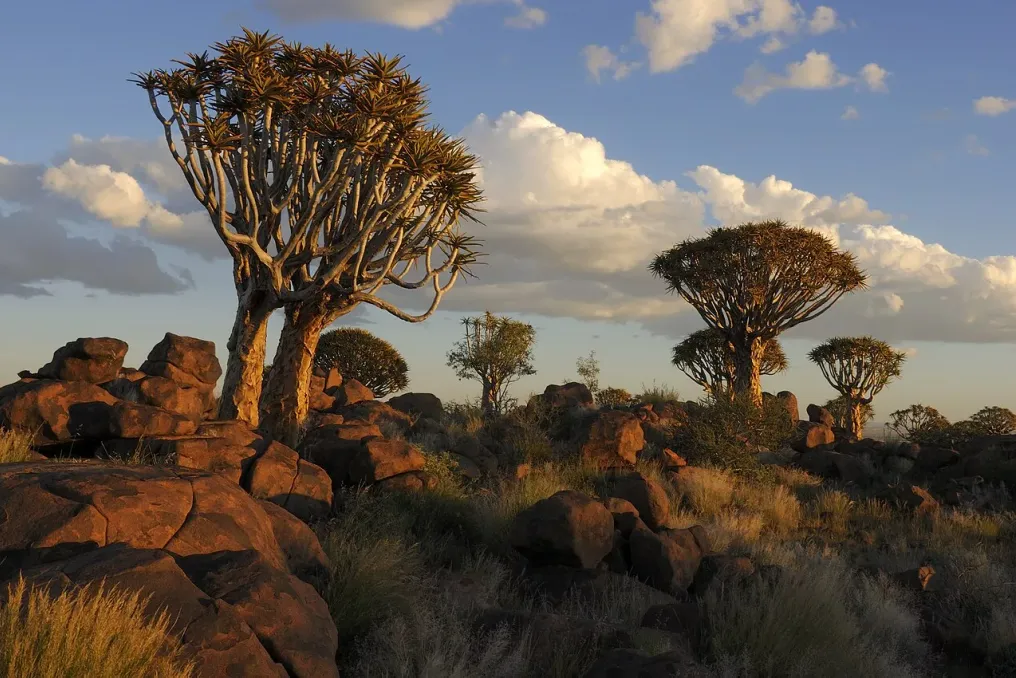
Acting as silent guardians in arid landscapes, ferns have adapted to life where few other trees can survive. These striking aloes thrive in the Northern Cape of South Africa and neighboring Namibia, storing water in their thick stems and reflecting heat with their pale covering.
Although not as ancient in origin as cycads, they represent a long evolutionary history of adaptation to the changing climate of Southern Africa. Some of the best places to observe them are in the areas around Keimoes and Kenhardt, and the famous Fern Forest near Keitumshupa in Namibia offers one of the continent's most picturesque desert landscapes. At sunset, their sculptural forms create unforgettable silhouettes against one of Africa's clearest night skies.
Hidden Survivors Under the Forest Floor
Not every living fossil is easy to spot. Velvet worms inhabit moist local forests in various parts of South Africa, especially in the Eastern Cape, KwaZulu-Natal, and Knysna forests. These soft-bodied and secretive invertebrates have changed very little over hundreds of millions of years. Their unusual hunting method involves spraying sticky mucus to catch prey—a technique that has fascinated evolutionary biologists for decades. Discovering such an animal requires patience, careful observation, and luck, making any sighting particularly valuable.
Living Fossils Outside of South Africa
Some of the world's most famous living fossils are located elsewhere, but they help place the ancient species of South Africa into a global context.
Ginkgo biloba, often planted in botanical gardens worldwide, including in South Africa, is the last surviving representative of a lineage that once covered much of the Northern Hemisphere.
The chambered nautilus continues to drift in the Indo-Pacific waters, using a shell design that has changed little over millions of years. Meanwhile, African lungfish offer another glimpse into evolutionary history. Their ability to breathe air provides scientists with valuable insights into how ancient fish eventually transitioned to land, paving the way for amphibians, reptiles, mammals, and ultimately, humans.
Even horseshoe crabs, although absent from the shores of South Africa, deserve mention. They are closer to spiders than to true crabs and have survived for over 400 million years, illustrating how some marine lineages have weathered dramatic changes in Earth's oceans. Comparing them to South Africa's own ancient marine arthropods underscores the depth of the continent's evolutionary roots.