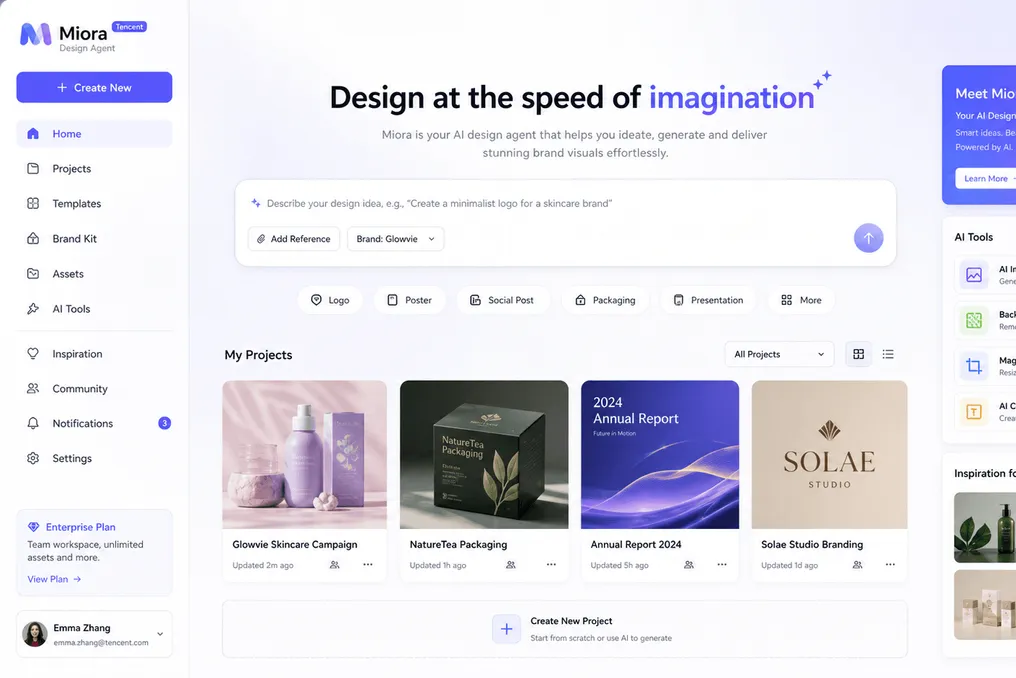
The Tencent Miora creative intelligence platform, launched in July 2026, is capable of handling an entire brand design project using multi-agent interaction based on just one text prompt.
Testing Miora's Capabilities
During practical testing, a detailed technical specification was submitted for a fictional company to create an AI-based companion named Puff AI. In a single session consuming 1000 integrals, Miora independently generated a complete brand identity system. This system included a logo, brand guidelines, corporate identity (VI) assets, application interface mockups, a promotional poster, a video clip, and a set of stickers.
Platform Workflow
Miora operates through a unified interface featuring a conversational panel on the left and real-time output on the canvas on the right. After receiving the technical specification, the platform first analyzed and summarized the brand's positioning, keywords, and worldview. It then presented the user with a summary for confirmation before starting any visual material creation. This stage proved useful as it ensured a general understanding of the brand direction. Subsequently, the platform followed a sequential workflow: generating the logo, creating brand guidelines, producing VI assets, and developing supplementary materials, with each step requiring user confirmation before proceeding to the next.
Output Quality and Functionality
The generated result demonstrated high visual consistency. The minimalist blue-and-white style, consistent with the concept of a companion robot, was maintained across all elements: the logo, application interface, posters, and video. The platform supports detailed image editing, including background removal, text replacement, and area modification, but precise editing of PAG animations and video content is not possible. Miora offers Agent modes at Standard, Pro, and Ultra levels. Model choices include NanoBanana and GPT-image for visual content, and Seedance, Kling, and Happy Horse for video generation. Available skills include full brand visualization case studies, narrative illustration, sticker set creation, reverse prompting for images, and video stitching.
Cost and Use Cases
The cost starts at $20 USD per month for 2000 integrals, which include premium models; new users receive 1000 free integrals. In practice, 1000 integrals allowed for the completion of approximately one full brand design project, indicating that costs are proportional to the volume of output. The platform covers categories such as brand design, film and video creativity, e-commerce advertising, game design, as well as website and application creation, positioning itself as a general creative agency rather than a niche tool.
Limitations and Prospects
Existing limitations include the inability to fine-tune animated and video assets after their creation, as well as a strong dependence of result quality on the initial technical specification. Sometimes the platform required several iterations to refine the style. Miora's experience shows that design agent technology has reached practical applicability for visualizing brand concepts and primary asset production, although achieving professional polish still requires human designer intervention. The orchestration approach of multi-agent systems, which links the logo to guidelines, then to VI, and subsequently to extended assets, represents the most mature automated workflow in commercial AI-based products as of July 2026, confirming the thesis that design agents can handle entire projects, not just isolated tasks.