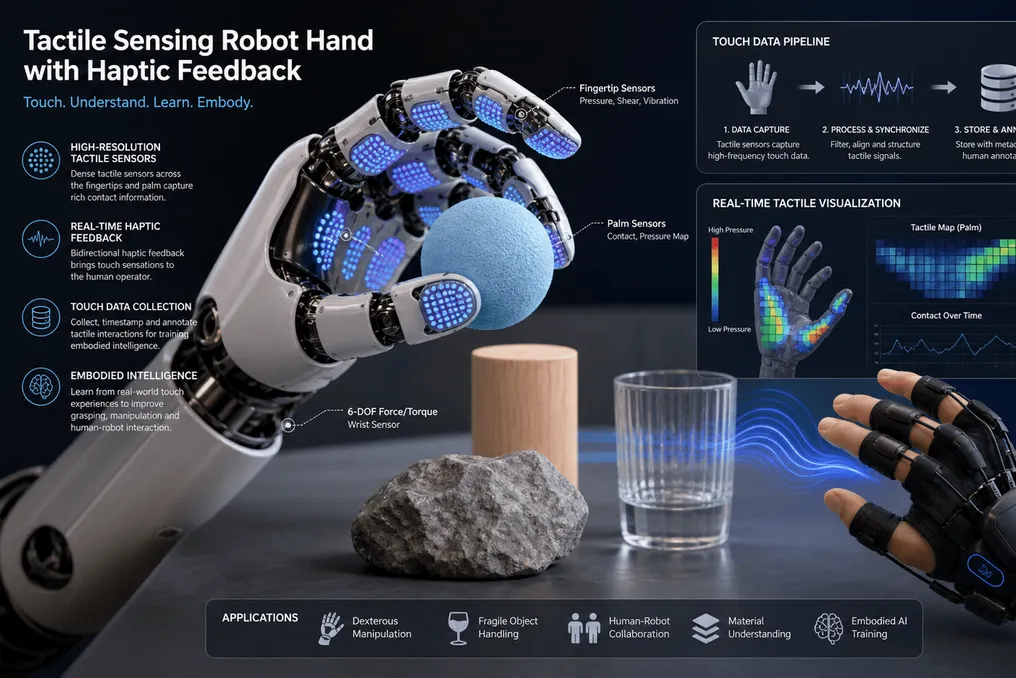
XinZhi Embodied and Fudan University have jointly released three technical reports detailing 30,000 hours of tactile data, aiming to address the gap in embodied intelligence related to the lack of touch sensation in robotics.
XinZhi Embodied and Fudan University have jointly released three technical reports detailing 30,000 hours of tactile data, aiming to address the gap in embodied intelligence related to the lack of touch sensation in robotics.
Despite rapid progress in visual and language capabilities, the sense of touch remains underdeveloped, even though it is critically important for manipulation tasks such as grasping, assembly, and object identification. This collaboration provided 30,000 hours of tactile interaction data collected during real robot operations. This data is intended to train models capable of understanding physical characteristics, such as texture, hardness, temperature, and friction, through touch.
The scarcity of tactile data is recognized as a serious obstacle in the field of embodied AI. Vision-based systems can recognize objects and plan approach trajectories, but they cannot determine grip force, detect slippage, or differentiate material properties through contact. Human manipulation heavily relies on tactile feedback, which allows one to feel the security of holding an object, the approach to slipping, and the necessary force for different materials. These skills are acquired by humans through thousands of hours of interaction, and replicating them in robots requires a similar volume of tactile experience.
The three presented reports cover the development and calibration of tactile sensors, the methodology for collecting large-scale tactile data, and the training of manipulation models incorporating tactile information. The sensor approach employed integrates several conversion principles, including capacitive, piezoelectric, and resistive sensing, allowing for the recording of both static pressure distribution and dynamic vibration signals during contact. Data collection was conducted using multiple robot platforms performing grasping, in-hand manipulation, and surface exploration tasks on thousands of objects with varying materials, geometries, and textures.
The release of this data represents a significant contribution to the open ecosystem of embodied AI. High-quality tactile data remains rare because its collection requires specialized equipment, precise annotation of contact events, and long operational time for the robot. By providing open access to 30,000 hours of structured tactile interaction data, XinZhi Embodied and Fudan University aim to accelerate research in haptic-supported manipulation. This will enable the creation of robots capable of working with a wide range of objects, materials, and real-world conditions, rather than being limited to vision-oriented work in controlled environments.
This work aligns with the general trend in embodied intelligence toward multimodal perception, which mimics the integration of human senses. While vision provides global spatial understanding and language provides task instructions, touch offers local data on physical interaction necessary for dexterous manipulation. The collaboration, based in Shanghai between XinZhi Embodied and Fudan University, reflects the deepening integration between academic research and startup innovation within the Chinese embodied AI ecosystem, with research outcomes directly influencing product development cycles. The release of this tactile data is expected to allow third-party researchers and developers to create manipulation capabilities that were previously inaccessible due to data shortages.
As levels of loneliness, uncertainty, or emotional distress rise, people are increasingly turning to AI-based chatbots for help, bypassing traditional therapists, a phenomenon experts view as dangerous.
According to a report by Independent on Sunday, the growing use of AI for personal conversations calls into question how technology is changing ways of seeking comfort, advice, and emotional support, especially among young users. Danny van Loggerenberg, founder of the National Child Protection Centre, noted that his work in South African schools has shown that many children already rely on AI companions for support and reassurance.
He reported that 82% of the children his organization interacted with admitted that they were turning to AI for advice and comfort for the first time, or exclusively. Van Loggerenberg emphasized that children over 12 in South Africa often 'meet' these companions, as the chatbot becomes a friend who learns about them.
These relationships can become deeply personal, and some children begin to develop romantic feelings for AI companions. The expert warned that this could become dangerous if vulnerable children develop an unhealthy dependence on technology. He cited a disturbing example where some children stated that the only way to be with their companion in their imagination was to commit suicide.
Children often use AI companions to seek advice on social situations, including issues of acceptance by peers, communication methods, and behavior. In some cases, children asked AI tools to help them write suicide notes, indicating what they wanted to include in the letter.
Popular platforms for children include Copilot, Gemini, and Claude. Van Loggerenberg explained that part of AI's appeal is that it does not set the same boundaries as humans. Artificial intelligence does not say 'no'; even if it disagrees, the user can be persuaded of anything. He added that the same conversation with AI can yield different answers depending on how it was trained.
However, for one young woman, AI serves as a tool for structuring thoughts and processing difficult situations. She uses it to draft messages, process emotions, and consider different viewpoints, but believes it cannot replace professional therapy. She noted that therapy offers something AI cannot fully replicate: genuine human connection with someone who knows her history, understands her patterns over time, and is professionally trained to help her cope with problems.
Another young woman reported using ChatGPT for a wide range of daily tasks, such as studying, grammar checking, and finding solace during bad times. She prefers sharing this with AI because people can be judgmental. She also admitted to talking to AI about everything, after which she deletes the dialogues.
For some users, the chatbot has become more than just an information source—it is a place they turn to when they don't know who else to approach. Cassie Chambers, Operations Director of the South African Depression and Anxiety Group (SADAG), observed that the organization is increasingly receiving inquiries from people who have already interacted with ChatGPT or other AI tools before seeking help. Some users reported that AI prompted them to contact SADAG or seek professional support.
Chambers believes that AI acts as a 'gateway,' helping people take the first step. Nevertheless, she insists that AI is merely a tool, not a therapist. AI's accessibility, confidentiality, and 24/7 availability make it appealing to those hesitant to approach a person. However, diagnosis, risk assessment, treatment planning, and crisis intervention require qualified professionals.
The South African Society of Psychiatrists (SASOP) has warned that the increased use of AI chatbots for mental health support raises international legal and regulatory concerns. The society pointed out that instances of interaction with vulnerable users abroad have been linked to suicides, suicide-homicides, mass shootings, and psychological trauma, leading to lawsuits against some AI companies, including OpenAI.
Professor Christopher Sabo, a member of SASOP, stated that AI chatbots can provide inaccurate information, offer false reassurance, or reinforce harmful thought patterns. He also noted that anthropomorphic responses can induce a feeling of emotional dependency. Sabo stressed that AI cannot replace the value of personal interaction with an experienced, trained psychiatrist. He warned that AI may respond inappropriately in crises and potentially increase risks for vulnerable individuals, reminding that when dealing with emotional problems, a human is necessary.
Dr. Colin Surendra Thakur, an IT expert at Unisa, views AI as a new stage in society's relationship with technology. He noted that while earlier concerns focused on internet addiction, AI has transformed the internet from a predominantly reactive tool into a conversational one. Thakur warned that this development could spawn new forms of dependency, citing companion apps like Replika, which can evolve into emotionally close relationships.
Replika has already faced criticism for its interactions with vulnerable users, including allegations related to self-harm discussions and concerns about emotional attachment. Previously, Independent on Saturday asked ChatGPT why people turn to AI with questions about mental health and deeply personal topics. Among the questions people ask, according to ChatGPT, were: 'What is the least painful way to die?', 'What will happen if I take X and Y together?', and 'Can you write a farewell letter?'. ChatGPT acknowledged that it cannot confidently determine a person's intent and advised seeking immediate help in a crisis rather than following instructions that might cause harm.
Most prop firm operators evaluate a technology provider the same way a driver examines a car in the cabin. They study the platform, control panels, integrations, and launch timelines. However, they rarely check the part that is critically important for achieving desired results after market movement begins—the supporting structure behind the software.
The prop trading industry has matured to the point where many operators call it the operator's era. In 2024, several firms exited, and those who possessed genuine business infrastructure, rather than just thin evaluation pipelines, survived. In such a consolidated market, the technology itself is merely a minimum requirement. The differentiator is what happens after the system goes live.
A platform demonstration shows the system at rest. It does not show what happens when volatility sharply increases during a major economic announcement, when payment connections freeze at the most inopportune moment, or when an edge case occurs that was not covered by adaptation scripts. These are the moments that define an operator's working week.
Migrations further emphasize this point. Transitioning to new platforms is a complex project management process for prop firms, capable of disrupting adaptation flows, account panels, URLs, and even the trader's sense of stability. Yet, a technically clean transition can be perceived by users as instability. When problems arise, the operator doesn't need the best feature list; they need a person who is already familiar with their settings and capable of acting quickly.
This is often where relationships with providers fail. The technology works as promised, but the operator is forced to route urgent queries through a general email inbox, re-explaining their configuration to the person in charge, and waiting for the market to change. Usually, the weak link is not the software, but the experience surrounding it.
Trade Tech Solutions approaches this issue from the opposite perspective. Instead of viewing support as just another ticketing system, the company embeds accountability into every client interaction structure, assigning an owner even before a problem arises.
Each client works with a clear chain of human oversight, not an anonymous support service: a dedicated project manager who is the primary point of contact and knows the client's configuration in detail; a backup project manager ensuring complete business continuity so nothing stops if one person is unavailable; and active supervision from the head of project management who intervenes directly in complex, sensitive, or escalated issues.
The main principle is simple: no request should get lost because responsibility is built into the model itself, not dependent on chance. The operator always knows who is responsible for their problem, and this person already possesses a deep understanding of their trading ecosystem.
This continuity is most crucial during transitions that place strain on the business—from launch to platform changes and periods of rapid scaling. A dedicated contact who was present since the prop firm's migration carries context that a constantly changing support team cannot spontaneously recover.
Human oversight solves the relationship problem. A technical issue requires its own structure, and here the provider's approach to trading platform support becomes specific. Clients contact the development team through a specialized prioritized ticketing system, not through unmanaged email.
The difference lies in how the issue moves through the system. Instead of landing in a general folder where urgency is poorly defined, each request follows a specific path: it is categorized by type and severity so that true emergencies are not buried under routine questions; it is assigned to a clear owner on the development side, without ambiguity regarding responsibility; and it is resolved and tracked along a visible chain of ownership, allowing the operator to see the status of their request.
For prop trading operations, this structure is the quiet foundation of infrastructure management. It transforms support from reactive chaos into a predictable process, which is exactly what an operator needs when a technical solution cannot wait until the next business day.
The strategic argument follows naturally. As the industry professionalizes and technology becomes a basic expectation, forward move those operators who view operational reliability as a core asset, not a cost center. Proactive support ceases to be a courtesy; it becomes part of the firm's competitive battle.
This is where the provider's philosophy distinguishes them from a traditional software vendor. The vendor's work ends upon delivery. The partner's involvement does not switch to maintenance mode at the moment of client launch because the true assessment of any infrastructure happens later, under load.
Stefano M., Partnership Manager at Trade Tech Solutions, notes: 'When the client goes live, our involvement does not switch to maintenance mode. The same team that managed the migration remains actively involved because the real test of any infrastructure is how it performs under pressure.'
This standard applies to the entire operational surface that the operator relies on daily, including reporting, payment connections, and semi-automated payouts with manual approval, where an additional layer of human confirmation is an intentional protective measure, not a limitation.
The lesson for everyone evaluating a prop firm's technology partner is to look beyond the demo. The platform will almost always operate in a controlled environment. More complex and revealing questions concern moments when nothing is controlled. Operators would benefit from asking who is responsible for their account, who is responsible when that person is absent, how technical issues are prioritized, and whether the provider remains involved a year after launch. A strong prop firm support model answers all four questions before signing the contract.
The most important thing when trade orders continue to come in is the platform's resilience. Anything can happen at high speeds, and when the unexpected happens, it is critical how quickly the technology stack can adapt and continue operating. This single moment tells the operator whether they chose a vendor or a technology partner.
A platform can be copied. Feature lists converge over time, and most reputable providers ultimately offer a similar technical base. What is difficult to replicate is the support structure with named owners, real continuity, and direct connection to the people who build the system. For operators deciding where to host their infrastructure, this experience is what is worth studying most closely.