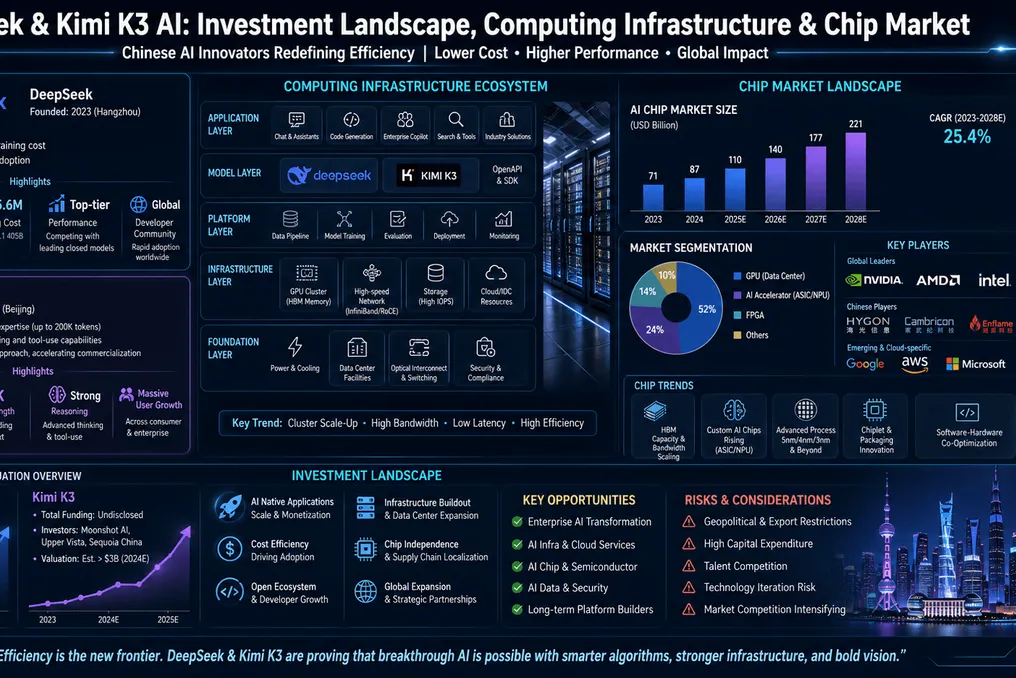
The investment strategy in the field of artificial intelligence is changing: the focus is shifting from celebrating increased efficiency to an arms race in computational power. The Kimi K3 model with 2.8 trillion parameters has become a turning point, comparable to the moment of DeepSeek 2.0.
Shift in Investment Paradigm
After DeepSeek-R1 caused panic in the markets by suggesting that cheaper training would devalue investments in computing, the situation has changed. Jevons Paradox demonstrates that increased efficiency leads to an increase in overall consumption of computational resources, rather than a decrease in demand.
Scale of Capital Expenditures
The volume of capital expenditures exceeds previous expectations. Google has increased its CapEx forecasts for 2026 by $15 billion, bringing them to the range of $195–$205 billion. Company management warns that infrastructure costs will continue to pressure margins due to rising depreciation and data center operating expenses, and they are expected to increase significantly in 2027.
Analysts predict that the total capital expenditures of the five largest global cloud service providers will exceed $800 billion in 2026, potentially reaching $1–$1.2 trillion by 2027. Meanwhile, the top 14 providers show an annual CapEx growth exceeding 90%, as the imbalance between supply and demand for AI computing power persists despite efficiency advancements.
Market Differentiation and Stocks
The market has clearly divided between AI model developers and AI infrastructure providers. In June 2026, hyperscaler stocks fell by a cumulative 18%, marking the worst monthly performance since Meta's IPO in 2012, as investors questioned the possibility of proportional returns on massive capital investments. Even Google's earnings report, which exceeded expectations, triggered a 4% drop after the close of trading solely due to CapEx news.
Conversely, shares of AI hardware manufacturers rose by 16% during the same period, creating a mirror image of the trend. The most obvious winners were memory and semiconductor manufacturers, as the demand for HBM, DRAM, and GPUs remains structurally undersupplied.
Technical Requirements and Bottlenecks
The K3 model with 2.8 trillion parameters requires at least 10 GB300 GPUs for local deployment. Even if training costs decrease by 40%, doubling the training frequency within the arms race will lead to a 20% increase in net compute demand. Thus, efficiency stimulates more competition, not less.
The most acute bottleneck is memory: the supply of HBM from SK Hynix is limited for the next two to three years. AI inference is driving a resurgence in central processors, projected to grow 4–5 times. A Chinese example demonstrates the Zhipu AI data center with a capacity of 1 GW, showing that even companies focused on model efficiency are now actively investing in scaling computational power.