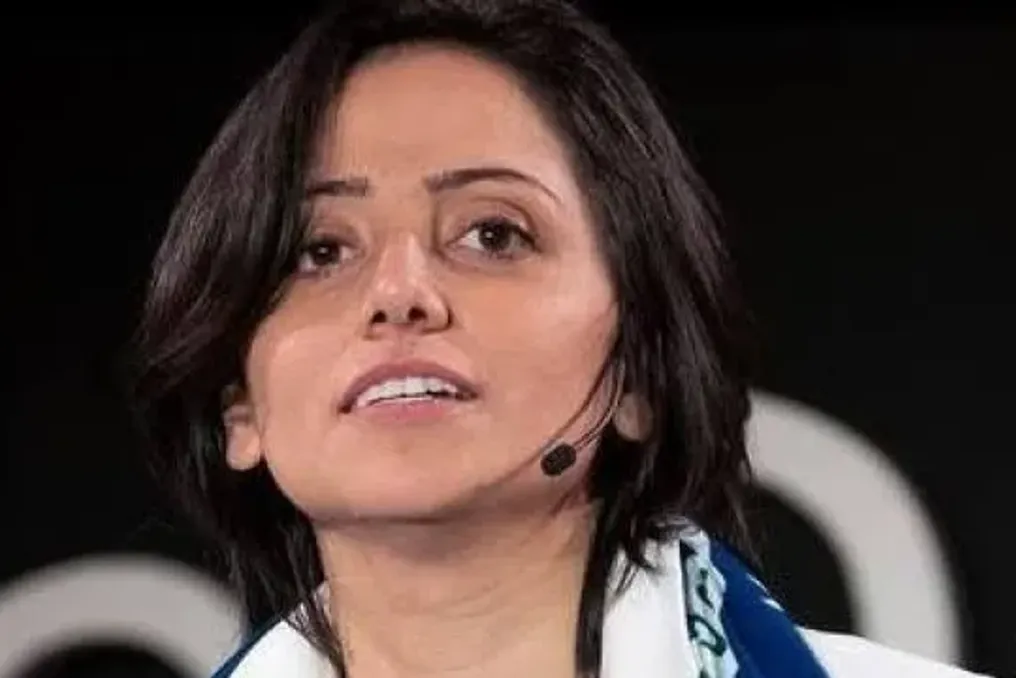
Maha's story began at birth along with two brothers. Their parents, one a Syrian Christian and the other a Syrian Muslim, moved to Lebanon shortly after meeting to preserve a love that religious differences forbade in their home country.
Maha's story began at birth along with two brothers. Their parents, one a Syrian Christian and the other a Syrian Muslim, moved to Lebanon shortly after meeting to preserve a love that religious differences forbade in their home country.
Maha Mamo told the Lusa agency that in Lebanon, where a woman cannot pass citizenship to her children, there is only the concept that a person is Lebanese if their father is Lebanese. They had no homeland, birth certificates, IDs, passports, or any documents confirming their legal existence, although this did not affect their childhood.
Maha felt different when she became a teenager and was invited to a professional basketball team but could not join. Initially, she thought the reason was her Syrian background, but when a group of students went on a volunteer mission to Jordan and Maha was left behind, she realized this was not the case. The true reason became clear when she tried to enroll in university.
She wanted to study medicine, but the university refused her admission, stating that since she was not Lebanese, she could not study, despite having sufficient grades, because documentation was required. Even numerous services that had always helped her in Lebanon were unsuccessful. Eventually, she enrolled in a private university that did not have a medical course but allowed her to receive a diploma in her name, albeit unofficially invalid. She chose information systems.
From age sixteen, when the internet became widely available, Maha began submitting asylum applications to embassies worldwide, continuing this task for ten years, receiving only rejections. It was only in 2014 that she found hope. During the Syrian refugee crisis, Brazil introduced a special humanitarian visa for this nationality, which was her parents' nationality.
Maha Mamo recalls that someone read her story and suggested that a 'Brazilian way' might exist to help her. Since many refugees at the time had burned documents due to the war, the Brazilian embassy decided that the three brothers could move to this country, where they could obtain new documents. Although none of them spoke Portuguese, knew anyone in Brazil, or anything about the country, they went there, considering it their last hope.
Her parents remained in Lebanon, where her father managed a small truck and could send them money. Thus, their only contact in the new country was with a family from Minas Gerais, where one of her school friends visited once. Maha remembers saying goodbye to her parents on her last day in Lebanon and the uncertainty of starting everything over, having nothing to hold onto.
She said she took eight bags, packing things she wouldn't even think of today. She had never flown on an airplane or traveled, didn't know what to bring, and couldn't imagine what the climate in Brazil was like. The last thing she put in her pocket was a house key, knowing she would never return. That day was a mix of happiness and unhappiness: it was everything she had dreamed of for 26 years, but she was leaving behind everything: her community, friends, family, to go somewhere where she didn't know if there was a pharmacy or a supermarket.
She immediately started looking for ways to obtain Brazilian citizenship and, during this process, found a UN campaign called '#Ibelong'. This showed her that millions of people like her existed around the world, although she thought she was alone. Along the way, she met Bella, who is now her wife, and she told her that the only way was to become a refugee.
Bella, who volunteers for an NGO helping Haitians in Brazil, informed her: 'There is good news and bad news.' The good news was that applying for asylum provided access to basic necessities like healthcare and a driver's license, which was her dream, and also allowed her to work legally. The bad news was that naturalization could take 20 years due to the lack of laws for stateless persons. Maha admitted she was upset but saw light at the end of the tunnel.
Six months later, Bella contacted her about participating in a television documentary, and Maha agreed. This led to a series of conferences and lectures aimed at drawing attention to the issue of statelessness, which she continues to support. When she had been in Brazil for a year and a half, she received refugee status. She expressed joy, noting: 'How sad it is to talk about someone who dreams of becoming a refugee? But for the first time, we had a document.'
However, the revolution did not stop there. A month later, her younger brother died in a robbery. Maha grieved that he died without obtaining citizenship, and noted that since her existence was registered, his death was also nonexistent. She stated: 'What happens when you die without citizenship? Nothing. You are not buried.' Her brother was able to obtain a death certificate as a refugee, and the two sisters decided to bring his body to Lebanon so their parents could say goodbye.
It was at the moment of her brother's disappearance that Maha found herself. She stopped working and doing everything else, focusing on advocacy. She began participating in TV and newspaper interviews, telling her story. The UN started inviting her to events. In 2018, she and her sister became the first stateless persons in Brazilian history to gain citizenship. Since then, she has dedicated her life to this cause and contributed to legislative changes in 13 countries.
Her current goal is to help stateless persons in Portugal, where her sister and mother live. She has given lectures, met with judges, told her story in parliament, and strongly wishes to see the ratification of the new stateless persons status adopted by the President of the Republic earlier this month. Therefore, in August, she is going to Portugal to celebrate her sister's 40th birthday and try to speak with António Jesus Seguro.
Returning to Lebanon for a lecture at her old school, she met a stateless boy, the son of an illegitimate child. This boy, who later became an orphan, was raised by an aunt, a former schoolmate of Maha. This aunt followed her on social media and contacted her. They created a group and started raising funds for the boy's DNA test. Last week, they received confirmation that his grandfather was Lebanese. He does not yet know this. They are waiting for the documents to inform him that he is Lebanese and has citizenship.
Maha acknowledged that many more people need help in Lebanon and in many other parts of the world, as this problem reflects a 'strong lack of maturity and humanity.' She concluded: 'You don't choose where to be born, you don't choose who your parents will be, but no one should have to live without the possibility of existing.'
Flávio Bolsonaro's candidacy was officially announced by the PL president, Valdemar Costa Neto, during a proclamation ceremony held at the Pacaembu football stadium in São Paulo. The event featured the participation of Argentine President Javier Milei.
At 45 years old, Flávio Bolsonaro is entering the presidential race after his father, Jair Bolsonaro, was barred from holding public office due to convictions and house arrest for participating in an attempted coup following the defeat in the 2022 elections to the current President, Lula da Silva, who seeks re-election at age 80. Costa Neto made sure to recall Jair, classifying him as 'the greatest leader' he has ever known, before praising Flávio.
During the ceremony, Flávio Bolsonaro received and was moved by video messages sent by his brothers Eduardo Bolsonaro, who resides abroad in the United States alleging judicial persecution, and Carlos Bolsonaro. Carlos Bolsonaro, a former city councilor of Rio de Janeiro, expressed his confidence, saying: 'I trust your ability to carry on Jair Bolsonaro's work.'
According to recent polls, Lula da Silva maintains a slight lead over Jair Bolsonaro's eldest son. A poll released by Datafolha on Friday indicated that Lula has 48% of voting intentions, compared to 43% for Flávio Bolsonaro, in a potential second round. The 45-year-old senator faces several issues that generate criticism and uncertainty about his political project. Although he seeks support from other right-wing parties, negotiations have not progressed.
Parties such as Republicanos and the União Progressista coalition, composed of União Brasil and Progressistas (PP), opted not to support Flávio Bolsonaro's candidacy, which has weakened due to family conflicts and controversies related to an alleged connection with a detained banker. Michelle Bolsonaro, Jair Bolsonaro's wife, publicly accused her stepson of 'humiliating' her and even left the presidency of the women's wing of the PL. Flávio apologized to her on social media shortly before the event, in an attempt to calm the situation.
Another point of attention is Flávio Bolsonaro's alleged link to Daniel Vorcaro, former owner of Banco Master, an institution that was placed into extrajudicial liquidation by the Central Bank in November 2025 and is currently under preventive detention. Vorcaro is being investigated for a millionaire fraud scheme in the financial system, using fake credits. The scandal gained prominence when the press began exposing Vorcaro's contacts and business dealings with high figures in the three powers, including Supreme Federal Court judges and congressmen. Flávio Bolsonaro was also involved in this controversy, as last May, the portal Intercept Brasil revealed that the senator negotiated directly with Vorcaro a financing of millions of reais for the production of a biographical film about his father. The Supreme Federal Court authorized the investigation of this financing on Thursday, which does not yet have a release date in Brazil.
A one-month-old baby began showing vital signs again about two hours after being officially declared deceased in a hospital in São Paulo, Brazil. The alert was issued by an employee of the funeral agency after she went to collect the body.
The incident occurred on July 15th, the day Noah Gabriel da Cruz Santos turned one month old. According to Brazilian press, the baby had suffered cardiopulmonary arrest while hospitalized in the Intensive Care Unit (ICU) of Santa Casa de Rio Claro, in the interior of São Paulo.
The child's mother informed ICL Notícias that it was the funeral home employee who notified the medical team about the baby's persistent vital signs shortly after collecting him for funeral preparations, approximately two hours later.
Noah was born prematurely and has several health conditions, including cleft palate and a congenital malformation affecting his ability to eat, speak, hear, and develop teeth. He has been hospitalized since birth, awaiting transfer to a specialized hospital for surgery.
After the episode, he was reevaluated and readmitted to the ICU. The hospital explained that Noah's health condition had worsened, resulting in the cardiopulmonary arrest on Wednesday, July 15th. Cardiopulmonary resuscitation maneuvers were performed for about 45 minutes, following all protocols, before death was confirmed.
After the declaration of death, the baby remained in the ICU for about an hour before being moved to another room awaiting body removal. Regina Célia Paschoal, an employee of the funeral agency, was the one who noticed that the baby was still moving inside the bag. She described the moment as a 'shock' and a 'great emotion.'
In an interview with TV Globo, Regina reported seeing Noah move inside the bag designated for bodies and took the initiative to open it. Upon doing so, the baby began to move more intensely and make sounds, indicating a desire to breathe. She emphasized that in her seventeen years of experience, she had never witnessed anything like it.
Regina was accompanied by her colleague, Matheus, who immediately called a nurse upon realizing the possibility that the boy was alive. He commented on the experience: 'It was desperate, but with relief, right?'. Regina instructed the nurses to check the reason for the movements and what appeared to be a hiccup, as if he were choking.
The boy's parents classified the event as an 'authentic miracle' and rejected the idea of medical negligence, stating that they will not pursue legal action against Santa Casa de Rio Claro.