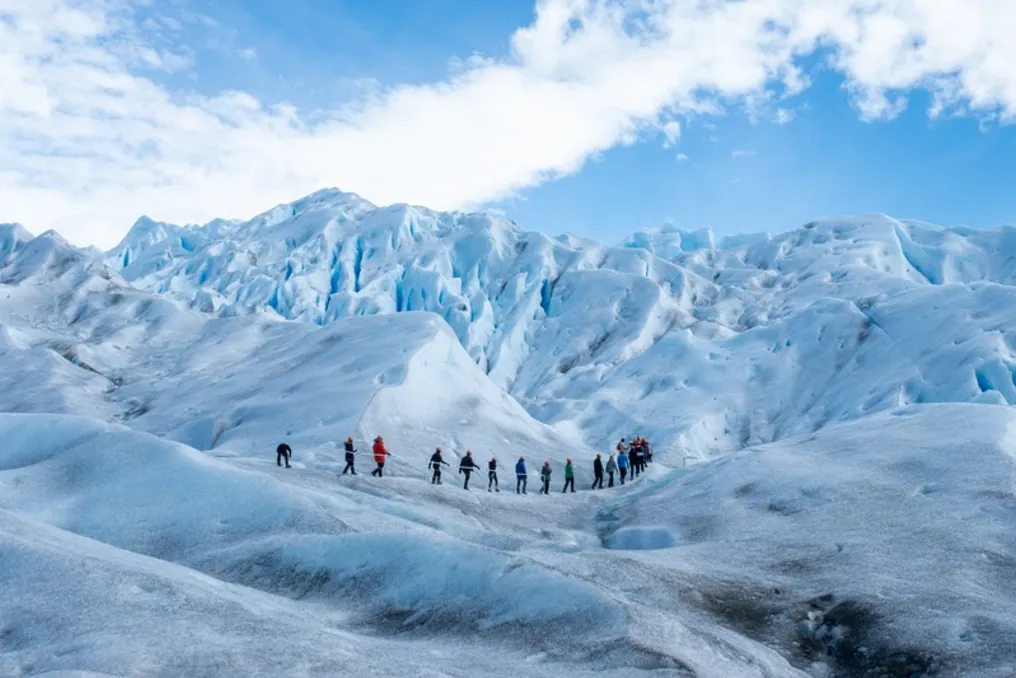
Trekking on glaciers represents a rare opportunity to step onto a constantly changing landscape composed of crevasses, meltwater rivers, and multi-year ice layers. Glacier trekking allows visitors to explore unique landscapes beyond viewpoints and predefined routes in national parks. In South America, the main locations for this practice are in the Patagonian region, although there are other options across the continent.
Argentine Glaciers: Perito Moreno and Viedma
One of the most famous glaciers in Patagonia is Perito Moreno, which covers an area of 250 km² and extends from the Southern Patagonian Ice Field to the south of Lake Argentino. This glacier is larger than the capital of the country, Buenos Aires, which has an area of about 202 km². The Perito Moreno Glacier is located in the Santa Cruz province, within Los Glaciares National Park. The nearest town to the glacier is El Calafate, located 80 kilometers from the park. Access to Perito Moreno is possible by car via Route 11. The entrance fee to the park was approximately 175 Brazilian Reals in July 2026.
There are two routes to explore Perito Moreno: mini-trekking and big ice. Mini-trekking lasts approximately 1 hour and 30 minutes, while Big Ice can take up to 4 hours (including transfer from El Calafate to and from the site, as well as sea travel, the total tour time will be about 10 hours). Both tours head towards the southern side of the glacier and are conducted by authorized companies. There are age and health restrictions. In summer, the weather is clearer, with fewer snowfalls and milder temperatures, but the program is available year-round: even in winter, the average temperature in the city remains around five degrees.
Los Glaciares National Park also hosts the Viedma Glacier, which is closer to the town of El Chaltén, known as a trekking paradise. However, since 2017, hiking on the glacier has been impossible due to accelerated glacial retreat caused by climate change, which led to the formation of a large crevasse between the shore and the glacier and increased instability of the rock walls. Instead, Solo Patagonia offers a boat trip on Lake Viedma, departing from Puerto Bay-Tunnel in El Chaltén. The route includes approaching the majestic glacier, disembarking at Cabo de Hornos bay for a short walk to a viewpoint, and then returning to the vessel to see the bluish walls of Viedma up close. The total duration of the tour, including the sea journey, is usually about 4 hours, departing between 10:00 and 11:00 and returning around 15:00. In addition to the lake view, a feature of Viedma is the dark stripes on its surface, formed by a mixture of ice and volcanic ash.
Trekking in Torres del Paine (Chile)
Unlike the previous two destinations, Torres del Paine is located in Chile. The national park where they are situated covers 227 thousand hectares and is recognized as a UNESCO biosphere reserve. The nearest town to the park is Puerto Natales, which is 120 kilometers away. Access to the park is via land roads; the drive by car or bus from Puerto Natales along Route 9 should take about an hour. The main attractions of this trek are the granite peaks of three towers: the South Tower, 2850 meters high, the Central Tower, reaching 2800 meters, and the North Tower, reaching 2600 meters. Furthermore, the trails pass through diverse landscapes. For example, the W trek crosses steppes, forests, and glaciers.
It is important to note that these trekking routes are significantly longer than the previous ones: unlike the Argentine options, time here is measured in days, not hours. The classic W trek, the most famous in the park, lasts about 5 days and covers a distance of 80 to 85 kilometers. The park provides accommodation for tourists, ranging from dormitories to premium camping. The climate in this region can change rapidly, posing certain risks. It is necessary to thoroughly study the information before starting the hike.
Expeditions to Condoriri (Bolivia)
This option is intended exclusively for strong and experienced tourists. Located in the Cordillera Real, Bolivia, among the Andes, the start of the trek is 60 kilometers from La Paz, and the road to the trail takes between 2 hours and 30 minutes to 3 hours (by car or bus). Expeditions usually start from La Paz in the morning; upon arrival at the trail location, it is still necessary to walk 3.4 kilometers to the base camp. The camp is located on the shore of Lake Ciar-Hota, and expeditions usually provide good infrastructure, including tents and dining halls.
Depending on the chosen route, there are several options, but the most iconic is the Condoriri trail. The hike can last from 10 to 12 days, but the classic trek usually takes 3 days. The additional difficulty of this route must be taken into account: it passes at an altitude of over 4,000 meters, which may be too much for an average tourist. Nevertheless, those who overcome this challenge are rewarded with magnificent panoramic views, as the mountain height allows viewing the Huayna Potosi and Illimani mountains, as well as Lake Titicaca.