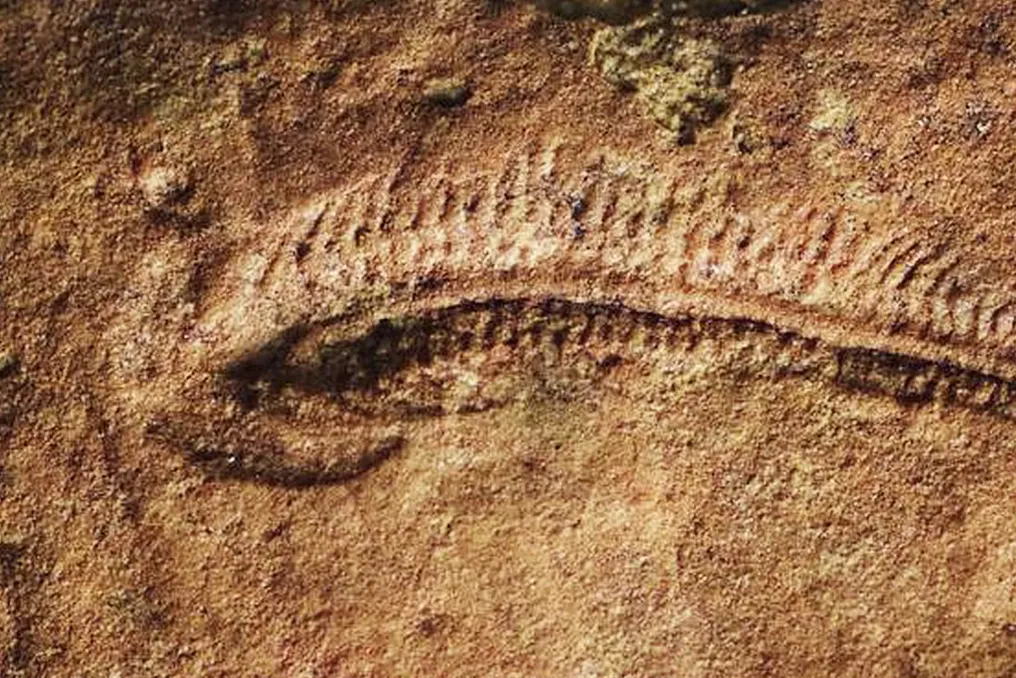
A new fossil analysis indicates that the first living beings to exhibit laterality, such as Spriggina floundersi, were marine animals resembling leeches and did not possess hands.
Discovery about Spriggina floundersi
Approximately 550 million years ago, during the Ediacaran period, a marine organism known as Spriggina floundersi, which was finger-sized, crawled on the ocean floor. A recent study of its fossils revealed that although it was an animal without upper limbs, it showed a strong inclination to move to the right, making it the oldest documented example of a right-handed animal.
Methodology and Study Location
Researchers from the United States examined a set of exceptionally well-preserved fossils located in the Nilpena Ediacara National Park, in South Australia. Many of these specimens were folded, and most showed a tendency to lean to the right side. The study was published in the journal Scientific Reports, by Nature, on July 9th.
Implications of Primitive Laterality
Paleontologist Scott Evans, who led the research, explained that, unlike what is imagined when thinking about human dexterity (such as holding a pencil), this discovery points out that animals without hands or feet could develop their own form of laterality. The research suggests that the preference for one side of the body arose much earlier than previously thought, shortly after organisms began to exhibit bilateral symmetry.
Characteristics of the Organism and Fossil Analysis
Spriggina was one of the first animals to display this symmetry during the Ediacaran, a period between 635 and 538 million years ago, when microscopic beings evolved into larger multicellular organisms. This organism, measuring only a few centimeters, had an elongated and segmented body, with a larger front end that resembled a crescent moon-shaped helmet. The fossils from Nilpena Ediacara National Park, along with the Flinders Ranges region and South Australia, provide a detailed record of this moment.
Detailed Movement Results
By analyzing over one hundred specimens, scientists photographed the rock relief to observe the final posture of the animals and then created three-dimensional models to measure the deviation of each Spriggina's curvature relative to a straight line. The results indicated that these animals were more mobile than previously thought, capable of wriggling similarly to modern earthworms. More significantly, the data showed a clear preference for the right side when turning, almost twice as often as the left side. Since the fossils are mirrored images, this inclination confirms that the population preference was for the right side.
Possible Sensory Capabilities
Additionally, the new findings may offer clues about how these animals perceived their environment. Scott Evans commented that, given that current animals with laterality (such as insects, octopuses, birds, and mammals) possess complex sensory systems, this suggests that Spriggina's nervous system was relatively sophisticated, comparable to that of currently known animals.