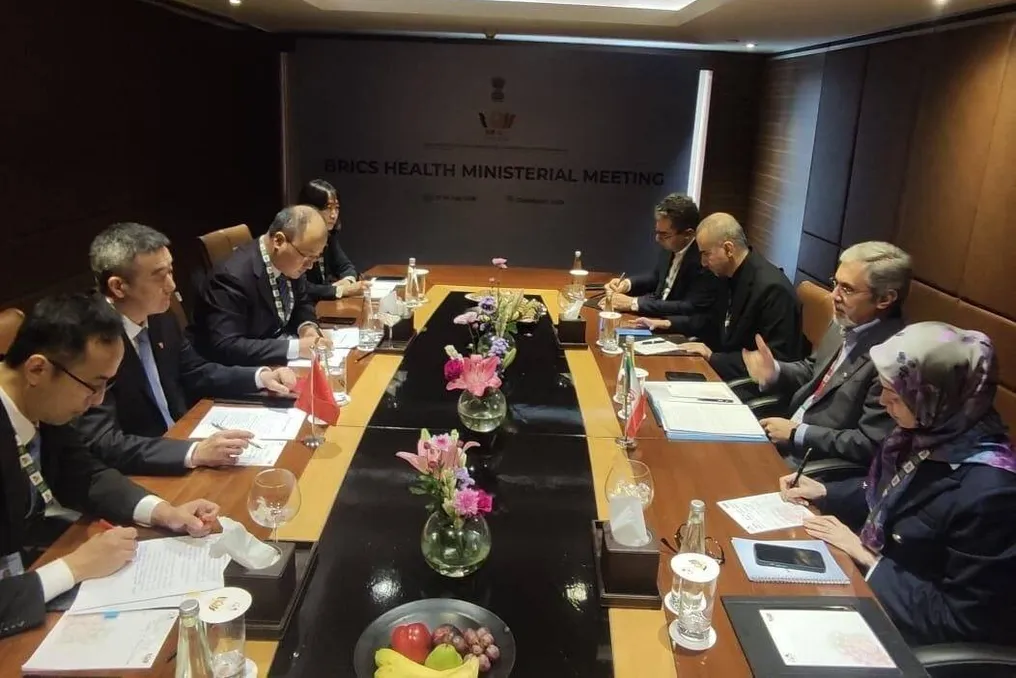
Officials from Iran and China held discussions aimed at developing joint work in the healthcare sector. Special attention was paid to the supply of pharmaceuticals, raw materials, and medical equipment.
Meeting within BRICS
The meeting took place on the sidelines of the XVI BRICS Ministerial Meeting on Health, which was held in Chandigarh, India, from July 21 to 25. Ali Jafarian, Senior Advisor to the Iranian Minister of Health, emphasized the significance of traditional medicine in both countries.
He spoke about the possibility of integrating Persian medicine into the national healthcare system using a scientifically sound approach to ensure the safe and proper application of traditional treatment methods, and called for expanding ties in this area, according to IRNA.
Scientific and Technological Partnership
Jafarian also addressed the topic of scientific research cooperation in vaccine production within BRICS, noting the potential of the two countries for joint vaccine development. He stressed the need for the exchange of knowledge, experience, and technologies between Iran and China.
For his part, Zeng Yixin, Deputy Director of the Chinese National Health Commission, welcomed the deepening of bilateral relations in line with existing memorandums between Beijing and Tehran. He stated the readiness to increase cooperation in traditional medicine, highlighting its special importance to China as an integral part of cultural heritage, rather than just a component of the healthcare system.
Long-Term Programs and Investments
In 2025, Iran and China agreed to implement joint programs in the pharmaceutical and medical fields under a 25-year agreement signed by both sides. Hamid Inanlou, an official from the Food and Drug Administration (FDA), reported that these programs are designed to stimulate the commercial, scientific, and industrial potential of both nations, boost domestic production, and facilitate access to regional markets.
He added that part of the 25-year strategic partnership focuses on expanding healthcare cooperation, including the exchange of experience and technologies, conducting medical research, training, exchange of specialized personnel, and developing new drugs. Inanlou also noted plans for the production of medical and laboratory equipment, such as syringes, diagnostic kits, health products, as well as joint investments and the creation of joint ventures.
Previously Reached Agreements
In June 2025, Ding Zhisheng, Vice Premier of the People's Republic of China, expressed China's willingness to strengthen scientific and technological cooperation with Iran under the Belt and Road Initiative (BRI). Zhisheng met with Hossein Afshin, Vice President for Science, Technology, and Knowledge-Based Economy, on the sidelines of the Second Conference on Science and Technology Exchange within the BRI, held in Chengdu, the capital of Sichuan Province in southwestern China, from June 10 to 12.
The Chinese official stated that China intends to effectively implement the Iran-China strategic partnership and promote high-quality cooperation within the BRI. According to Zhisheng, 'we strive to develop the potential for scientific and technological cooperation between the two sides to bring more tangible benefits to the people of both countries.'
Active Diplomacy in BRICS
The Iranian delegation actively participated in drafting the declaration and presenting technical and legal proposals to strengthen healthcare cooperation among BRICS member states at the XVI BRICS Ministerial Meeting on Health.
Iran's position was based on prioritizing consensus while safeguarding national interests, protecting the authority of regulatory bodies, expanding production and research capacities, ensuring equal access to medicines, vaccines, and medical technologies, and promoting cooperation in traditional medicine and mental health.
Proposals for the BRICS Action Plan
The Iranian delegation emphasized that cooperation within BRICS must go beyond declarations and transform into joint, actionable initiatives with measurable results. They also noted that access to medical products and technologies should not be blocked by obstacles disrupting supply chains, technology transfer, joint production, or timely patient access to treatment.
Clarifying the country's achievements in healthcare during crises, Jafarian put forward three key priorities for developing the 'BRICS Action Plan'. The first proposal concerned strengthening joint preparedness, including establishing early warning systems, emergency response networks, combating antimicrobial resistance, and environmental threats while respecting national sovereignty.
The second proposal was the development of pharmaceutical innovations, suggesting a shift from unilateral technology transfer to joint research, local production, and the creation of resilient supply chains. The third proposal focused on improving regulatory interaction. Stating Iran's readiness to participate in BRICS GxP initiatives, the official stressed the importance of experience exchange and reducing duplication of efforts to accelerate access to safe and quality medicines.
He also noted that despite strong pressure from recent illegal attacks by the US and Israel on the country, especially on hospitals, medical staff, and the pharmaceutical supply chain, the provision of essential medical services in Iran has not ceased, demonstrating true resilience. For example, during a 40-day military crisis in March, 15 complex liver transplant operations were successfully performed in Tehran.
Iran is ready to expand cooperation in various fields, including tuberculosis research, new vaccines, and advanced diagnostics.