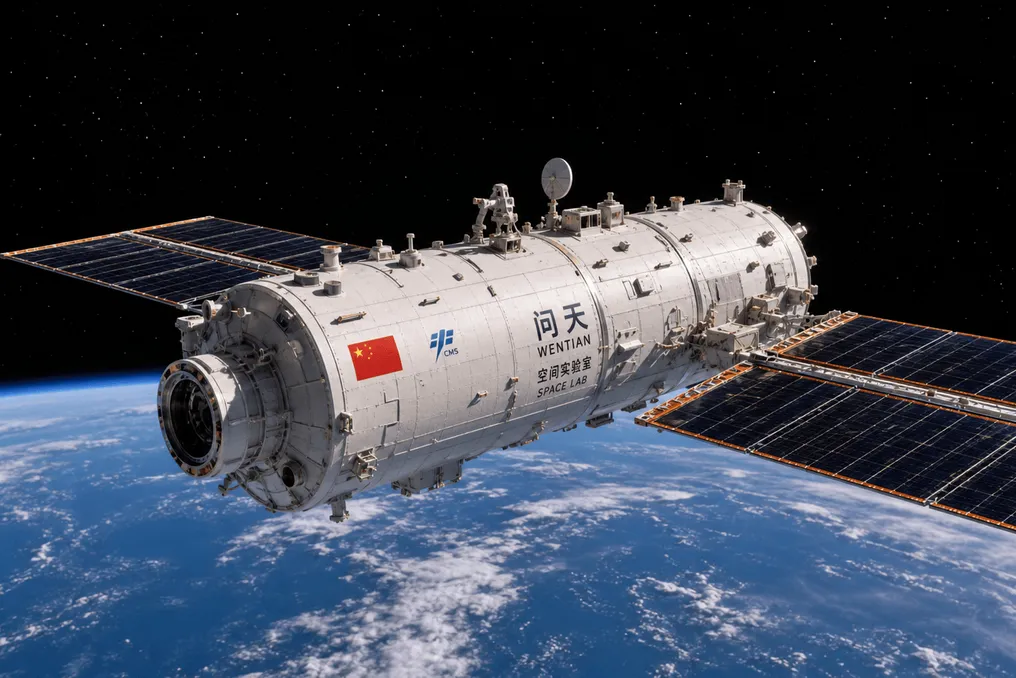
The Wentian scientific laboratory module, launched in July 2022, has reached four years of stable operation in orbit. This module is the first specialized module for scientific experiments in the country, supporting capacity for six crew members and external exposure.
Module Characteristics and Functions
The Wentian module measures 17.9 meters in length, 4.2 meters in diameter, and weighs 23 tons. It functions as a multi-functional research platform and serves as a backup for the main Tianhe module, capable of fully controlling the space station combination if necessary. The deployment of this module into orbit demonstrates China's progress from manned spaceflight capabilities to establishing sustainable orbital scientific research infrastructure.
Internal Structure and Scientific Capabilities
The module's design includes three compartments: a working compartment, a docking compartment, and a resource compartment. The working compartment is equipped with three sleeping berths for the crew and one hygiene zone, allowing the Tiangong space station to accommodate up to six astronauts simultaneously. This is where the Shenzhou-14 crew arrived for the first time in Chinese space history, when astronauts Chen Dong and Liu Yang met the Shenzhou-15 crew aboard Wentian. In addition to crew accommodation, the module provides extensive space for experimental racks for research in materials science, hydrodynamics, combustion science, and life sciences under microgravity conditions.
Infrastructure Achievements
The docking compartment represents a significant infrastructural breakthrough. Thanks to its 'square outside—round inside' design, the external square hull serves as a platform for external exposure experiments, while the internal cylindrical space is used as an astronaut egress channel for extravehicular activities (EVA). A one-meter diameter hatch allows passage for astronauts and movement of large equipment for external operations. The first spacewalk from Wentian occurred on September 1, 2022, when the Shenzhou-14 crew conducted EVA through this hatch, which offers a more spacious preparation area and smoother internal surfaces compared to the Tianhe module unit.
Power Supply and Overall Configuration
Another innovation is the ability to generate energy. Dual-axis flexible solar wings unfold over 55 meters, with each wing providing approximately 110 square meters of effective energy generation area. Daily power generation exceeds 430 kWh, ensuring sufficient power for scientific research and station operations. The flexible solar array technology, which can be folded during launch and deployed in orbit, is a major engineering achievement in China's aerospace energy systems.
Prospects and Role in the Program
The four-year anniversary coincides with the achievement of operational maturity for the complete Tiangong space station, which is now in a permanent configuration with the Tianhe, Wentian, and Mengtian modules. The station has hosted numerous crew rotations and conducted hundreds of experiments covering space biomedicine, materials science, fundamental physics, and Earth observation. The Wentian external exposure platform continues to conduct experiments on material exposure and space environment monitoring. The module's sustained operation confirms China's approach to modular space station architecture and positions the country for long-term human presence in low Earth orbit within the planned lifespan of Tiangong, supporting preparations for future deep space exploration and international cooperation.