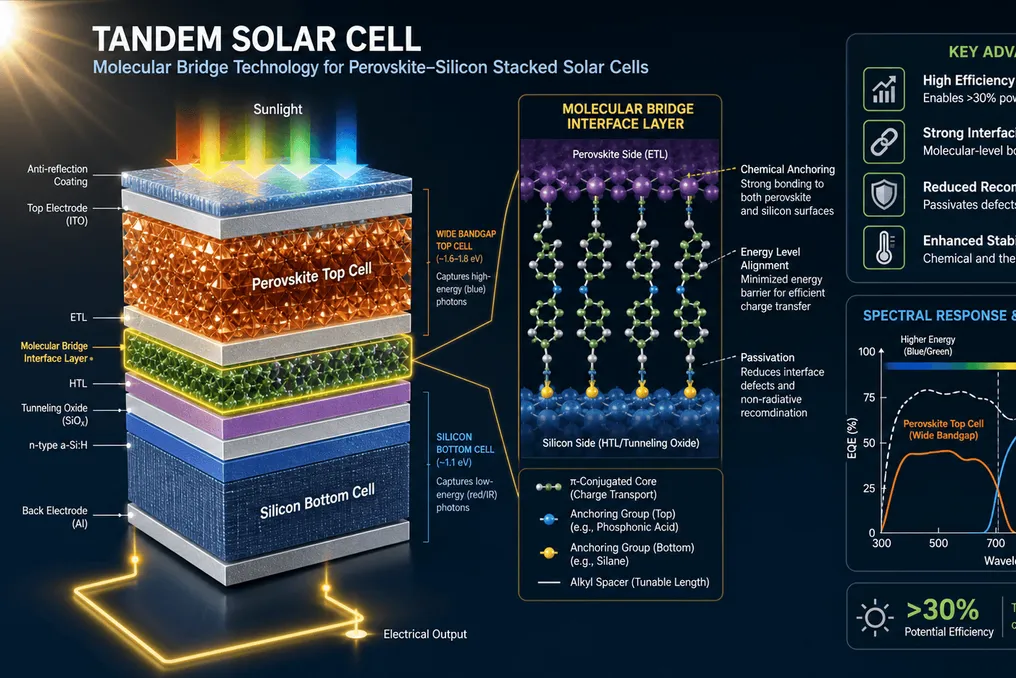
A team of researchers from Suzhou University, in collaboration with the Hong Kong Polytechnic University, has created a composite layer that does not contain indium. This material utilizes a molecular bridge between perovskite and silicon to enhance the efficiency and long-term stability of tandem solar cells.
Overcoming Critical Barriers
Researchers from Suzhou University, led by Professors Yan Xinbo and Zhang Xiaohun, developed this composite layer in cooperation with the Hong Kong Polytechnic University and various partners from the photovoltaic industry. It forms a molecular bridge between the perovskite and crystalline silicon layers in tandem solar cells. This achievement resolves two serious problems facing perovskite and silicon-based tandem photodetectors: charge loss at the interface of the two materials and reduced long-term stability, which hindered the commercial implementation of such architectures.
Principle of Molecular Bridge Operation
The molecular bridge functions at the atomic level. The Suzhou team developed a self-assembling monolayer that chemically bonds to both the perovskite surface and the silicon surface. This creates a continuous electronic pathway for efficient charge transport while passivating defects and suppressing non-radiative recombination.
Significance of Indium Elimination
The elimination of indium is particularly significant. Indium tin oxide has traditionally been used as a transparent conductive layer in displays and photovoltaic devices. However, indium is classified as a critical material subject to concentration risks in the supply chain and rising costs due to demand from the display industry. The new composite layer completely excludes indium, replacing it with more accessible and less expensive materials that provide comparable or better optical transparency and electrical conductivity. This substitution removes both the cost barrier to the commercialization of tandem solar cells and the risk of material supply disruption that concerned the photovoltaic industry.
Prospects for Industrialization
This research marks progress toward the industrialization of next-generation photovoltaic technologies. Theoretically, perovskite-silicon tandem cells can demonstrate efficiencies exceeding the Shockley-Queisser limit for single-junction silicon cells, which is around 29%. Laboratory tandem cells have already exceeded 33% efficiency, but translating these results into commercially viable products requires solving issues of interface stability and production scalability, which is the focus of the molecular bridge approach. The Suzhou team's work suggests that molecular engineering at the perovskite-silicon interface can simultaneously improve efficiency and operational lifespan, eliminating two of the most critical obstacles to commercialization. The model of university-industry collaboration accelerates the transition from laboratory development to manufacturing. With successful scaling, the molecular bridge technique could strengthen China's leadership in solar energy while reducing dependence on indium.