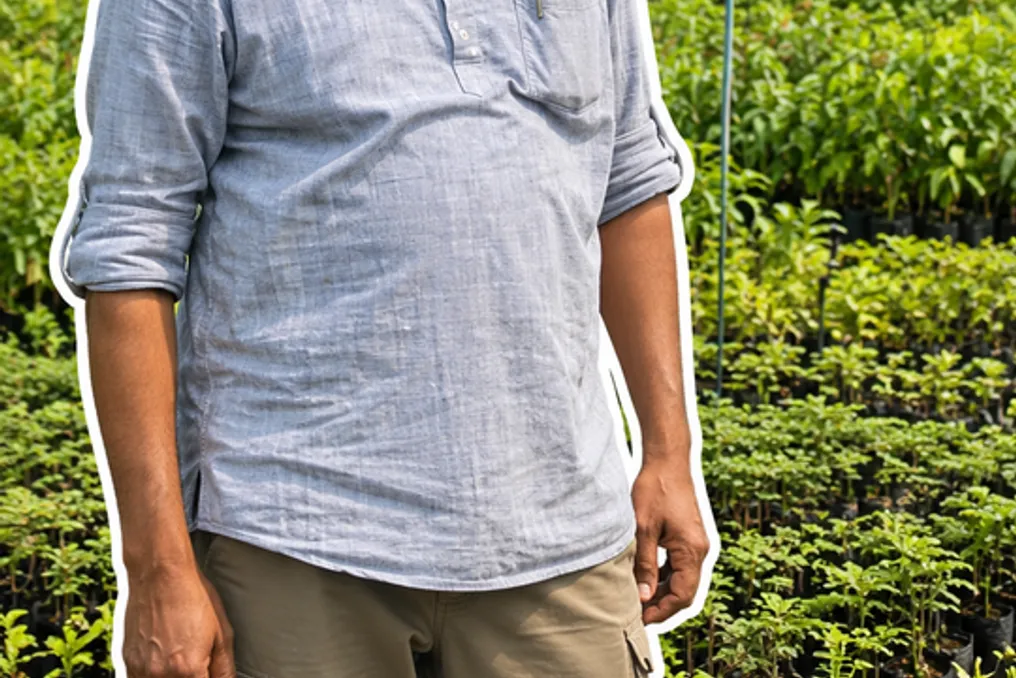
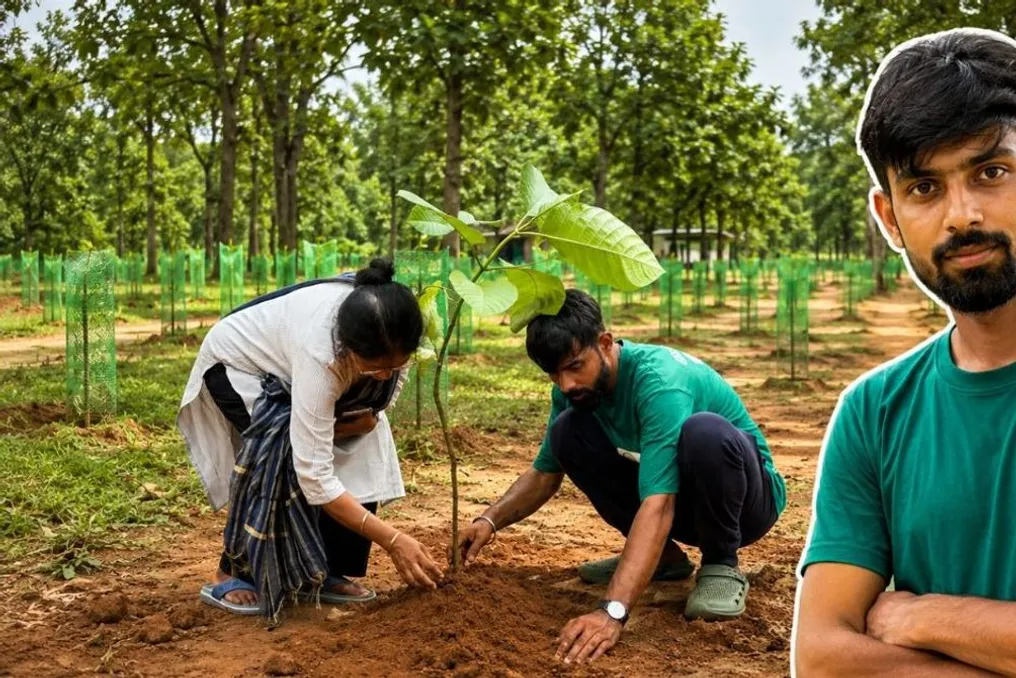
In Santiniketan, where the red earth shines under the shade of ancient trees, and where Rabindranath Tagore's vision of learning under trees still lives, 29-year-old Somnat Ghosh is creating something both poetic and practical—a home for trees that people plant and then forget.
The 'Tree Shelter' Concept
His foundation, Brikkho, calls itself the first 'Tree Shelter Home' in India. This phrase seems metaphorical until Ghosh explains its meaning. He argues that a tree becomes an 'orphan' in two ways: when it is mindlessly cut down, or when it is planted ceremonially but then abandoned after being photographed.
According to Ghosh, every tree deserves more than just a planting event; it needs a caretaker. He asks, 'If there are homes for orphaned children in society, why not create a system of guardianship for abandoned trees?' For him, Brikkho is such a family that plants, nurtures, monitors, and protects. The goal is not just to increase the number of trees, but to build long-term connections between people and nature.
Origins of the Idea and Turning Point
This connection did not begin with Brikkho. It arose many years ago from a complex choice. Ghosh meticulously built a multimedia studio, gathering cameras, drones, and editing systems piece by piece. This was the result of many years of hard work and financial difficulties. However, another call grew louder.
He recalls, 'If I don't act now, there is absolutely no guarantee that I can do it in the future.' His love for plants and animals began in childhood. Later, while working on a project with the Burdwan Forest Department, this quiet feeling became something much more urgent. Life in the forest changed him. He also noticed that many people genuinely want to plant trees, but very few know how to ensure the survival of these saplings. There was enthusiasm, but no support system. This gap eventually led to the creation of the Brikkho Foundation.
Activity During the Pandemic
Like many life changes, his impulse intensified during the COVID-19 quarantine. In Santiniketan, Ghosh and a group of volunteers formed the 'Helping Hands' group. For 150 consecutive days, they fed stray dogs left hungry after tea stalls and snack bars closed. They delivered medicine to elderly residents, spread information about masks, and later delivered aid supplies to the Sundarbans after Cyclone Amphan. The work went far beyond environmental conservation.
He notes, 'The emotional and spiritual nourishment I received during that period changed my personality. It strengthened my desire to dedicate myself completely to this cause.' This experience reinforced his belief that caring for nature can never be separated from caring for people.
Guardianship Model and Project Growth
When the Brikkho Foundation was officially established, Ghosh aimed to solve a problem that had long troubled him: too often, tree planting ended the moment the sapling hit the ground. For him, the real work should start right then. Today, the Brikkho guardianship model merges the digital and physical worlds. People can take guardianship of a local tree through the Brikkho Foundation for a one-time contribution of 600 rupees.
People can adopt local tree species online, while the Foundation plants them in groups, focusing on the Sonajhuri forest—a landscape named after Acacia auriculiformis, where golden flowers fall like drops of gold. Trees are planted on land provided by the Forest Department, as well as on land voluntarily provided by local farmers for reforestation. The Foundation continues to care for each sapling through regular audits, soil preparation before the monsoon, fence repairs, and organic additives until the trees can grow independently. Each adopted tree is monitored and supported for three years, ensuring its survival and healthy growth until it achieves self-sufficiency.
To date, over 2000 trees have been planted, maintaining a 95% survival rate. Brikkho Foundation has been actively working since 2021, and these nearly 2000 trees were planted between 2021 and 2026. Approximately 500–600 people have adopted trees under the program. Since plantings are distributed across multiple locations, the Foundation does not tie them to a single area. Many adopters plant trees in memory of loved ones and return years later to watch them grow.
To enhance accountability, Brikkho has also developed a 'Track My Plant' feature, allowing adopters to monitor each tree using geotagged photos and regular updates. Furthermore, each adopter receives a Green Hero Certificate, the geotagged location of the adopted tree, online tracking via the Brikkho website, and periodic planting updates. Ghosh believes this feature eliminates one of the biggest drawbacks of large-scale tree planting drives: too often, nobody knows what happens after the planting ceremony.
Creating Forests, Not Plantations
For Ghosh, success is measured not by the number of trees planted, but by the type of forest they form. Brikkho deliberately avoids monoculture plantations. Instead, he creates multi-layered ecosystems using Neem, Shal, Kadamba, Banyan, Peepal, and local shrubs that support birds, insects, and microorganisms. He believes that resilience lies in diversity.
He says, 'A forest of 10,000 trees is beautiful, but it becomes revolutionary when it is built by 10,000 conscious people, each owning a part of its heartbeat.' For him, the smallest unit of change is not an acre of land, but one person connected to one living tree. The Foundation's forest area is located in the Kankalitala area of Bolpur, where the adopted trees continue to take root and grow. His work has also received official recognition and approval from the Forest Department of the Government of India.
From Forests to Rivers
As the Foundation grew, so did its mission. Through the Mission Clean Santiniketan program, attention shifted to the Kopai River viewpoint—a tributary of the Ganges mentioned in Tagore's works, but increasingly clogged with plastic waste. For an entire year, volunteers cleaned this stretch every weekend. The Kopai River cleanup campaign ran continuously for about seven months, during which volunteers collected trash into large bags over almost 120–150 days of cleaning.
Today, in collaboration with the Wildlife Institute of India, the initiative is working on river restoration through better waste management, including bins and recycling systems. Similar cleanups have been conducted in the Sonajhuri forest and around Kanch Mandir. During humid afternoons, volunteers bend down to collect plastic wrappers left by tourists, filling bags with discarded bottles and fishing lines that clog the river.
The work does not stop there. They also visit tribal settlements on the edge of the forest, listening to elders speak about seed preservation and traditional farming methods. In return, they share practical knowledge about organic composting and crop rotation, creating an exchange where indigenous wisdom and modern methods complement each other. In addition to these efforts, the Brikkho Foundation has conducted environmental awareness programs in 10 villages and carried out planting activities in five to six villages around Santiniketan.
Social Support Alongside Nature
The same philosophy guides the Foundation's work in communities. The cultural landscape of Santiniketan is interwoven with Bengali traditions and tribal heritage. Through the 'Sharing Happiness' Program, food is distributed to villages in Birbhum district, including Beldanga, Baduria, Dunaipur, Saheb Danga, and Amradanga. Some villages are predominantly Adivasi, while others are more diverse, but together they reflect the communities surrounding Santiniketan. Since the start of the program, the Brikkho Foundation has distributed over 5000 food kits among beneficiaries in these communities.
However, for volunteers, the most memorable moments are often the simplest: children eagerly awaiting food kits; elderly people singing folk songs while receiving medicine. This initiative reflects Ghosh's conviction that ecological restoration and social care cannot exist separately.
Vision for the Future Until 2050
The sight of the ancient trees of Santiniketan, slowly disappearing due to age, storms, and neglect, inspired another long-term vision. The Green Santiniketan 2050 mission poses a simple question: if today's giants disappear, what will replace them? The answer is equally simple: plant now so that in twenty years, there is another canopy overhead.
The mission hopes to create not only greener landscapes but also a cooler microclimate, healthier public spaces, and a continuity of Tagore's vision for Santiniketan. Like many grassroots movements, Brikkho's biggest challenge remains funding. Saplings themselves are accessible, but their protection is not. Fencing, maintenance, labor, and long-term monitoring require constant financial support.
Ghosh started the Foundation primarily with his own funds. Even today, the initiative is mainly financed by Somnat Ghosh himself, with additional support from tree adoption contributions, individual donations, and donations specifically received for food distribution programs. The 600 rupee contribution for adoption covers the full cost of planting, protecting, monitoring, and maintaining the tree for three years, after which it usually becomes self-sufficient. The Foundation's main recurring expenses include tree maintenance and monitoring, fencing and protection, sapling preparation and planting, website maintenance, office operations, as well as travel and transport for monitoring plantings and moving saplings. As it grows, crowdfunding and public support are becoming increasingly important. Nevertheless, he draws strength from Tagore's song 'Ekla Cholo Re'—go alone if necessary.
Today, about 50 volunteers—students, planting experts, retired officers, and teachers—stand beside him. Arup Kumar Thandar, District Coordinator, West Bengal Biodiversity Council, says, 'What is remarkable about the Foundation is that its volunteers go far beyond planting or adopting trees. They take on less glamorous tasks—clearing forest floors, cleaning rivers, and visiting tribal settlements to learn about traditional wisdom.' When people tell Ghosh that one person or even one tree cannot change much, he smiles. He says, 'The ocean is formed by drops.' He dreams of a future when the sons and daughters of Santiniketan—and admirers of Tagore's vision and poetry worldwide—join forces to make this house of knowledge greener. Their contribution will not only support our movement but also renew the eternal bond between knowledge and nature.