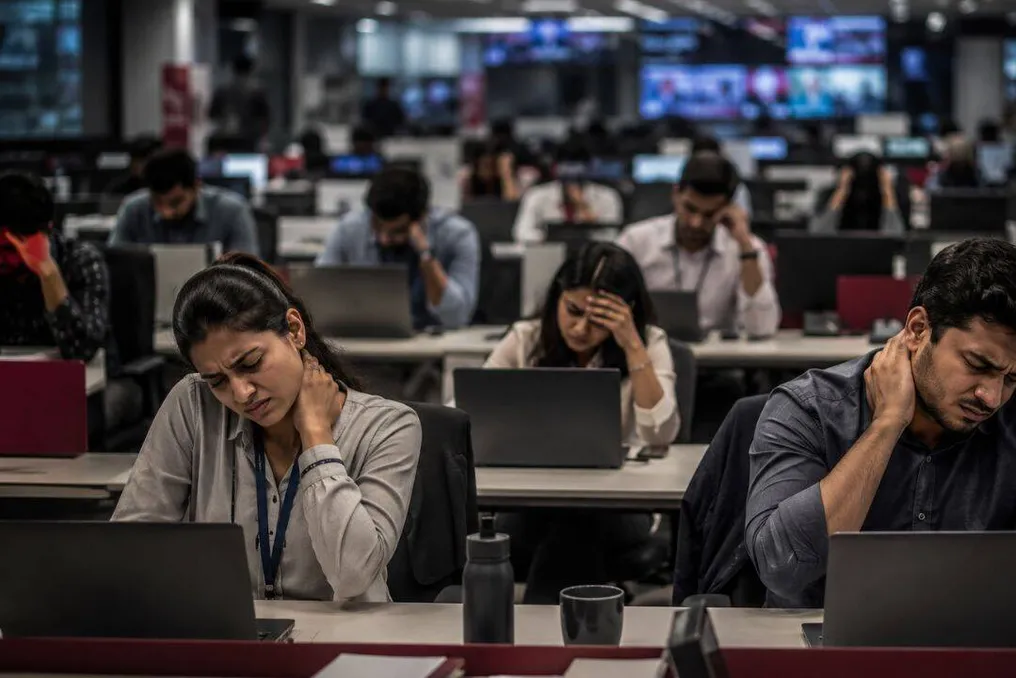
For millions of people in India, the workday begins and ends in front of a laptop. Eight to ten hours spent at a desk, endless video conferences, a series of meetings, and constant screen time have become the new normal. Although labor productivity has increased, an unnoticed problem at the workplace—neck pain—has also grown.
The Problem of Neck Pain
Doctors note a sharp increase in young professionals aged 20 and 30 seeking treatment for neck pain, stiffness, headaches, and posture problems. What was previously considered an age-related condition is increasingly becoming a professional risk caused by office work.
The growing dependence on smartphones and laptops, coupled with a sedentary lifestyle, has turned neck pain into a modern workplace health issue. Beyond physical discomfort, it negatively affects productivity, mental well-being, and healthcare costs, raising concerns about whether India's rapidly growing office workers are paying too high a price for long hours in front of a screen.
Understanding Cervical Radiculitis
Neck pain is defined as discomfort or pain in the neck area (cervical spine) and surrounding areas, including the shoulders and upper back. Symptoms can range from mild stiffness to severe pain, and in some cases, may be accompanied by headaches, tingling, or numbness in the arms when nerves are affected.
Although neck pain can occur at any age, it is becoming more common among young adults due to prolonged screen time, poor posture, and a sedentary lifestyle. According to a study published in The Lancet, nearly 200 million people worldwide suffered from neck pain in 2020. The study predicts that this number could reach 270 million by 2050, driven by aging populations, sedentary lifestyles, and changing work patterns.
Global Health Impact
The impact of this issue extends far beyond simple physical discomfort. The World Health Organization (WHO) indicates that musculoskeletal diseases are among the leading causes of disability and work absence globally, affecting quality of life and productivity across different age groups. The GBD 2019 analysis estimated that about 1.71 billion people worldwide live with conditions such as neck pain, lower back pain, fractures, osteoarthritis, rheumatoid arthritis, and other musculoskeletal conditions.
A Workplace Epidemic?
To gauge the scale of the problem, specialists surveyed 30 working professionals about their work habits, posture, and neck condition. Their responses revealed a common pattern: prolonged sitting, infrequent breaks, and recurring neck pain. Most respondents were young professionals: 26 out of 30 participants were between the ages of 24 and 35, highlighting the growing impact of neck pain on younger employees, not just the elderly.
Ten respondents experienced neck discomfort monthly, nine reported symptoms weekly, and seven stated they faced neck pain almost daily, demonstrating the prevalence of this condition among desk-bound workers. Shashank, a 38-year-old media professional, reported frequent pain in his neck, shoulders, and arms. He noted: 'I spend about 8 hours a day sitting in a chair that does not provide good support for my neck. I believe that more frequent breaks and awareness of proper office furniture can help employees work more effectively. Poor furniture placement leads to poor posture, which ultimately causes all sorts of problems,' he told TOI.
Medical Perspective on Changes
Dr. Arun Bhanot, Director of Spine Surgery at CK Birla Hospital in Gurugram, stated a noticeable increase in young patients with office jobs seeking treatment for neck pain. He explained: 'The patient profile has fundamentally changed. Previously, it was mainly older people with degenerative changes. Now we see a constant stream of people in their late 20s and 30s,' he said.
Long hours at the desk were the norm: 21 respondents spent more than eight hours sitting per day, and another seven reported sitting for seven to eight hours. Despite the long screen time, regular movement was rare. Twelve respondents said they rarely took breaks during work, and 10 took a break from their desk only once every two to three hours—much less frequently than doctors recommend. Komal Gupta, a 30-year-old journalist, told TOI that she barely has time for regular exercise, although she knows it would help reduce neck pain. She added: 'Most workdays are filled with deadlines, so finding time for stretching or training becomes difficult.'
Ergonomics Expert Advice
Dr. Surender Pal Singh, Head of Physiotherapy at CK Birla Hospital in Delhi, advises positioning the monitor at eye level, ensuring proper chair support, and avoiding carrying heavy laptop backpacks on one shoulder, as uneven weight distribution can increase strain on the neck and upper back. However, most respondents replied that employers provide no furniture or equipment. Gupta noted: 'My office also does not provide an external monitor or a laptop stand, so I am forced to work directly on my laptop for long hours, which puts extra strain on my neck and shoulders.'
The Problem Outside Corporate Offices
The problem is not limited to corporate offices. Jyoti Jaiswal, a 29-year-old dentist, asserts that healthcare workers are also at risk due to the nature of their work. She said: 'Treating patients often requires us to remain seated or stand in one position for long periods, which puts significant strain on the neck.' Jaiswal believes that improving workload management could help mitigate this issue. 'Proper scheduling of appointments is crucial so that each patient can be given enough time without rushing or compromising posture. It also gives doctors short breaks between consultations, reducing physical tension.'
Tushar Gaur, a 25-year-old accountant from Meerut, reported that his job requires long hours of sitting, data entry, and continuous computer work. He noted: 'Prolonged sitting and constant screen time often cause severe pain on the left side of my neck. I realized that regular breaks help reduce discomfort, but this is not always possible on busy workdays.'
Scientific Basis of Strain
Dr. Bhanot explained that the head weighs about 4.5–5 kilograms in a neutral position. But if it is tilted forward by just 15 degrees to look at a screen, the effective load on the cervical spine increases sharply. If this posture is maintained for eight hours a day, five days a week, muscles and ligaments simply give out. Recalling one of his cases treating a 26-year-old software developer, he recounted: 'He developed severe neck pain, finger numbness, and hunching after working from bed for almost a year with a laptop placed on a pillow. There was no disc herniation, but there was significant muscle strain. Thanks to ergonomic correction, physiotherapy, and scheduled movement breaks, he largely eliminated the symptoms within six weeks.'
Solutions to the Problem
The vast majority of respondents concluded that preventing neck pain requires both individual lifestyle changes and employer support. Many stated that companies should invest in ergonomic workspaces, including better chairs, adjustable desks, laptop stands, and the option of standing desks to reduce the strain caused by prolonged sitting.
Some respondents also called for the implementation of more employee-friendly workplace policies, such as reduced working hours, flexible schedules, and improved workload management, to give employees enough time to rest, exercise, and maintain proper posture. Others suggested that employers encourage frequent breaks, with some even recommending software reminders or apps that temporarily block screens every 30 minutes to prompt employees to stand up, stretch, and move.
Dr. Singh emphasized that prevention is often simple but ignored. He stated: 'Standing up, stretching, and walking for just one or two minutes every 30 minutes can significantly reduce pressure on the neck and back,' adding that even the best workstation cannot prevent neck tension if a person remains seated for long periods without regular movement. In a work environment increasingly focused on productivity, the next big investment may not be technology, but healthier employees.