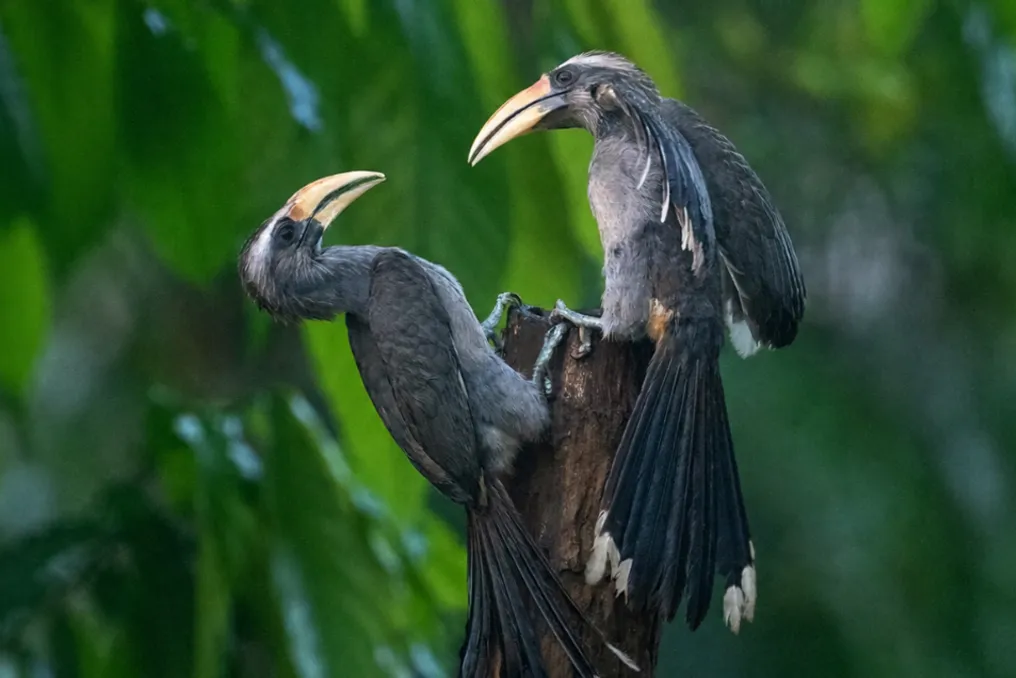
For the fourth consecutive year, Indian Grey Hornbills have successfully reproduced in the Gir landscape located in Gujarat. This success signifies more than just the return of a single bird.
Population Return
The species disappeared from Gir sometime between the 1950s and 1960s. Thanks to a carefully planned reintroduction program, the hornbills have begun nesting, raising chicks, and establishing territories again. Approximately 40 individuals were released between 2021 and 2023, and scientists note that the population shows signs of self-sustainability.
For nature conservation specialists, this is a cause for joy. For everyone else, it is a reminder that some bird species serve as indicators of the health of an entire forest mass, and the hornbills are such examples.
Habitat Requirements
Unlike many bird species capable of adapting to fragmented landscapes, hornbills are highly selective in their habitat choice. They require mature forests with large native trees, tree cavities sufficient for nesting, and fruiting trees that provide food throughout different seasons. It is critically important that the forests remain extensively connected.
Without any of these elements, it is difficult for hornbills to survive, which is why scientists call them indicator species. Their presence signals to researchers that the forest maintains the necessary structure, diversity, and ecological balance to support a wide range of wildlife. The success of the reintroduction in Gir was achieved not only through the release of birds but also through years of habitat restoration, protection, and monitoring efforts that allowed the landscape to become suitable for them again.
Role of Hornbills in the Ecosystem
Hornbills are sometimes called the 'farmers of the forest,' and this title is well-deserved. Most hornbill species feed on fruits, especially figs, berries, and other large forest fruits. Many of these seeds are too large to be dispersed by small birds. After feeding, they can fly several kilometers before dropping or regurgitating the seeds. The seeds land far from the parent tree, which reduces competition and gives new seedlings a better chance of growing. Over time, this contributes to the natural regeneration of forests.
Researchers in the Western Ghats of India and the northeastern region have shown that hornbills are among the most important long-distance seed dispersers in tropical forests; without them, many local tree species would struggle to spread.
Unique Breeding Strategy
Hornbills possess one of the most remarkable nesting strategies in the world of birds. When the mating season begins, the female enters a cavity in a large tree trunk. The pair seals the entrance with mud, fruit pulp, and excrement, leaving only a narrow slit. The female remains inside for several weeks. The male becomes the sole provider for the family, delivering fruits and food daily through the tiny opening until the chicks are old enough.
This is an exceptional survival strategy, but it has one condition: the tree must remain alive. If the old nesting tree is cut down, the entire breeding season can be lost. This is another reason why hornbills are so dependent on ancient forests filled with mature trees that have developed natural cavities over decades.
Significance of Old Trees
When restoring forests, the main focus is usually on young saplings. However, old trees are indispensable for hornbills. Large trees provide nesting cavities, shade, food, and shelter for countless birds, mammals, reptiles, and insects. Many of these cavities form naturally only after decades of growth. Once these giants disappear, they cannot be replaced overnight. The return of hornbills to Gir indicates that there are now enough of these ecological building blocks for the birds to reproduce successfully again. This is encouraging not only for the hornbills but also for many other forest species inhabiting the same environment.
Success of the Program in Gir
The program in Gir was not only aimed at releasing birds. Forestry staff monitored their movements, restored suitable habitats, and controlled reproductive success, involving local communities in landscape protection. Recent data shows that the birds have settled in the landscape and are reproducing like a wild population. This is a significant change. Wildlife conservation is measured by counting individual animals, but true success occurs when these animals begin to reproduce independently and no longer depend on constant human intervention. It appears this is happening in Gir.
More Than Just a Return Story
India is home to nine species of hornbills, ranging from the Indian Grey Hornbill found on the plains to the impressive Great Hornbill of the Western Ghats and the northeast. Many face increasing pressure due to habitat loss, the disappearance of old nesting trees, and forest fragmentation. Their future depends on something extraordinarily simple: protecting large forests, protecting old trees, and maintaining the natural connections that allow wildlife to move freely.
When hornbills disappear, the forests lose one of their greatest gardeners. When they return, they bring much more than their characteristic calls. They transport seeds across the landscape, helping forests regenerate. They remind us that healthy ecosystems develop slowly, over decades, through the relationships between trees, birds, and countless other species that depend on them. This is why the recent reproductive success in Gir means more than just the return of a bird after 60 years; it is a sign that when forests are given a chance to recover, nature knows how to heal itself.