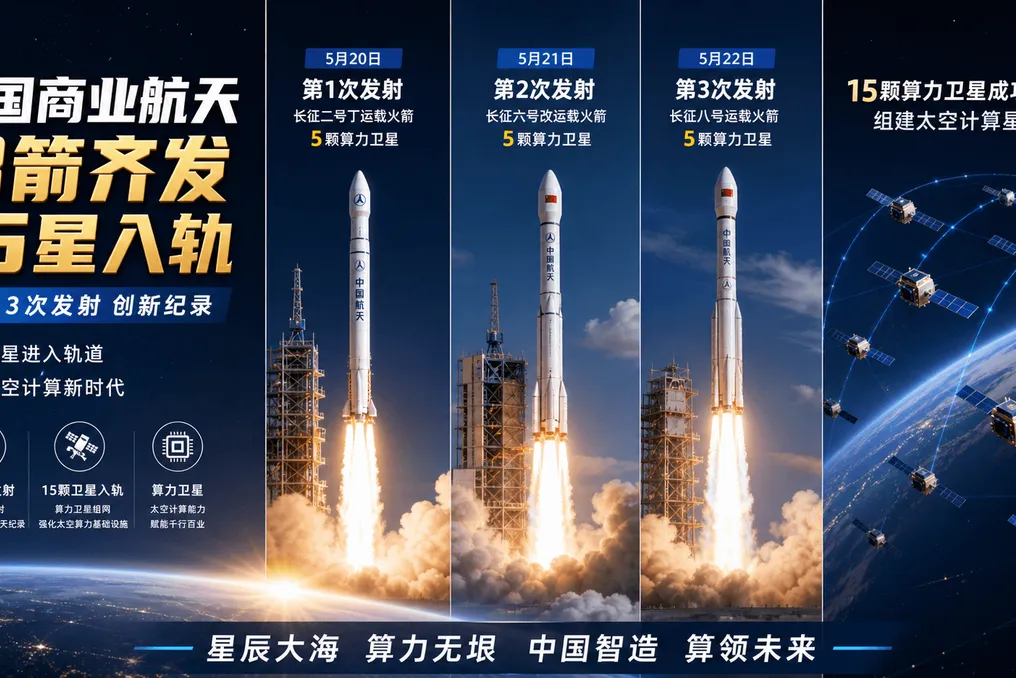
Over three days, from July 22 to 24, China conducted three rocket launches that deployed 15 satellites. These missions, carried out by the companies Orienspace Gravity-1, CZ-3B, and CAS Space Lijian-1, included payloads for artificial intelligence processing and space debris monitoring.
Launch Details and Payloads
The Orienspace Gravity-1 Y4 mission placed nine satellites into orbit from Eastern China. The CZ-3B rocket was used to launch Tianlian-2 06 from Sichuan. The CAS Space Lijian-1 Y15 agency delivered five satellites, including the first commercial space debris monitor and AI-based computing units.
The payloads demonstrate a clear trend toward the application of AI and task orientation. The CAS Space mission delivered Gande-1 01, which is the first commercial satellite for space debris observation, equipped with high-resolution and wide-field-of-view cameras. The Jitianxing A-04 satellite, developed jointly by Zhejiang Lab, Yunjian Information, MUSA GPU, and partners, uses a bore model for autonomous state management and independent mission planning, and is equipped with an intelligent MUSA GPU-based computing payload, an onboard router, and a laser communication terminal.
Furthermore, the Xiguang-2 03 satellite provides infrared sounding with three bands, while Yinglong Fengguang-1 carries meteorological microwave and infrared payloads.
Innovation and Mission Development
During the Orienspace Gravity-1 mission, the Lilac-3 satellite was launched. This apparatus is described as China's first UFO-shaped satellite, featuring an ultra-thin, lightweight, and highly integrated design compared to traditional CubeSats. It serves as a test platform for the low-cost deployment of global university satellite constellations. The onboard high-performance star tracker functions as a celestial eye for controlling satellite orientation and is the primary source of data for space situational awareness. This mission marks the fourth flight of Gravity-1, continuing Orienspace's pace of rapid launches, while the reusable liquid-fueled rocket Gravity-2 is under development for the fourth quarter of 2026.
CAS Space Lijian-1 successfully launched 110 satellites across 15 flights with a total payload mass exceeding 16 tons, becoming the only commercial rocket in China to surpass the threshold of 100 launched satellites. Deputy Commander Meng Xiangfu emphasized that this achievement is not just a number but confirmation of product maturity and delivery capability. The rocket has fully passed technological verification and engineering research to reach the stage of mature serial production and frequency-normalized launch. The rocket has served over 30 clients, including six international customers.
Commercial Success and Reliability
Chief Designer Shi Xiaonin noted that the rocket has captured one hundred percent market share in China's external commercial market. Thanks to specialized, joint, and flexible models, as well as standardized interfaces, CAS Space guarantees launch windows, ensuring rare reliability. The achievement of mature rocket technology is gradually lowering barriers across the entire commercial aerospace industry chain.