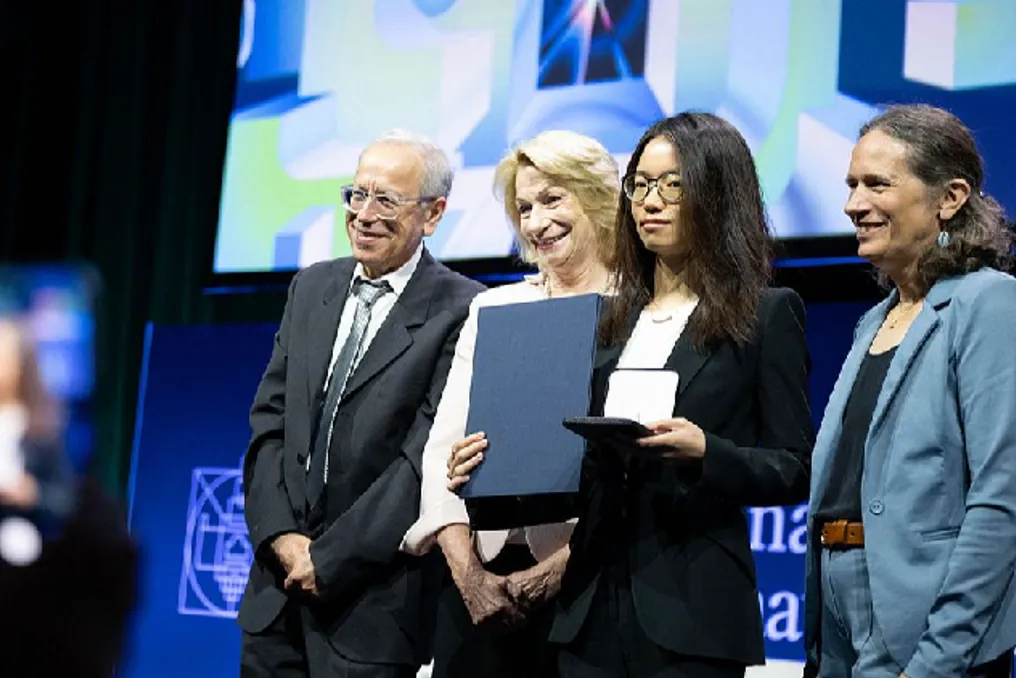
At the International Congress of Mathematicians held in Philadelphia on July 23, 2026, two Chinese mathematicians, Deng Yu and Wang Hong, were awarded prestigious Fields Medals. This marks the first time that citizens of China have won this high honor.
Recognition of Scientists' Achievements
At the opening ceremony of the congress, held at the Pennsylvania Convention Center, the International Mathematical Union announced that Deng received the medal for his work in partial differential equations (PDEs), and Wang received it for her research in harmonic analysis and geometric measure theory.
Deng Yu's Achievements
Deng Yu, born in 1989 in Shenzhen, Guangdong Province, is a professor at the University of Chicago. Along with his colleagues, he solved the so-called narrow formulation of Hilbert's Sixth Problem by developing a complete mathematically rigorous logical chain linking microscopic particle systems to the macroscopic Boltzmann equation. This problem was posed by the German mathematician David Hilbert in 1900 and remained unsolved for 125 years, aiming to establish a strict axiomatic foundation for the fundamental laws of physics.
After the press conference, Deng noted that receiving a name after great mathematicians, whom he has always admired, is a huge honor and an important recognition of his work with colleagues in the field of PDEs and probability.
Wang Hong's Research
Wang Hong, born in 1991 in Guilin, Guangxi Zhuang Autonomous Region, currently teaches at the Institute for Advanced Studies in France and at the Courant Institute of New York University. As a co-author, Wang solved the Kakeya three-dimensional conjecture, which had puzzled mathematicians for decades. This conjecture relates to the question of what volume is required to cover the trajectory of an 'infinitely thin needle' rotating in all possible directions in space.
Wang's work not only resolved a century-old mathematical problem but also proposed a new analytical approach that may be significant for fields such as radar, remote sensing, and signal processing, where the correlation of wave packets is important. Wang shared that her work combines methods from two fields—harmonic analysis and geometric measure theory.
International Resonance and Assessment
The achievements of both mathematicians garnered widespread approval in the global community. French President Emmanuel Macron personally called Wang to congratulate her on receiving the Fields Medal, calling it 'truly wonderful news' and a testament to her accomplishments.
Renowned mathematician and the first recipient of the Fields Medal from China, Shin-Tung Yau, emphasized that despite differences in their paths, they demonstrate a tendency toward interdisciplinary integration, which is becoming a key strength in the development of mathematics. Laureate Efim Zelmanov stated that the outstanding achievements of these scientists are convincing proof of China's growing significance in the global mathematical community.
Zhang Jinping, an academician of the Chinese Academy of Sciences, called these awards a historic breakthrough for Chinese mathematics, noting that it is the first instance of Chinese mathematicians receiving the Fields Medal.
General Information About the Prize
This year, a total of four Fields Medals were awarded. The other laureates are John Pardon, an American mathematician from Stony Brook University, and Jacob Zimmerman, a Canadian mathematician from the University of Toronto. The Fields Medal is the premier international mathematical prize, awarded every four years to two or four young researchers under the age of 40 for outstanding achievements and future potential.